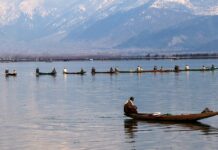
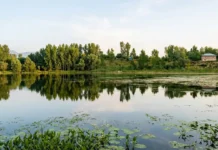
SRINAGAR: A new study of sediments from Wular Lake has identified three principal geological sources feeding the Kashmir lake: Higher Himalayan crystalline rocks, Panjal, Trap basalts and the Karewa Group, using sediment geochemistry and explainable machine learning. The researchers found that the three-source pattern was strongly reproduced by both supervised and unsupervised statistical approaches, with a Random Forest model recording 95.5 per cent median leave-one-out cross-validation accuracy and k-means clustering reproducing the same three groups with an Adjusted Rand Index of 1.0.
The study, published in the journal Minerals by MDPI on August 3, 2026, examined 22 surface-sediment samples collected by boat from across Wular Lake. The sampling covered the Jhelum inflow and outflow, central basin, northern and eastern margins close to Panjal Trap and limestone formations, and the southern shore influenced by Karewa and alluvial deposits. The samples were taken from the upper 5-10 cm of sediment in water depths of about 2-5 metres. The authors note that, given Wular’s high sedimentation and silt flux, this sediment interval integrates deposition over roughly the last few years to decades.
The paper, Integrating Sediment Geochemistry with Explainable Machine Learning for Provenance Discrimination in Wular Lake, Kashmir Himalaya, India, was authored by Mukhtar Hasan Ahmad, Shaik A Rashid, Mohammad Khalid, Javid A Ganai, Shamshad Ahmad, Amir Khan and Abuzar. Ahmad, Rashid, Khan and Abuzar are from the Department of Geology, Aligarh Muslim University, Aligarh; Khalid is from the Department of Pharmaceutics, College of Pharmacy, King Khalid University, Asir-Abha, Saudi Arabia; Ganai is from the Department of Earth Sciences, University of Kashmir, Srinagar; and Shamshad Ahmad is from the Department of Civil Engineering, Government Engineering College, Samastipur, Bihar.
The researchers analysed 49 geochemical variables including 10 major oxides, 25 trace elements and 14 rare-earth elements, along with mineralogical information obtained through X-ray diffraction. The sediment mineral assemblage was dominated by quartz, muscovite/illite, chlorite and feldspar.
The geological setting of Wular provides three distinct potential sediment sources. The Higher Himalayan Crystalline Series, consisting principally of gneisses, schists and granites, represents the siliceous-mature end member. The Permo-Carboniferous Panjal Trap, composed largely of basaltic and basaltic-andesitic volcanic rocks, represents the detrital-mafic end member, while the Plio-Pleistocene Karewa Group, comprising fluvio-lacustrine silts, sands and calcareous sediments, represents the carbonate-bearing end member.
The study found that Wular sediments are compositionally immature and moderately weathered. The Chemical Index of Alteration ranged from 68.5 to 75.1, with a mean of 72.1, indicating moderate chemical weathering. At the same time, ICV values above one and Zr/Sc ratios of 3.4–6.0 point to first-cycle, compositionally immature detrital material without significant zircon addition or recycling.
Conventional geochemical discrimination classified the sediments as broadly shale-like, but several elemental ratios revealed a substantial mafic imprint. Elevated Fe2O3/K2O and Al2O3/TiO2 ratios, together with Cr/Th and Co/Th signatures, were consistent with significant contributions from volcanic rocks. The authors also point to an important geological relationship in the catchment: Karewa sediments themselves were largely derived from the Panjal Traps, making the volcanic rocks an important primary source for both Karewa deposits and the modern lake sediment system.
The researchers then used a three-stage interpretable machine-learning framework combining Principal Component Analysis, Random Forest classification and SHAP, or SHapley Additive exPlanations, to identify which variables most effectively separated the provenance groups. Trace elements emerged as particularly useful discriminators. Cr, Co, Sc, Ni and Zn provided stronger separation than many of the conventional major oxides. SHAP analysis showed that increasing Sc, V and Cr values raised the probability of classification into the detrital-mafic, or Panjal Trap, group, while CaO concentrations above roughly 4–5 wt% increased the probability of the carbonate-bearing group.
Rare-earth element patterns provided another line of evidence. The sediments were enriched in light rare-earth elements, with normalised La/Yb ratios ranging from 8.0 to 19.4. Eu/Eu* values ranged from 0.56 to 0.73, while Ce/Ce* values of 0.98–1.03 indicated virtually no significant cerium anomaly. The siliceous-mature group had a mean total rare-earth-element concentration of about 215 ppm, compared with about 157 ppm for the detrital-mafic group, while the carbonate-bearing group showed intermediate values. The authors interpret these patterns as further support for the three-source model.
Statistical testing also found significant differences among the provenance groups in variables including SiO2, Fe2O3, CaO, Sc, Cr, Co, Ni, Zn, V, Sr and total rare-earth elements, as well as several provenance-sensitive ratios. Kruskal-Wallis H values ranged from 10.3 to 16.9, with p values of 0.002 or lower for the reported variables.
The machine-learning results, however, require an important qualification. The reported 95.5 per cent Random Forest accuracy is based on leave-one-out cross-validation within the study dataset, and the provenance labels used for training were themselves assigned from the same geochemical information. The authors therefore treat the figure as an internal consistency or separability assessment rather than independent validation of predictive performance. The k-means analysis is significant in this context because it reproduced the same three-group structure without using the assigned labels; its Adjusted Rand Index was 1.0.
The researchers also examined whether human activity could be distorting the provenance signal. Average enrichment factors for Pb, Cu, Cd, Zn and Sb were 1.4, 1.6, 1.7, 1.9 and 2.9 respectively when normalised to aluminium. When normalised to TiO2, the values were 1.7 or lower. The authors identify Sb as an element that warrants monitoring, but conclude that the main provenance interpretation remains robust because Cr, Co, Sc, Ni, V and the rare-earth elements are not typical urban or agricultural contaminants and instead covary with the mafic elemental suite.
The findings also place Wular within a wider pattern of sedimentary processes in Kashmir Valley lakes. Wular’s mean CIA of about 72 contrasts with much higher values reported for Dal Lake, where CIA ranges from 87 to 95, while Manasbal shows low-to-moderate weathering. The researchers suggest that the stronger weathering signature at Dal may reflect longer sediment residence and greater anthropogenic influence.
The study does not, however, calculate the exact percentage contribution of each geological source to Wular’s sediment. The authors say that quantitative source apportionment would require denser sampling of source rocks and tributaries followed by formal end-member mixing analysis. They propose that sediment cores could also help reconstruct changes in provenance, climate and land use through time.
The authors say the PCA–Random Forest–SHAP framework could potentially be transferred to other lakes in the Kashmir Valley and other multi-source lacustrine environments, although its performance needs to be tested against independent datasets.