by Sri Varshith Kumar Reddy E
Jammu and Kashmir’s economy remains heavily dependent on seasonal horticulture and tourism. Diversifying into agro-processing, hydropower, manufacturing, digital services and high-value tourism could create year-round growth.

Every October, the Valley’s economy parks itself on the highway. Trucks queue for kilometres with crates stacked to the canopy, the mandis of Sopore and Parimpora hum from before dawn, and every conversation turns to grades and rates. In 2024-25, fresh fruit worth Rs 6,003 crore left the Union Territory on 1.02 lakh trucks. The spectacle carries genuine prosperity. It also carries a warning that the Valley has heard before.
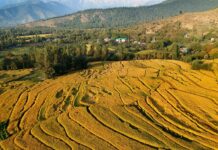
Jammu and Kashmir produced 23.18 lakh tonnes of fresh fruit in 2024-25, and apples supplied 20.56 lakh tonnes, close to 89 per cent of the total. About 92 per cent of that fruit grows in the Kashmir Valley. The Union Territory grows roughly 75 per cent of India’s apples, and horticulture contributes close to 8 per cent of its GSDP while sustaining more than seven lakh families. Few regions of this size place so much of their fortune on one fruit, in one geography, harvested in one season.
Tourism, the other great pillar, shows a similar profile. It contributes nearly 7 per cent of GSDP and supports around five lakh people. Both pillars are seasonal, both depend on weather and public mood, and both bring income only to those who live where the apples ripen or the snow falls. The question before policymakers is how a UT with a nominal GSDP of about ₹2.86 lakh crore, growing at 5.82 per cent in 2025-26 after 7.06 per cent the year before, can add engines that run in every month.
Keep the Orchard
Any argument for moving beyond apples must first honour what apples do. An orchard hectare generates about 400 man-days of work a year, and the industry supports an estimated 3.5 million livelihoods. No factory, software park or start-up cluster can match that density of employment within a decade. A strategy that treats the orchard as a legacy to be outgrown would damage the rural Valley and the politics that rest on it.
The orchard does carry a structural weakness, and the weakness points to the opportunity. Nearly one-fifth of the crop is lost every year. About six lakh tonnes fall into the C-grade category, which suits juice, concentrate, cider and dried products, while the Valley’s processing capacity stands near one lakh tonnes. Indian orchards typically yield 7 to 8 tonnes per hectare, against 40 to 70 tonnes in the United States, China and New Zealand. India imports about five lakh tonnes of apples a year, and a trade framework with Washington could lower duties further.
A grower who competes on the raw apple will meet a rival with better machines, deeper cold stores and cheaper logistics. A grower who competes on the processed, graded and branded apple meets a far gentler contest. The Valley’s comparative advantage lies in the later stages of the chain.
A Value Chain
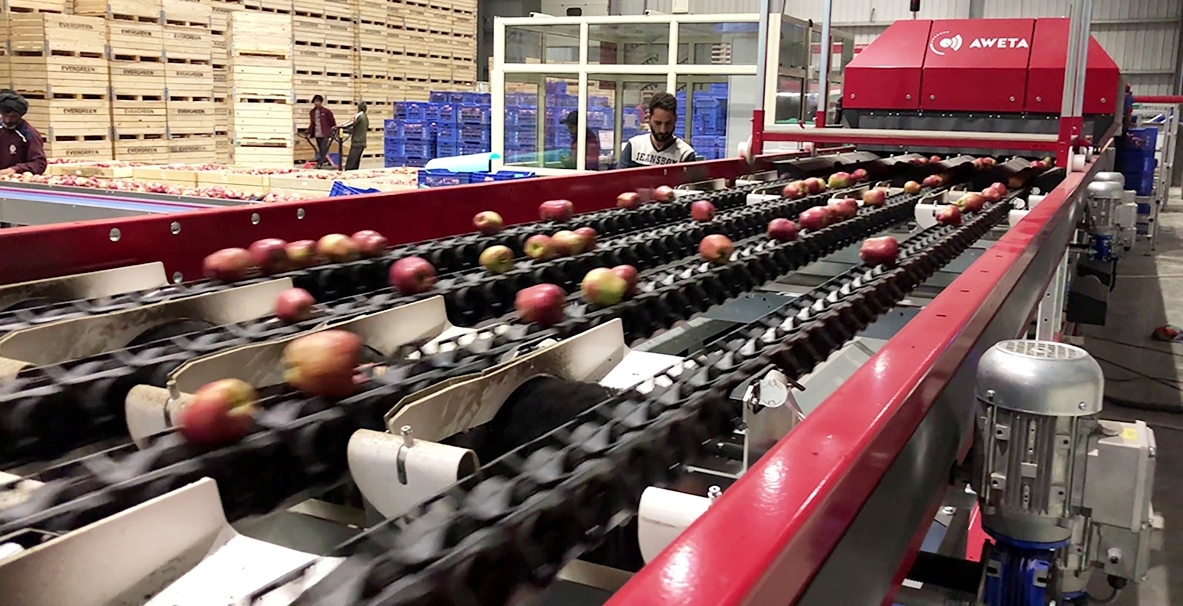
The early evidence for value-chain gains is persuasive. Controlled-atmosphere storage capacity has grown twelve-fold since 2015-16 to three lakh tonnes, against an estimated need of six lakh tonnes. In the Delhi market, apples stored in controlled atmosphere fetched 57 to 67 per cent more than fruit sold fresh at harvest. For the Kullu variety, machine-graded fruit packed in trays earned between 21 and 71 per cent more than manually graded fruit.
Public investment is arriving. A Rs 426.23 crore marketing project under the Holistic Agriculture Development Programme raised the number of units established from 129 to 202 in a year, and capital spending climbed from Rs 27.75 crore to Rs 43.47 crore. The Union Territory now runs 37 regulated mandis, which loosens the decades-old dependence on Delhi’s Azadpur market.
The next step is industrial. District-level agro-processing parks in Shopian, Pulwama, Baramulla, Anantnag, Kulgam, Kupwara and Budgam could pair apple processing with jam, dairy, nut and confectionery units, cold storage and logistics hubs. Switzerland built its prosperity that way, turning milk into chocolate and fruit into preserves. Kashmir has the milk, the walnuts, the almonds and the apple belt. A walnut chocolate or an apple-nut bar sells at many times the price of the raw crop, travels without a refrigerated truck and finds buyers in Dubai, Tashkent and Berlin.
Tourism Numbers
Tourism needs a franker reading. The Union Territory recorded a peak of 2.36 crore visits in 2024. In 2025, arrivals fell to 1.78 crore, ending three years of growth. Of that total, 1.62 crore visits went to the Jammu division and only 11.16 lakh to Kashmir, roughly 6 per cent. Reasi district alone, home to the Vaishno Devi shrine, took more than 81 lakh visits.
Two lessons follow. The Valley’s tourism income rests on a much smaller number of visitors than the headline suggests, so each visitor matters more. Foreign arrivals stood at about 36,000 in 2025, a tiny share of the total, which shows how far the Union Territory remains from premium international circuits. The relevant yardstick is spend per visitor and nights per stay. A traveller who stays six nights supports a houseboat owner, a guide, a craftsperson and a cafe, while a day-tripper supports one taxi.
Winter sports, adventure trails, wellness retreats, film shoots, destination weddings, conferences and a refreshed calendar of festivals can stretch the season. Floriculture adds a quiet link to this effort, with 278 parks and gardens and 356 hectares of commercial flower cultivation already recorded. Tourism earns more when the visitor has reasons to arrive in February.

New Engines
The first engine is hydropower, where the Union Territory holds an identified potential of about 14,500 MW and still depends on electricity from outside. Ratle, Pakal Dul, Kiroo and Kwar are progressing through the Chenab Valley Power Corporation, and the Centre is considering Sawalkot, a 1,856 MW run-of-the-river project on the Chenab. Hydropower brings royalty, free power, construction employment and a base for energy-intensive industries. It also gives Jammu and Kashmir something to sell to the north Indian grid at peak hours.
The second engine is enterprise. Registered start-ups rose to 1,306 in 2025-26 from 69 in 2020-21, with 816 added in the latest year and over 200 led by women. Industrial investment reached Rs 5,824 crore in 2025-26, up from Rs 4,145 crore a year earlier. Udyam registrations climbed to 6.35 lakh from 24,000 in 2021-22, and 390 of the 440 units registered under the New Central Sector Scheme have begun production. Under the Prime Minister’s Employment Generation Programme, 7,820 units were established in 2025-26, creating jobs for 62,560 people.
The third engine sits in the Valley’s human capital. Pashmina, Kani weaves, papier-mâché and walnut wood carry global recognition and a Geographical Indication to prove it. They lack design studios, direct-to-consumer platforms and international marketing. A young population, a cool climate and improving connectivity also make the case for IT-enabled services, data annotation, design work and remote-first firms. Such work depends on bandwidth and talent, and the closure of a highway at Banihal does not touch it.
Beneath the Promise
Sectors are the easy conversation. The conditions beneath them decide results. Investors need land with clear titles and predictable allotment timelines. Factories need uninterrupted power and year-round logistics. Small enterprises need credit that reaches Shopian and Kupwara as easily as it reaches Jammu. Young Kashmiris need skills matched to the jobs on offer.
Policy continuity matters most. The Deputy Chief Minister said on 6 October that the new industrial policy is in its final stage and that past lapses will not be repeated. He also noted that a Rs 28,400 crore package had been received, and that proper use would have spared industrialists the need to ask for more. Investors will judge the new policy on land allotment, incentive disbursal and the speed of single-window clearances. Announcements will earn them less attention.
The fiscal arithmetic leaves little room for generosity. A Union Territory with a deficit near 5.6 per cent of GSDP cannot subsidise its way to diversification, and public money should flow to the infrastructure that crowds in private capital. Cold chains, processing parks, power evacuation lines and skilling centres all qualify.
A Roadmap

A sensible sequence has three phases. Over the next two years, professionalise the apple economy by doubling grading lines, expanding controlled-atmosphere capacity towards the six lakh tonne requirement and building processing capacity for the C-grade crop. Over the next five years, scale agro-processing clusters, craft exports and higher-value tourism. Over the next decade, make hydropower, digital services and a deeper start-up base into genuine pillars of income.
The measures of success should change too. GSDP growth tells part of the story. Value added per worker, the share of household income earned outside the harvest months, and the number of nights a visitor spends in the Valley tell the rest. A Union Territory that earns across twelve months absorbs a bad apple season, a closed highway or a cancelled tourist season without a crisis.
Kashmir needs no farewell to apples and snow. It needs to sell them with a label, a brand and a margin attached, and to build new things beside them. The orchards already produce the fruit; the rivers already carry the power and the young already carry the talent.
(The author is a pracademic working on government policy and public institutions. Ideas are personal.)