by Iqbal Ahmad
The Vishow Valley holds a remarkable archaeological and spiritual heritage, closely associated with Sheikh Nooruddin Noorani and Kashmir’s Reshi tradition, offering significant potential for preservation and heritage tourism.
Although most people of my generation are, to some extent, familiar with Kashmir’s glorious Reshi and Sufi traditions, the younger and forthcoming generations appear increasingly distanced from this rich spiritual heritage. This is perhaps not entirely their fault. Neither the madrasa system nor mainstream education has devoted adequate space to the study of mysticism, its philosophy and its traditions.
Apart from special occasions such as the Urs of prominent saints, the lives and teachings of individual mystics are rarely discussed in a systematic manner. There is little regular provision in either religious or secular educational institutions for studying Kashmir’s mystical traditions. Consequently, much of this heritage has gradually faded from public consciousness, and some of the greatest icons of Kashmir’s spiritual tradition have become strangers to their own descendants.
One of the least explored aspects of this heritage is the ancient Reshi tradition associated with the Vishow Valley of south Kashmir. The Kulgam Valley, and more specifically the Vishow Valley, possesses an extraordinary combination of natural, archaeological, architectural and spiritual heritage. Yet much of it remains outside the established heritage-tourism map of Jammu and Kashmir.
The valley was not merely a geographical setting for Kashmir’s spiritual history. It is associated with the emergence and cultivation of one of Kashmir’s most distinctive indigenous mystical traditions, Kashmir Reshiyat, which subsequently spread across the Valley.
The Vishow Valley
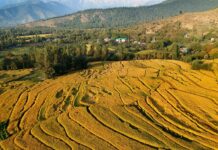
The valley lies in the southern part of Kashmir, in the lap of the Pir Panjal range, and extends along the Nallah Vishow. It is situated to the south-west of Srinagar and is connected by roads from its eastern, western and northern sides, while the southern reaches rise towards the Pir Panjal mountains.
The valley stretches from the historic spiritual centre of Qaimoh in the east towards the upper reaches of the Vishow and Kousarnag in the west. The river and its tributaries have shaped a landscape that combines forests, springs, archaeological sites, historic settlements and numerous shrines associated with Kashmir’s spiritual traditions.
An Ancient Past
The antiquity of the Vishow Valley appears to extend back thousands of years. Stray finds of Palaeolithic and Neolithic tools have reportedly been encountered in the region, although many such discoveries have remained undocumented. In recent years, local teachers have also reported evidence of fossil deposits in the upper reaches of the valley.
There has, however, been little systematic archaeological or geological exploration of the entire Vishow Valley. The archaeological record that does exist consists largely of individual discoveries and references in archaeological reports.
One of the most significant archaeological locations is Devesar, situated on the right bank of the Nallah Vishow. Identified in ancient records with Devesarasa, the site is associated with an ancient centre of learning and with Kashmir’s celebrated tradition of bronze art.
Among the important objects associated with Devesar are a remarkable bronze sculpture of the Buddha belonging to the Kushan period and a tenth-century bronze frame attributed to the period of King Shankaravarman. The latter, locally known as barputh or door-frame, depicts representations associated with the incarnations of Vishnu.
These objects are now preserved in the archaeological collection of the SPS Museum at Lalmandi, Srinagar. They represent some of the finest surviving examples of Kashmir’s ancient bronze tradition and have also featured in international discussions and exhibitions of Kashmiri art.
Other archaeological mounds are reported at Kotebal and Kousarbal on the right bank of the Nallah Vishow. These sites, however, still await systematic archaeological investigation.
Abode of Mysticism
The greatest significance of the Vishow Valley, however, lies in its spiritual heritage.
The valley is closely associated with Nund Reshi, better known as Sheikh Noor-ud-Din Noorani or Sheikh-ul-Alam, regarded as the patron saint of Kashmir and the foremost figure of the indigenous Reshi tradition.
There are different traditions concerning his birthplace. Some place it at Khee Jogipora, while others associate it with Qaimoh. Both places, however, lie within the Vishow Valley. Tradition also associates his childhood with Qaimoh in the pargana of Ardwani.
The valley preserves numerous oral traditions concerning the saint’s early life, teachings and spiritual experiences. Khee Jogipora and Qaimoh are particularly rich in such folklore. Several sites associated with Nund Reshi are also located in the area, including the spring at Khee Jogipora, the cave at Gufabal, the tombs associated with his family at Qaimoh and his celebrated meditation site at Tismer, beneath the Hounhang hill.
According to local tradition, Nund Reshi attained spiritual enlightenment at the cave of Gufabal and subsequently proceeded towards Tismer, where he meditated amid the forests. A shrine associated with him survives at the site.
Reshi Tradition
Much has already been written about the life and teachings of Sheikh Noor-ud-Din Noorani, popularly known as Nund Reshi. He is regarded as the principal founder and exponent of Kashmir’s indigenous Reshi tradition, a distinctive expression of the Valley’s mystical culture.
His teachings emphasised monotheism, devotion, spiritual discipline and the unity of creation. His message became deeply embedded in Kashmiri society and exerted a profound influence on its religious and cultural life.
One traditional rendering of his spiritual philosophy expresses it in these terms:
There is one God,
But with a hundred names,
There is not a single blade of grass
Which does not worship Him.
His teachings further describe a spiritual journey from recognition of God to self-realisation, culminating in the dissolution of distinctions such as gain and loss and, ultimately, life and death.
Centuries after his death, the appeal of Nund Reshi has not disappeared. His shrines, Khanqahs and associated spiritual centres continue to attract devotees. For generations of Kashmiris, these places have been spaces not merely of worship but of consolation, where people have carried their grief, hopes and personal struggles.
His sayings, popularly known as shrukh, remain an important part of Kashmir’s literary and spiritual inheritance and have been preserved in works such as Rishi Nama and Noor Nama.
Early Traditions
Nund Reshi is generally associated with south Kashmir, although traditions differ over whether he was born at Qaimoh or Khee Jogipora. One tradition places his birth in 779 AH, corresponding to 1377 AD.
Local Sufi tradition attributes a miraculous circumstance to his birth. According to one account, jasmine flowers appeared near a spring at Khee Jogipora, and the fragrance was perceived by his mother, Sadra Moji, around the time of his birth.
His father is identified as Sheikh Salar-ud-Din, while his mother is variously referred to as Sadra Moji or Sadra Dedd. In Kashmiri usage, Moji means mother and Dedd denotes grandmother.
Tradition holds that Nund Reshi possessed an exceptional spiritual inclination from childhood. He meditated at several locations before travelling across Kashmir. His movement attracted thousands of followers and eventually spread throughout the Valley. His influence extended beyond religious thought and contributed significantly to the evolution of Kashmiri social and cultural traditions.
The remarkable coins of the Reshi saints
The influence of Sheikh Noor-ud-Din Noorani is also reflected in Kashmir’s numismatic history.
Rare gold, silver and copper coins bearing the names of Sheikh Noor-ud-Din Noorani and another celebrated Kashmiri saint, Sheikh Hamza Makhdoom, have been identified by archaeologists and numismatists. These posthumous issues are associated with the Durrani period of Kashmir.
One series bears a Persian couplet invoking Noor-ud-Din and Makhdoom, conveying the idea that the coin has been illuminated by the radiance of Noor-ud-Din and struck in the name of Makhdoom, titled Qutb-ul-Arifeen.
The Durranis took control of Kashmir in 1753, when Ahmad Shah Abdali incorporated the Valley into the Afghan Empire. The Durrani rulers administered Kashmir through governors appointed from Kabul and maintained a mint in Kashmir.
The coins issued during this period are particularly interesting for their Persian legends. Their reverses generally carry the mint designation and date, while some copper issues bear invocations such as Ya Sheikh, Ya Makhdoom-e-Jahan.
The British numismatist W. R. Rodgers is credited with identifying and deciphering some of these unusual posthumous issues in the twentieth century. He recorded examples in the Catalogue of the Punjab Museum, Lahore. Subsequent scholars and numismatists further documented the series.
Mohammad Yousuf Taing, the noted Kashmiri scholar and cultural historian, also discussed these coins in the Kashmir Encyclopaedia published by the Jammu and Kashmir Academy of Art, Culture and Languages.
I have also documented one such silver coin in my own work on Kashmir’s numismatics, Kashmir Coins. Examples of the series are known in gold, silver and copper. A gold mohur weighing less than 335 grains has been identified in the Punjab Museum, Lahore, while silver rupees weighed less than 170 grains and copper pieces less than 126 grains.
The coins are dated according to the Hijri calendar, with examples assigned to AH 1223–1228. They were struck at the Kashmir mint, believed to have been located near the Saraf Kadal area of old Srinagar.
Historical accounts state that Atta Muhammad Khan was appointed governor of Kashmir in 1804 by Shah Shuja. Around 1808, he is said to have revolted against the Kabul administration and asserted his independence. In seeking popular legitimacy, he reportedly abandoned the conventional practice of placing the reigning Afghan ruler’s name on the coins and instead invoked the names of Kashmir’s revered Sufi saints.
Examples of these copper, silver and gold issues are preserved in museums in India and Pakistan, including the SPS Museum in Srinagar.
Landscape of Shrines
The spiritual landscape of the Vishow Valley is remarkably dense. There are few villages in the region without a shrine, relic or tradition associated with Kashmir’s mystical culture.
Alongside Reshi shrines are numerous shrines associated with Sayyid saints. Among the most important is the shrine at Kulgam associated with Mir Sayyid Hussain Simnani and Mir Hyder Rahmani, who are traditionally believed to have entered Kashmir with their families and other nobles during the reign of Sultan Shahab-ud-Din and settled at Aamnoo, Kulgam.
Local tradition holds that it was through Mir Sayyid Hussain Simnani that Salar, the father of Nund Reshi, embraced Islam.
The traditional practices of the Reshi order may no longer be followed as extensively as they once were, but the attachment of local people to its shrines and sacred sites remains strong. Devotees continue to visit these places, particularly on Thursdays and Fridays.
Among the sites associated with Nund Reshi are the tombs of Sadur Moji and Zoon Dedd at Qaimoh, the Nund Reshi cave at Gufabal, Alamdarnag at Khee Jogipora and the meditation site at Tismer.
The principal shrine of Nund Reshi is at Charar-i-Sharief in Budgam. Yet a substantial number of sites associated with his early life and spiritual journey are located in the Kulgam-Vishow Valley.
This concentration of archaeological and spiritual sites makes the valley an important component of Kashmir’s cultural landscape.
Spiritual Heritage
The Vishow Valley deserves a systematic heritage survey. Its archaeological mounds, ancient settlements, springs, caves, shrines and sites associated with Nund Reshi should be documented, mapped and scientifically investigated.

Such an exercise would not merely serve tourism. It would help preserve an important part of Kashmir’s cultural memory and provide future generations with access to a tradition that has shaped the Valley’s social and spiritual identity for centuries.
The valley could eventually form part of a dedicated spiritual and heritage tourism circuit in south Kashmir, linking its archaeological remains with its Reshi and Sufi sites.
There is also a need to revive the academic study of Kashmir’s mystical traditions. Educational institutions, including madrasa and general education systems, could provide appropriate space for introducing students to the history, philosophy, literature and social significance of the Reshi tradition.
The Vishow Valley is more than a picturesque landscape. It is a repository of Kashmir’s archaeological memory and spiritual inheritance. If properly researched, conserved and presented, it could help reconnect younger generations with one of the most distinctive traditions of Kashmiri civilisation.
(Author is a senior archaeologist. Ideas are personal.)