by Ajaz Ashraf
Heavy security, mass detentions and restrictions failed to prevent protests in Delhi, exposing the government’s growing apprehension about public dissent and its potential to spread before crucial Assembly elections.
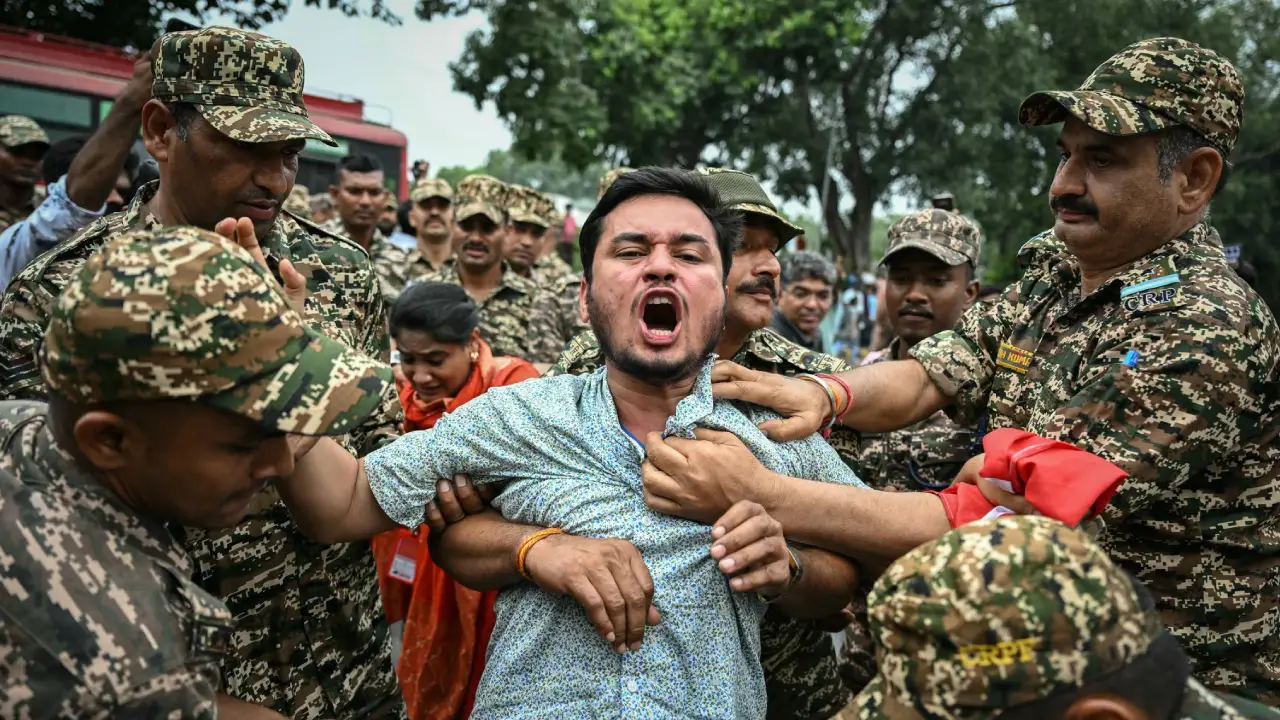
On October 10, the day the Cockroach Janta Party called for a protest at Jantar Mantar, the ambience in Lutyens’ Delhi was only a shade less than that experienced during the 2020-21 pandemic lockdowns. Road after road was barricaded; identity cards were checked multiple times; rare was the sight of a person who was not a journalist or in khaki. The deserted boulevards testified to the paranoia about those who rule the country from this area.
A couple of kilometres outside the sanitised enclave of the powerful, up the Safdarjung Flyover, a swarm of All India Students’ Association (AISA) members squatted on the road, preventing a police bus from ferrying away a batch of protesters. Slogans demanding the resignation of Chief Election Commissioner Gyanesh Kumar rent the air. By the time a journalist friend and I arrived, AISA leader Neha Bora had been whisked away.
It was surprising that Bora had evaded the spree of detentions the Delhi Police had embarked upon the day before October 10. A senior comrade of hers, with his shirt drenched in sweat, his voice quavering with pride, said she had been shifted from her residence three days earlier, with her phone switched off and kept at another place. Messages to her were conveyed in person. The police presumably failed to track her.
AISA organisers shortlisted four possible sites where they could protest, eventually settling upon Dilli Haat, an open-air market, largely because it was easily accessible from a Metro station not closed on October 10. “She was told of the site of protest when she was brought there,” the AISA leader said. The police were caught unawares.
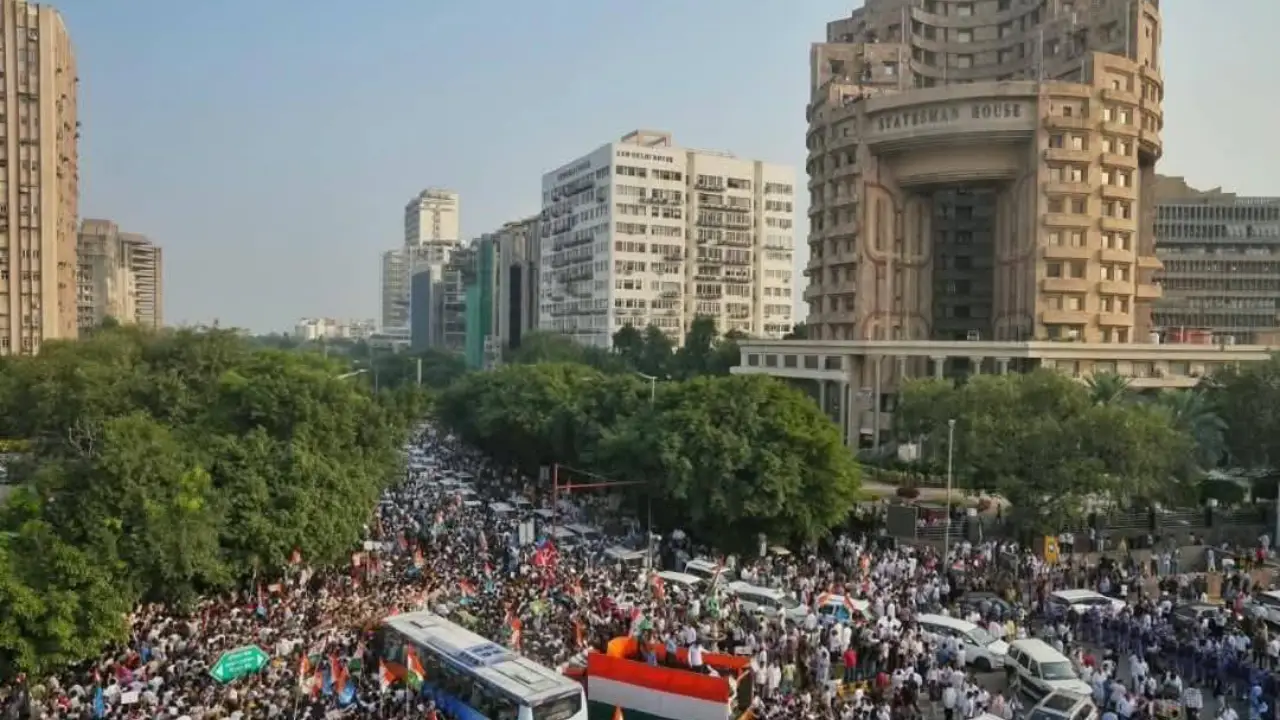
The two contrasting images of October 10 depict two different strategies of survival, so to speak, in the time of tumult. The Modi government has resorted to a stratagem resembling the one it adopted to tackle the coronavirus, over 250 trains were cancelled, gatherings of five or more persons were prohibited, and around 7,000 potential protesters were detained to prevent them from stepping into the public arena.
Yet the virus of resistance has become resilient through flash protests, as seen on the Safdarjung flyover and other spots in Delhi on October 10 and 11. It will now ride the news of protests to spread to other areas, leading to more and more people venting their fury against the government, which will fear being debilitated. It will, therefore, clamp down on protesters with the ruthlessness it displayed during the pandemic, brutalising those who walked hundreds of kilometres home.
The only vaccine Prime Minister Narendra Modi possesses to neutralise the virus of protest is to ask Gyanesh Kumar to resign. Yet he cannot be asked to resign as it would mean that all elections conducted under his supervision, particularly those based on the electoral rolls produced by the Special Intensive Revision, were rigged to favour the BJP. Kumar’s resignation will consequently delegitimise Modi’s current tenure.
Studying Agitations Since 1974
The Modi government has been apprehensive of mass protests for at least a year, after Gen Z erupted in Nepal and forced a regime change. In September 2025, Mahender Singh Manral, of the Indian Express, reported that in an address to the National Security Strategies Conference-2025, organised by the Intelligence Bureau, Home Minister Amit Shah emphasised the need to study all post-Independence agitations, particularly those after 1974, their mode of financing, and the role of “behind-the-scene players” in them. He entrusted this task to the Bureau of Police Research and Development.
Based on their study, Shah said a standard operating procedure should be prepared to “prevent mass agitations by vested interests in the future”. A month later, the then Delhi Police Commissioner Satish Golcha asked the Intelligence branch, Operations unit, and Delhi Armed Police to prepare a “contingency action plan” to deal with mass agitations of the kind Nepal’s Gen Z had unleashed.
Perhaps Shah’s apprehension of mass agitation stems from his party’s own experience, it had played a crucial role in the stir against the Emergency imposed by Indira Gandhi, and thereafter, in the late 1980s, organised the Ram Janmabhoomi movement. The latter led to the collapse of the V.P. Singh government, triggered bloody riots until 1993, in which thousands died, and destabilised the Indian polity.
A party that gained enormously from the Ram Janmabhoomi movement cannot help but become apprehensive of mass agitations organised by its rivals. Its apprehension likely turned into paranoia due to the unexpected number of people participating in the July 20 march to Parliament. Their presence signified the depth of popular anger against the country’s broken education system and unemployment.
The Modi government’s paranoia led it to perceive in the protest demanding Kumar’s resignation a diabolical plan to dislodge it. This perception is certainly influenced by its knowledge that the Election Commission of India, the government’s veritable handmaiden, has failed to convincingly counter the allegation that it has used the SIR to manipulate the voter list. Nor has the ECI replied to the allegations of rigging in Odisha and Andhra Pradesh during the 2024 Lok Sabha election.
Paranoid of an uncontrollable upsurge, as seen in Sri Lanka, Bangladesh, and Nepal, the government built a security wall around Lutyens’ Delhi to rule out the possibility of protesters besieging Modi and Shah. The measures taken to suppress the October 10 protest indeed echo the kind of Standard Operating Procedure the 2025 security conference and the Delhi Police Commissioner wanted to put in place.
Suppression until December
By ordering a lockdown in Lutyens’ Delhi and persisting with oppressive measures even on October 11, the Modi government wants to stop the virus of protest from spreading in geometric progression, at least until December. By then, opposition parties will begin their preparations for Assembly elections in Uttar Pradesh, Uttarakhand, Punjab, Goa, and Manipur. They will strive to stitch alliances or snipe at each other where they are in electoral competition, diminishing the virulence of the virus of resistance.
The BJP cadres interpret the Modi government’s paranoid behaviour as a sign of resoluteness against the “state of anarchy” that the opposition seeks to create with the “backing of foreign powers and alliances”. This was the claim of BJP president Nitin Nabin. During the pandemic, Hindutva supporters wrongly blamed the spread of the virus on the Tablighi Jamaat, a Muslim missionary movement. Over 200 of its members were arrested and booked under various laws.
Yet the coronavirus continued to infect people. Regardless of the BJP blaming the opposition and foreign powers for spreading the virus of resistance, its virulence will only grow, further deepening the government’s paranoia about the fate that might befall it. A paranoid entity, whether a person or government, ultimately exasperates and tires people.
(Ajaz Ashraf is a senior journalist from Delhi and the author of Bhima Koregaon: Challenging Caste. This write up first appeared on the Frontline website. Ideas are personal.)