by Dr Waseem Ahmad Bhat
What the Valley requires is not more visitors observing from the sidelines, but active political participants committed to challenging the ongoing suspension of civil liberties and constitutional governance.
In the aftermath of the abrogation of Article 370, Jammu and Kashmir has become a stage for performative federalism. Here, delegations with no legislative power, often from opposition parties, arrive in the Valley with stated intentions of solidarity but leave behind little more than press statements and fleeting headlines. While their presence may project moral resolve or democratic concern, the central question remains whether these visits yield any political or institutional consequence or merely amount to procedural theatre.
The Performative Spectacle of Delegations
Since the revocation of Jammu and Kashmir’s special status in 2019 and its subsequent conversion into a Union Territory, several opposition-led delegations have visited the region. Their itineraries follow a predictable pattern: brief meetings with civil society representatives, interactions with local party workers, expressions of support, and critical remarks aimed at the Centre. Despite these gestures, tangible outcomes, whether in terms of policy impact or institutional redress, have been minimal.
A recent visit by the Congress delegation, led by senior figures including Jairam Ramesh and K C Venugopal, typified this approach. Timed around elections, the visit appeared to be a bid to reassert the party’s fading relevance in a region it once considered strategically significant. Though the delegation interacted with party workers and residents, it notably failed to engage with the region’s altered political landscape. The erosion of democratic institutions, the narrowing space for dissent, and the ongoing detention of political leaders and civil society actors received scant attention. The visit generated some media coverage but produced no lasting political traction.
The Left’s Moral Assertion
In contrast, a delegation from the Communist Party of India (Marxist), led by General Secretary M A Baby and including parliamentarians John Brittas, Amra Ram, Bikash Ranjan Bhattacharyya, and S U Venkatesan, alongside local leaders such as M Y Tarigami and Mohammad Abas Rather, carried out a two-day tour of the Union Territory that was more explicitly ideological and constitutionally driven.
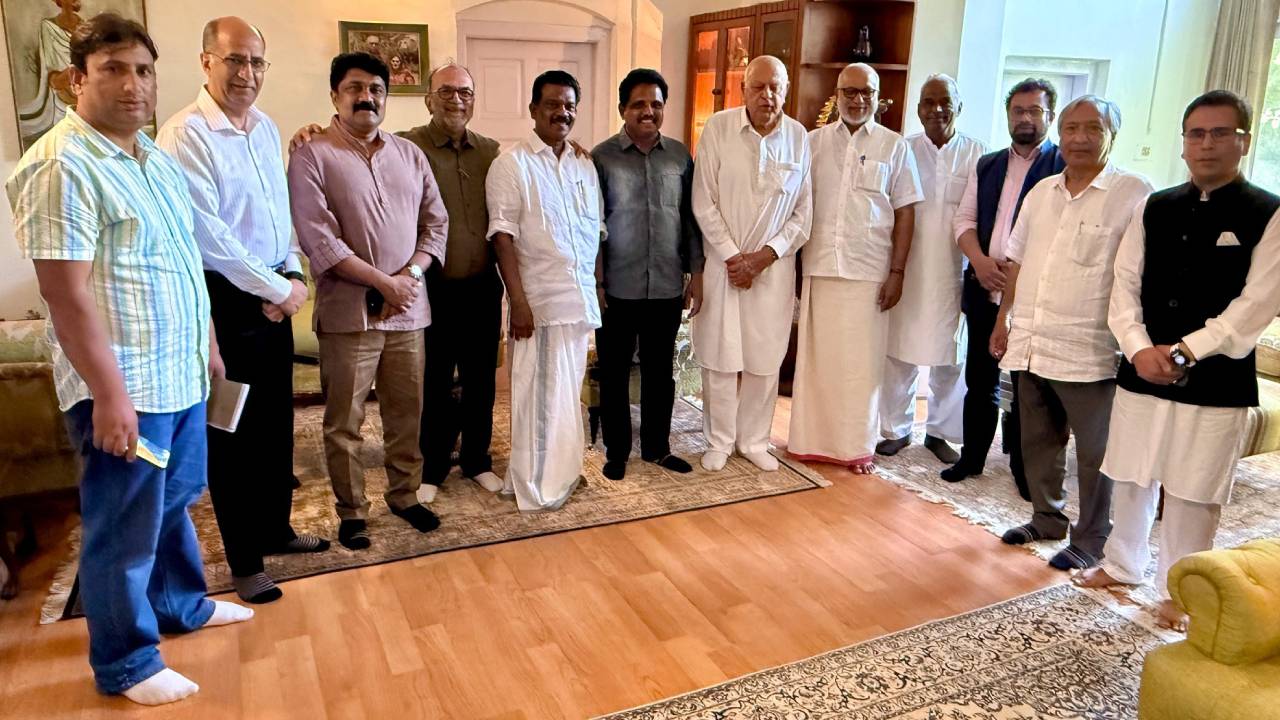
Their meeting with National Conference President Dr Farooq Abdullah in Srinagar marked a rare moment of consensus between the mainstream Left and Kashmir’s regional leadership. Both sides stressed the importance of peace, dialogue, and the urgent restoration of democratic and constitutional rights.
M A Baby openly condemned the conversion of Jammu and Kashmir into a Union Territory, characterising it as a direct assault on democratic principles. He criticised the marginalisation of elected leaders such as Omar Abdullah in favour of administrative decisions now centralised in the Lieutenant Governor’s office. These concerns mirror a broader trend in Indian federalism, in which regions marked by political sensitivity are increasingly governed through bureaucratic mechanisms that supplant democratic representation. This approach, though presented as administrative efficiency, risks undermining the federal compact in a plural democracy.
Humanitarian Crisis in Border Regions
The CPI(M) delegation’s visit to Uri, a town near the Line of Control impacted by retaliatory shelling following Operation Sindoor, highlighted the cost borne by civilians in militarized zones. The operation, which targeted alleged militant infrastructure in Pakistan-administered Kashmir, resulted in civilian casualties and the displacement of entire communities. M A Baby described scenes where families of eight or more were confined to single rooms. The government’s promised compensation of ₹1.30 lakh per family, he argued, was woefully insufficient.
Security narratives often obscure the human impact of conflict. Border residents live in a state of permanent vulnerability, treated less as citizens with rights than as expendable buffers in a long-standing geopolitical confrontation. CPI(M)’s demand for a special parliamentary session to address the condition of civilians in these regions is significant. However, without support from other political actors, it risks becoming another unaddressed appeal in an environment where majoritarian consensus often trumps humanitarian concern.
Delegations and the Myth of Engagement
The frequent visits of non-governing delegations reveal a deeper malaise within Indian federalism: the diminishing capacity of the opposition to influence policy or sustain institutional critique. These visits rarely result in structural change or revived political engagement. At best, they serve as records of dissent. At worst, they legitimise an altered status quo by enacting the appearance of engagement without any of its substance.
While symbolic gestures hold value, especially in regions increasingly alienated from the national political narrative, such gestures must be embedded in sustained political strategies to gain meaning. The CPI(M) convention held at Tagore Hall in Srinagar, which focused on constitutional restoration, represents one such attempt. However, for such efforts to matter, they must be part of a larger and continuing political intervention.
National Stakes and Marginal Voices
The CPI(M)’s pointed critique of the current administration’s Kashmir policy appears to be part of a broader effort to reaffirm its commitment to constitutional values and democratic accountability at a time when many opposition parties have either become reticent or appear compromised. The involvement of sitting parliamentarians lends some institutional weight to this stance. Yet the marginal electoral presence of the Left raises questions about its ability to translate moral positioning into political influence.
Symbolic interventions, however clear in intent, must evolve into sustained movements. The clarity with which the CPI(M) has articulated its position will need to resonate beyond Kashmir if it is to influence national discourse and policy. Without broader alliances or public mobilisation, such interventions risk becoming isolated statements rather than drivers of change.
The Limits of Symbolism
Delegations to Kashmir can still carry significance, but only if they transcend political tokenism and contribute to democratic revival. What the Valley requires is not more visitors observing from the sidelines, but active political participants committed to challenging the ongoing suspension of civil liberties and constitutional governance.
The future lies in moving from condemnation to mobilisation, from presence to persistence. Unless these visits develop into more than performative gestures, they will remain peripheral notes in the larger narrative of Kashmir’s continued political exclusion.
(The writer is an independent researcher focusing on party politics and federalism in Jammu and Kashmir. Ideas are personal.)