by Iqbal Ahmad
A detailed examination of Ushkar’s terracotta finds shows strong Gandhara influence, positioning the site as Kashmir’s earliest Kushan-era Buddhist centre with enduring Hellenistic artistic traditions.
Although Hellenistic art, or Greco-Buddhist art, better known as the Gandhara School of Art of ancient India, had almost disappeared from its original home very early, its influence remained prevalent in Jammu and Kashmir until quite late, almost up to the 12th century.
Several scholars have termed it post-Gandhara art, but in the real sense, it cannot be classified as late Gandhara art. Before proceeding further, let us first revisit the meaning of this art. Basically, it was a style of Buddhist visual art that evolved in Gandhara, in the modern-day Kandahar province of Afghanistan, during the Indo-Greek period and was later promoted by the vast Kushan Empire, whose artists carried it to distant regions of ancient South Asia.
During the Kushan era (100 CE to the 4th century CE), it became the most popular art form of the north-western areas of ancient India. It represents the artistic manifestation of Greco-Buddhism, a cultural syncretism between ancient Greek art and Buddhism. Its influence is found not only in the ancient architecture and sculptures of India and Pakistan, but particularly in the regions of northern India, especially Jammu and Kashmir, where its impact has been strong.
For 1300 Years
It is pertinent to mention here that the numismatic motif of the standing king and seated deity, introduced by Kushan emperor Kanishka I in the first century CE, continued in Kashmir’s coinage up to the 13th century CE. Besides, ancient monuments and sculptures found in this region also bear strong influences of this art.
The remains of an ancient monastery at Ushkar (Baramulla), and the sculptures recovered from this site, constitute evidence of the popularity of this art during the Kushan era.
Ushkar, the ancient Huvishkpur or Hushker in Baramulla, originally carried the name of Huvishka, a Kushan-era king. It is picturesquely situated at the mouth of the gorge through which the river Jhelum (Vyeth) leaves the Kashmir Valley. Baramulla once served as the gateway to this land, as it stood on the Jhelum Valley route, which was once considered the lifeline of Kashmir.
It was the first motorable road connecting Srinagar with Rawalpindi and other north-western towns of undivided India. In ancient times, this route also connected Kashmir with Taxila, Hazara, and ancient Gandhara (Kabul Valley).
Since ancient times, Baramulla town has been an attractive destination for tourists. Owing to its favourable geographical location, it was accessible to visitors who travelled to Kashmir in earlier periods.
A Traveller’s Halt
Ancient Chinese and Arab travellers such as Huen Tsang, Okong, and Al-Biruni were among the most celebrated envoys who visited the town in ancient times. During the Sikh and Dogra periods, several European travellers arrived here via this route. These travellers also provided brief descriptions of the town in their respective travelogues.
Baramulla is mentioned in ancient historical records. However, in early sources, it appears under different names. It is believed that the name emerged either from Hushkpur or from Kanishkpur. These two locations, adjacent to the modern town, are considered the earliest settlements founded by two Kushan princes, Kanishka I and Huviska, respectively, during the 1st and 2nd centuries CE.
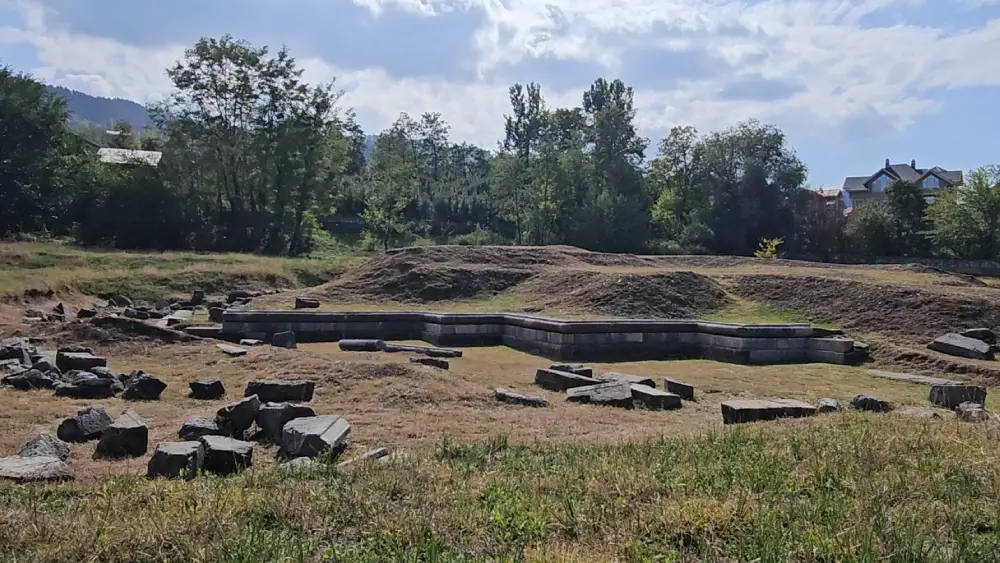
Excavations carried out in the early 20th century at Hushkpur revealed several antiquities from the period of Huviska. The most outstanding discovery was an early plinth structure identified as the basement of a Buddhist monastery. Even today, a massive limestone basement is visible on the elevated ground at Hushkpur.
Archaeologists believe these ruins belong to an ancient monastery built by Kthe ushan king Huviska. Huen Tsang, the Chinese ambassador who arrived in 631 CE, is recorded to have been received by King Durlabhavardana of the Karkota dynasty at this historic monastery.
The Excavations
It is learnt that Daya Ram Sahni, the 20th-century archaeologist, excavated Huskapura (modern Ushkara) near Baramulla and discovered the remains of a stupa and its surrounding wall. Although no circular tile pavement has been recorded at the site, several striking and significant terracotta figures were discovered. These fragments resemble Gandhara art influences and are among the earliest examples of Kashmir sculpture discovered so far.
PNK Bamzai attributed this art to the later Gandhara period and wrote that these “later Gandhara” terracottas have been variously dated from the 4th to the 8th centuries CE. The figures and figurines depict clear Hellenistic influence. Hellenistic art remained the dominant cultural force for nearly a thousand years, from the 3rd century BC to around 700 CE, in what is now Afghanistan, with its final echoes lasting in Kashmir until the 10th century CE.
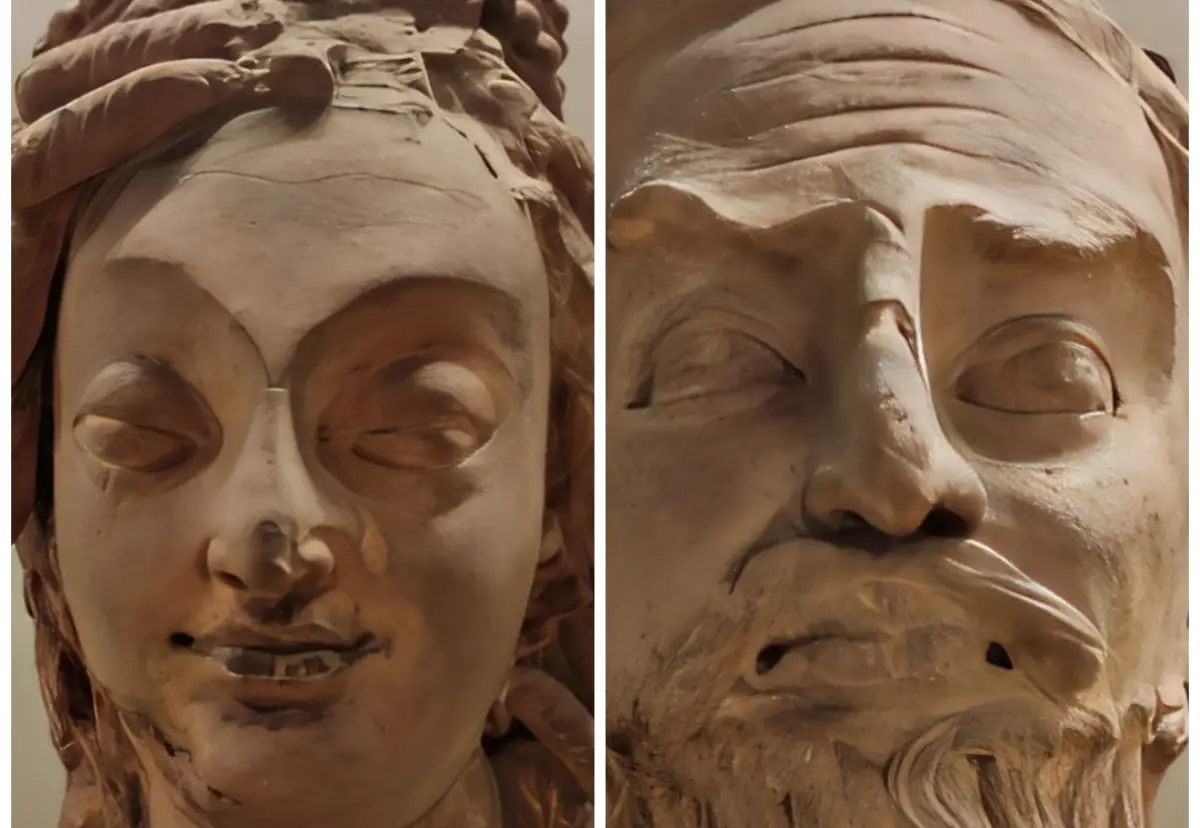
RC Kak, another 20th-century archaeologist, wrote that the structure to which the terracotta heads belonged may date to Kushan times. This view is strengthened by the discovery, outside the north-eastern corner of the surrounding wall, of eleven terracotta heads along with several fragmentary limbs of images displaying unmistakable influence of the Gandhara School of the 3rd and 4th centuries. These are now preserved in the Srinagar Museum.
My Opinion
The contributor of this paper also examined the Ushkar finds, particularly their remarkable terracotta heads. In texture and artistic style, these closely resemble mainstream Gandhara art rather than its later phases and can be dated to a period before the 4th century CE, as observed by several other archaeologists. Some of the artefacts from this site are housed in the SPS Museum, Srinagar, and are described below:
(a) One terracotta head illustrates a Bodhisattva. The unusually ornamental treatment of the hair is noteworthy. The delicate features, rounded chin, and twisted, dandified locks secured by a beaded fillet placed sideways make the face attractive despite the somewhat weary smile and self-satisfied expression.
(b) Another terracotta head depicts a shaggy-bearded Brahman ascetic. The close-pressed lips, knitted eyebrows, and furrowed forehead are so remarkably realistic that it is difficult to imagine the artist was not drawing a portrait from life. The hair is neatly brushed upwards and was probably gathered in a knot at the back of the head, held in place by an ornamental band. The ardent gaze and prominent cheekbones suggest intense self-mortification.

(c) This is one of the most beautiful heads found at Ushkar. The oval face, small nose, sensitive nostrils, soft, delicate lips, plump, rounded chin, and hair smoothly combed back and falling in curly tresses on the shoulders are all essentially feminine. She is an upasika, or female lay devotee. Her soft and wistful gaze, intensified by the upturned poise of the face, reflects the devotion with which these feminine worshippers approached the Master.
(d) This illustration represents the head of a contemplative young monk with a shaven crown, high forehead, arched eyebrows, and large, dreamy eyes. The remarkably high and narrow skull appears to be the result of lateral pressure, a practice once prevalent among certain tribes of Central Asia.
The terracotta heads and other artefacts from this site constitute the earliest evidence of Kashmiri sculptural art. Strongly influenced by Hellenistic style, these artefacts can be dated to the period between the 2nd and 4th centuries CE.
(The writer is a senior archaeologist and author. Ideas are personal.)