by Amir Sultan
Modern psychiatry shapes understanding of mental health, but excessive medicalisation risks overlooking social, cultural, economic, and structural causes of suffering

Few conversations enjoy as much acceptance today as conversations on mental health. As a student of mental health studies, I notice how casually people borrow the language of psychological disorders. Terms such as depression, schizophrenia, anxiety, ADHD, and, of course, narcissism and other personality disorders are everywhere—in films, memes, social media posts, and our casual conversations. We have become remarkably confident in misusing this vocabulary. More importantly, we seldom ask a simpler question: what exactly do these terms imply?
Apparently, issues of mental health are issues of the mind, much as diabetes is an illness of the pancreas or pneumonia is an illness of the lungs. This comparison is comforting because it places issues of mental health within the familiar framework of medicine. Therefore, these issues can be identified, classified, and successfully treated in the same way as physical diseases. Yet this has not always been the case.
Mental health has previously been understood as a spiritual crisis, divine punishment, moral struggle, mystical insight, or a reaction to unbearable social circumstances, making its interpretation considerably more complex. Even today, psychiatry, rather than relying on a blood test, a biopsy, or an MRI scan to establish the presence or absence of a psychological disorder, depends largely on conversations, observations, patterns of behaviour, and judgements about whether a person’s thoughts or emotions have become so persistent and disruptive that they interfere with everyday life.

The Transformation
This historical transformation, from spiritual crisis to a medical framework, has increasingly asserted mental disorders as objective facts. Yet every framework also inherits the assumptions of its own age. This raises a disturbing possibility: perhaps issues of mental health remain vague until viewed through a particular lens. Through a spiritual lens, distress becomes a spiritual crisis; through a medical lens, it becomes a psychiatric condition.
Interestingly, research supports both perspectives, and practitioners continue to operate within each of them.
Moreover, issues of mental health occupy an unusual position within science because they are not merely biological events. They emerge where biology, personal history, relationships, culture, and meaning intersect. A panic attack is experienced by the nervous system, but also by a person whose fears have a history. A delusion is neither reducible to dopamine nor understandable without considering the life in which it appears. Psychological distress cannot simply be compressed into diagnostic manuals and assigned fixed boundaries when its very nature remains uncertain.
One of the so-called greatest achievements of psychiatry has been the development of diagnostic categories and a common language through manuals such as the DSM and the ICD. Their developers claim that these manuals enable the diagnosis of conditions such as panic disorder, OCD, and schizophrenia, thereby reducing confusion and helping millions receive treatment. History, however, offers reason for humility. Diagnoses have appeared, disappeared, merged, fragmented, and been redefined over time. Homosexuality was once considered a psychiatric disorder before being removed from diagnostic manuals. New disorders have emerged, while others have quietly faded.
Perhaps no one illustrates this better than Allen Frances. As the Chair of the DSM-IV Task Force, he helped shape one of the most influential diagnostic manuals in psychiatry. Years later, however, he warned that psychiatry risked expanding its boundaries so far that ordinary human experiences increasingly came to resemble mental disorders. His concern was not that mental illnesses were imaginary, but that grief, childhood exuberance, shyness, everyday forgetfulness, and many of life’s ordinary struggles were becoming easier to medicalise. He reminded us that psychiatry carries two responsibilities: to recognise genuine issues of mental health, but also to avoid transforming normal human variation into pathology. Both mistakes carry consequences.
A Peculiar Ecosystem
Another often overlooked aspect of mental health is the ecosystem it creates. Psychological disorders do not exist only in books or clinics. They extend into insurance policies, research grants, universities, professional organisations, pharmaceutical markets, government programmes, and public discourse. These institutions, in turn, shape how mental disorders themselves are understood.
The pharmaceutical industry occupies a particularly influential position within this ecosystem. Critics have argued that medications increasingly define psychological disorders, sometimes serving commercial interests as much as scientific ones. Pharmaceutical companies fund research, sponsor conferences, support continuing medical education, invest billions in developing medications, and subsequently profit from their widespread use.
The philosopher-psychiatrist John Z Sadler describes this broader landscape as the Mental Health Medical-Industrial Complex. His point is that once diagnostic systems become embedded within research institutions, regulatory agencies, insurance mechanisms, professional organisations, and pharmaceutical markets, these institutions begin to reinforce one another. Issues of mental health become scientific concepts, administrative codes, commercial markets, and social identities simultaneously. The more successful a diagnostic category becomes, the more difficult it becomes to question—not because it is necessarily wrong, but because many parts of the system now depend upon it.
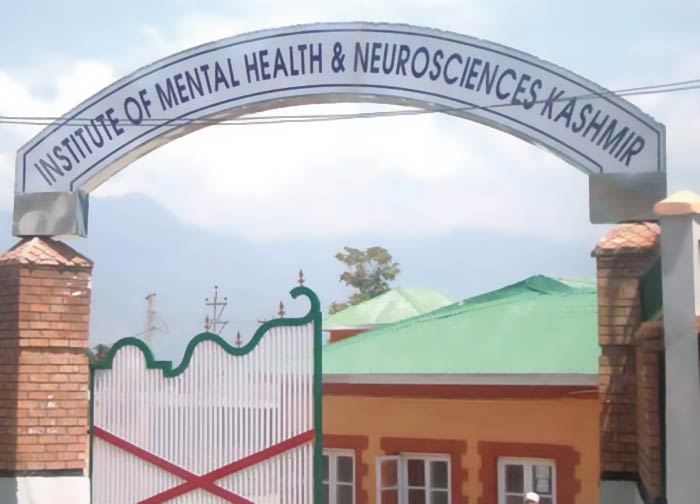
Kashmir, as well as India more broadly, illustrates this paradox with particular clarity. We are repeatedly told that mental illness is under-recognised and under-treated, and this is undoubtedly true for many people experiencing severe psychological distress. Yet we continue to approach suffering primarily through the language of individual pathology while remaining structurally incompetent in addressing the conditions that repeatedly produce it.
Farmers driven to suicide by indebtedness, unemployed youth confronting chronic uncertainty, women surviving domestic violence, children trapped within educational systems built upon relentless competition, and communities living with displacement and poverty are increasingly encouraged to understand their suffering through psychiatric categories. Diagnosis becomes the preferred response to conditions that are fundamentally political, economic, and social. We medicalise despair while leaving untouched the structures that manufacture it.
Structural Competence
This is what scholars describe as a failure of structural competence. It is easier to prescribe antidepressants than to confront unemployment; easier to diagnose anxiety than to reform educational systems that systematically cultivate it; and easier to label psychological distress than to dismantle the inequalities from which that distress repeatedly emerges. The individual becomes the site of intervention because transforming individuals is infinitely more manageable than transforming societies.
The greatest success of modern psychiatry may therefore not be the discovery of psychological disorders or the development of diagnostic manuals, but the normalisation of a particular way of understanding mental health. Increasingly, we encounter ourselves through diagnostic language. We learn to narrate sadness as depression, distraction as ADHD, grief as pathology, loneliness as disorder, and existential uncertainty as illness. The vocabulary becomes so familiar that it begins to appear natural, inevitable, and beyond question.

But science begins where certainty ends. Every concept deserves interrogation, particularly those that have become too familiar to notice. Psychological disorders should not be exempt from such scrutiny simply because they have become institutionalised. They are among the most powerful ideas modern society has created—not merely because they organise suffering, but because they organise entire systems of knowledge, authority, identity, and commerce around suffering.
Perhaps the question is no longer whether psychological disorders exist. The more unsettling question is whether we have become so committed to understanding human suffering through a psychiatric lens that we have forgotten there are other ways of making sense of it. When every form of distress becomes a diagnosis, we do not merely change the language of suffering. We change the very meaning of what it is to be human.
(The author has a PhD in psychology. Ideas are personal.)