by Athar Parvaiz
Through excerpts from his early articles, Rahmani provides insight into the pressing issues of the time. One such article highlighted the potential damage to the Taj Mahal posed by nearby refineries, due to pollution.
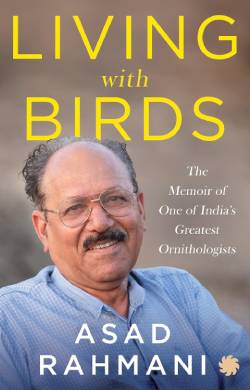
A recent book release invitation for Living with Birds by Asad Rahmani, a renowned Indian ornithologist, landed in my inbox in early November. Although I was unable to attend the New Delhi event, I later obtained the book and was captivated by its content. Jointly published by Juggernaut and Indian Pitta, this memoir traces Rahmani’s fascinating journey from his early life and conservation efforts to becoming a legendary figure in Indian wildlife.
Through amusing anecdotes and heartfelt stories, Rahmani underscores the importance of wildlife, making Living with Birds a must-read for nature enthusiasts.
The book begins with a Prelude, showcasing Rahmani’s scientific approach through a captivating account of his observations of bird behaviour during a solar eclipse. This event ultimately led him to secure a job at the Bombay Natural History Museum (BNHS) as a young field biologist. Rahmani recalls being “brimming with excitement” at the prospect of witnessing and documenting abnormal bird behaviours during the eclipse, while many others in the country were alarmed by the prospect of a total solar eclipse, with some bordering on hysteria.
That solar eclipse in February 1980 proved to be a pivotal moment in Rahmani’s life. He describes it as a “turning point”. The brief disappearance of the sun that day illuminated a bright future ahead, he recalls.
The subsequent chapter delves into Rahmani’s formative years, shaped by his father’s occupation as a judge, which necessitated frequent relocations. He fondly reminisces about places such as Mussoorie and Saharanpur. Rahmani also pays tribute to the art of reading, which became an integral part of his daily routine.
One of the notable strengths of Living with Birdsis Rahmani’s vivid descriptions of geography, bird anatomy, and flora and fauna. His writing enables readers to visualise the stories he narrates, making the book an engaging read.
Rahmani recounts how he became increasingly rebellious with time, defying societal norms. A notable instance was his refusal to attend a dinner invitation at the Palace of Rampur’s Nawab with his family. He declined due to his leftist leanings, questioning how he could dine in a “bourgeoisie house”.
His family, particularly his father, had envisioned a career in engineering for him, given his aptitude for mathematics. However, Rahmani strongly resisted this path, opting instead to pursue biology. This decision resulted in a year-long setback in his academic career, as his father had to arrange for a biology tutor, a subject Rahmani had not previously studied.
Rahmani reflects on the 1972 Wildlife Protection Act, citing its profound and lasting impact. The legislation facilitated his encounters with numerous conservationists in the years that followed. Through excerpts from his early articles, Rahmani provides insight into the pressing issues of the time. One such article highlighted the potential damage to the Taj Mahal posed by nearby refineries, due to pollution.
A pivotal moment in Rahmani’s life came in 1981 when he ventured into the Thar Desert as part of a survey following the bustard hunting incident of 1980. His vivid descriptions of even the most mundane details are captivating.
Rahmani’s account of Indira Gandhi’s assassination in 1984 offers a unique perspective. As a scientist, he, along with Dr Salim Ali, lamented her sudden death. Gandhi was an ardent wildlife lover, and her concern for the subject was unparalleled among Indian prime ministers. Rahmani notes that she was supportive of their scientific work.
The Bustard project of 1981 was followed by the Florican project in 1984. Rahmani provides intriguing insights into the latter project.
During his tenure as director of the Bombay Natural History Society (BNHS), Rahmani considered changing the organisation’s name to reflect changing times. Initially, he contemplated altering “Bombay” to “Bharat”, preserving the acronym. However, due to peculiar laws, this was not feasible. Ultimately, the decision was made to retain the original name, a choice Rahmani welcomes.
Rahmani recounts the alarming decline of the Gyps vulture population in India, which plummeted by 90 per cent towards the end of 1996. The sudden drop was mystifying, prompting numerous theories. One prevailing notion was that a virus was responsible for the vulture deaths.
To investigate further, the Bombay Natural History Society (BNHS) enlisted the help of a foreign animal virologist. The research necessitated sending vulture carcasses to a laboratory in Australia for analysis. However, this was hindered by a law prohibiting the export of genetic material.
BNHS had to obtain special government permission, a process that took two years. In a surprising twist, the Australian laboratory had burned down and remained closed for an extended period. Ultimately, the investigation revealed that the drug Diclofenac, used as a painkiller in cows, was the primary cause of the vulture decline. Vultures ingested the drug while feeding on carcasses.
Rahmani notes that the vulture programme remains the longest-running initiative in BNHS’s 140-year history, thanks to support from other institutions.
Certain chapters of the book shift the focus away from Rahmani himself, instead highlighting the individuals who have surrounded him throughout his career. One such figure is the renowned bird ringer Ali Hussain, whose charisma and expertise left an indelible mark on Rahmani.
Rahmani also dedicates space to his students and fellow scientists, recounting engaging anecdotes and stories. The book is a compelling read for biologists, bird enthusiasts, students, and scientists alike.
(The author is an environmental and science journalist. Ideas are personal.)