by Khalid Bashir Ahmad
The SPS Museum, guardian of Kashmir’s heritage, showcases artefacts, coins, textiles, and history, enchanting visitors while facing preservation challenges
After a long gap, I returned to the SPS Museum today, this time with my little grandnieces in tow, for a gentle walk through history. The youngest, Maryam, just two and a half, was especially thrilled to visit the mujium, eager to see “a leopard and a bear.” Her delight lent a new kind of magic to the visit, as if the artefacts themselves had stirred in anticipation of her wonder. Her elder sister, Baheej, seven, was no less enthusiastic. All week, she had been asking, “When are we going to the museum?”
I had promised them a glimpse into the treasure trove of Kashmir, a peep into the Valley’s layered past. And today, at last, was the moment to keep that promise. As a student of Kashmir’s history, and perhaps more so as a former head of the Department of Archives, Archaeology, and Museums, my interest in visiting the museum was no less intense. For me, it was not merely a stroll through curated relics but a return to a space I had once helped shape, protect, and interpret. This was not just a visit; it was a homecoming of sorts.
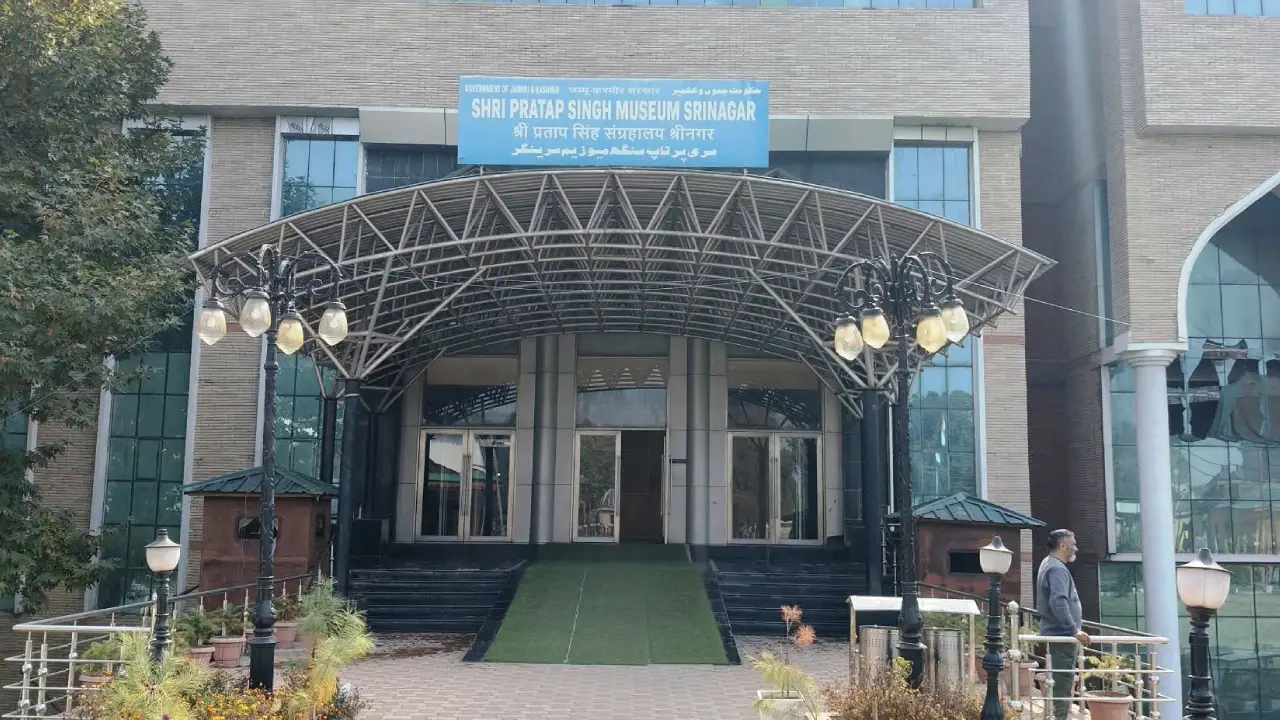
The museum, established in 1898, was housed in Maharaja Pratap Singh’s Summer Guesthouse at Lal Mandi in Srinagar, nestled on the left bank of the Jhelum. Its earliest collection included shawls and armoury sourced from the State Toshkhana, the government repository for trophies and crafts. Over time, it evolved into one of the finest museums in the subcontinent, now home to nearly 80,000 artefacts spanning archaeology, numismatics, decorative arts, arms and armoury, paintings, and textiles.
The Genesis
The idea of a museum in Srinagar was born from the curiosity and scholarship of British officers and European travellers, many of whom were well-versed in Sanskrit and Persian, and their desire to cultivate public interest in Kashmir’s rich cultural heritage. Among them was Dr Francois Bernier, who accompanied Mughal monarch Aurangzeb on his visit to Kashmir in 1646 AD as his physician and wrote his voluminous travelogue of travels in the Mughal Empire. Bernier’s vivid accounts of the Valley’s history and people sparked fascination in the West, opening doors for European scholars and travellers.
Figures like Aurel Stein translated ancient manuscripts, illuminating Kashmir’s deep historical roots. Alexander Cunningham, the renowned Indologist and former Surveyor General of India, arrived in the late 19th century and published extensively on Kashmir’s monuments and coins. These efforts, along with subsequent antiquarian tours, laid the groundwork for a deeper understanding of the Valley’s archaeological legacy.
Inspired by this growing interest, officers of the British Residency in Kashmir, chiefly Captain SH Godfray, Assistant to Resident, proposed to Maharaja Pratap Singh the establishment of a museum to house Kashmir’s antiquities and craft traditions. The proposal was approved, and the initial collection for the museum was drawn from the State Toshkhana, with additional gifts from the royal family.
Guest House
The ruler’s Summer Guesthouse was chosen as the site, and the museum was named after him. Over the years, archaeological excavations, generous donations, and careful acquisitions enriched the collection, now numbering around 82,000 artefacts, including 71,000 coins. Each piece tells a story, and together they form a mosaic of Kashmir’s layered past.
Initially, the museum was placed under the charge of the Librarian of the SPS Library, which had been incorporated with the museum itself. It was a modest beginning, one where books and artefacts shared custodianship, and the lines between scholarship and preservation were still fluid. The Librarian, more accustomed to manuscripts and catalogues, now found himself guardian of shawls, sculptures, and coins, a quiet testament to how institutions evolve, often in unexpected ways.
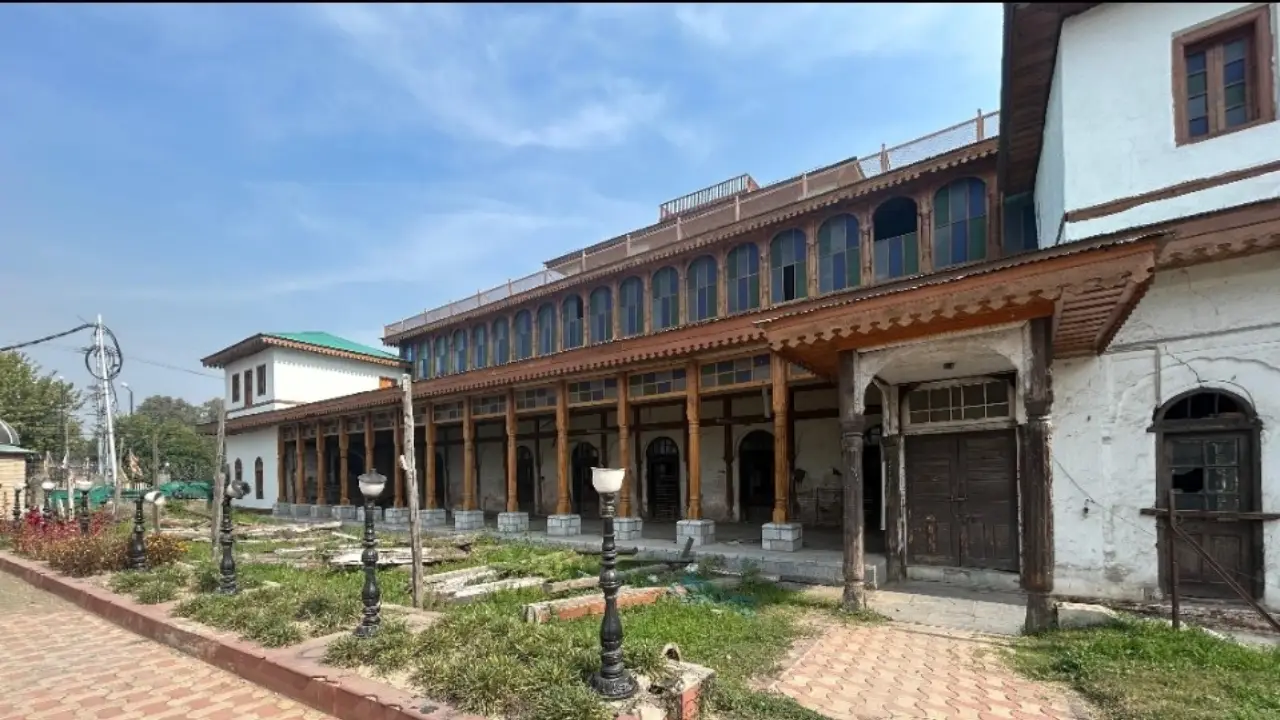
As the museum’s collection expanded, the original building proved inadequate for housing and displaying its growing treasure trove. Only a fraction of the artefacts could be exhibited; the rest remained in storage, unseen and unsung. The structure itself, aged and fragile, was no longer fit for safe conservation.
The New Building
Recognising the need for a modern, spacious facility, construction of a new museum building began in 2006 during the Chief Ministership of Ghulam Nabi Azad. In a curious gesture of principle, Azad declined to lay the foundation stone at the outset. He reasoned that if the ceremony were held too early, the executing agency might lose its sense of urgency, assuming the symbolic milestone had already passed.
By withholding the formal laying of the stone, the Chief Minister kept anticipation alive, ensuring the agency remained alert, guessing when he might arrive to mark the occasion. True to his word, he laid the foundation stone only in 2008, once the four-storey-plus-basement structure had already risen. His interest in the project was keen; he even introduced a double-shift work schedule to hasten its completion and visited the construction site thrice a month. Today, the ground and first floors are functional, while the basement serves as storage for the bulk of the collection. The second and third floors remain unfinished.
The project’s initial estimate of Rs 30.91 crore has since ballooned—first to Rs 72 crore, and more recently to Rs 92 crore. The building was partially opened to the public in 2014, following the devastating September deluge that damaged parts of the collection. Yet it awaits formal inauguration. Initially, the natural history and mineral sections were to remain in the old building, but they too were shifted to the new premises after its retrofitting and renovation began in 2019. That work is still underway. The old structure had been declared unsafe by the R&B Department. Despite the scale of the new building, its planners and architects appear to have underestimated the museum’s spatial needs. According to a senior official, even with all floors of the new building and the renovated old structure combined, only about 30 per cent of the collection could be displayed. At present, a mere 20 per cent is accessible to the public.
The Archaeology
The archaeological section of the museum holds a remarkable collection of stone and metal images, some dating as far back as the 5th century AD. Among them are the serene figure of Gajalakshmi and a striking three-headed Shiva. These artefacts hail from Kashmir’s famed archaeological sites, Pandrathan, Parihaspur, Awantipur, Ushkar, Harwan, Hoinar, Pahalgam, Hutmura, Ashrat-nar-Badgam, Verinag, Soura, and the Tomb of Madin Sahib. Famed archaeologists Sir John Marshall and explorer Aurel Stein also contributed to this assemblage, deepening its historical resonance. The section offers a glimpse into the lives of Burzahom’s pit-dwellers, the earliest known human settlement in Kashmir, etched into the Neolithic soil.
One curious relic in the archaeological section is an elephant tusk, part of a fossil unearthed near Pampore in 1931 by American archaeologist Dr Helmut de Terra. Then a Research Associate at the Carnegie Institution of Washington, de Terra had been sent to India twice by Yale. After his first expedition, he took the mammoth fossil back to New Haven and installed it there. When Maharaja Hari Singh learned of this, he wrote to the university requesting its return. Though de Terra claimed to have written authorisation from the Kashmir Government, he eventually agreed to return the fossil, perhaps motivated by his desire to revisit the Valley. The tusk was installed in the Maharaja’s palace, reportedly used as coat-hangers, before finding its way to the museum. Shockingly, in 2007, a skull and tusks excavated at Galandhar, again near Pampore, were clandestinely removed from the site and shifted to Jammu. Despite the passage of years, they have not been returned. The incident casts a shadow over the custodianship of Kashmir’s archaeological heritage, raising questions about accountability and the silent journeys of artefacts that vanish from their rightful context.
Diversity
The armoury section showcases around 300 items, including Sikh and Dogra weapons, guns, revolvers, swords, daggers, shields, and old cannons. The textiles section is a tapestry of time, featuring shawls, brocade, zari work, bed-covers, darbari chogas, and carpets from the Sultanate, Afghan, Sikh, and Dogra periods.
The numismatics section is staggering in scale, with over 71,000 coins, gold, silver, and copper, spanning punch-marked pieces to those from the Greek, Indo-Greek, Indo-Scythian, Indo-Parthian, Kushan, Hun, medieval Hindu, and Sultanate periods, as well as coins from Kabul, the Shahis, Mughals, Durranis, Sikhs, and Dogras. The manuscripts section holds a rich array of documents, manuscripts, pattas, and wills, in scripts such as Sharda, Sanskrit, Persian, Bodhi, Brahmi, and Arabic. The decorative arts section dazzles with about 4,000 items, transferred from the State Toshkhana, including wood carvings, papier-mâché, jewellery, utensils, table-tops, enamelled flasks, and brass spittoons. Each object whispers of craft, court, and continuity. In the natural history section, one finds the skins, skulls, horns, and eggs of wild animals and water birds, a collection curated with devotion by Colonel AE Ward, a noted expert on Kashmir’s fauna.
The anthropology section features ethnographic mannequins dressed in the traditional attire of various communities of Jammu and Kashmir. A statue of Amar Singh, brother of Maharaja Pratap Singh, in the gallery feels somewhat out of place, given that Dogra dress is already represented by mannequins.
Interestingly, way back in 1931, Sheikh Mohammad Abdullah, mass leader and later Prime Minister and Chief Minister of Jammu and Kashmir, had protested against what he alleged was a misrepresentation of the Muslims of Kashmir, pointing to a mannequin identified as A Pandit boy of old type, far from being prehistoric, wearing the dress of ‘the present-day Kashmiri Pandit boys’, while two other mannequins with features betraying but little likeness to human faces were captioned as ‘A Muslim bride and bridegroom’.
The Flip Side
The SPS Museum, guardian of Kashmir’s heritage, has not been immune to the darker currents of history. Over the years, there have been troubling incidents of theft, each one a quiet wound in the archive of memory. The first such occurrence was reported in 1917, nineteen years after the museum’s establishment.
A total of 68 precious objects were stolen, including jamawars, silk brocades, Shah Pasand Kani Tosa shawls, Pashmina robes, and agate and turquoise stones. The thieves had broken open six almirahs and three glass cases to make off with the loot. The stolen artefacts belonged to the Afghan, Sikh, and Dogra periods, each piece a thread in the Valley’s historical tapestry. Maharaja Pratap Singh, deeply disturbed by the incident, remarked: “This theft has been committed in a state building, and if the theft remains untraced, it will be very disgraceful on the part of the Kashmir police. The very fact of a theft having been committed in ajaib ghar shows that the thieves are not afraid of the Kashmir police.”
In 1973, another major theft shook the museum. Six antiques, five bronze and one wooden, were stolen. Among them was a Standing Buddha (bronze), a Jain figure, a wooden Buddha, Tara (bronze), a seated Buddha (bronze), and Ardha Nari Shawara (bronze). Each object was irreplaceable, each loss a silence where once there was a story.
Again, in 2003, an invaluable 17th-century Arabic manuscript of the Holy Qur’an, bearing the seal of Emperor Aurangzeb, was found missing. And in 2008, a report in Greater Kashmir alleged that 84 gold and silver coins had vanished from the museum’s numismatic collection. Museum officials, however, denied the claim.
Many Worlds
As we wandered through the museum’s many worlds, past stone deities and ancient coins, shawls woven with centuries of breath, and mannequins dressed in the rhythms of vanished mornings, I found myself watching my grandnieces more than the artefacts. Their delight was unfiltered, their questions unburdened by history. To them, the leopard was real, the bear a friend, and the mujium a place of magic.
For all its unfinished floors and locked-away treasures, the museum still pulses with memory. It is a place where fossils return from foreign halls, where tusks become coat-hangers before finding their rightful place, and where even the mannequins seem to whisper stories in the dialect of cloth and gesture. Only a fraction of the collection is on display. But what is visible, what is felt, is enough to stir the imagination, to make a child believe, and to remind an elder that history is not just what we preserve, but what we pass on.
Tailpiece: Entry to the museum costs a modest Rs 10 per visitor, with children under 10 charged just Rs 5. In stark contrast, parking outside the museum demands Rs 40—four times the adult entry fee. Meanwhile, foreign visitors are required to pay Rs 50 for admission.
(Former Director of Archives, Archaeology, and Museums, Khalid Bashir Ahmad, is the author of many books on Kashmir history.)