by Dr Tauseef Ahmad Parray
Tolan’s Islam: A New History is a valuable resource for students and scholars–though Muslim readers, especially students, must approach this book with caution and careful consideration–offering comprehensive coverage, insightful narration, diverse perspectives, and rich annotations that shed light on the diversity and complexity of Islamic history.

Islam—as a religion, culture and civilisation, and ideology and worldview—has been discussed and debated in numerous works, past and present, by Muslims and non-Muslims. Such is the upsurge in the literature on Islam from the West that “books about Islam”, as Alexander Knysh puts forth in Islam in Historical Perspective (2025, p. xv), “are a legion”, utilising a diverse range of approaches: insider, outsider, macro, micro, civilizational, etc.
The book under review, authored by John Tolan (professor emeritus of history at the University of Nantes, France), is a new addition to this very genre, which narrates the history of Islam from 7th-century Arabia to the 21st century, extending across all the continents—from Asia to Africa and from Europe to the UK and USA. Tolan is an academic historian who has authored works like Saracens: Islam in the Medieval European Imagination (2002), Sons of Ishmael: Muslims through European Eyes in the Middle Ages (2008), Saint Francis and the Sultan (2009), Europe and the Islamic World: A History (co-authored, 2013), and Faces of Muhammad: Western Perceptions of the Prophet of Islam from the Middle Ages to Today (2019).
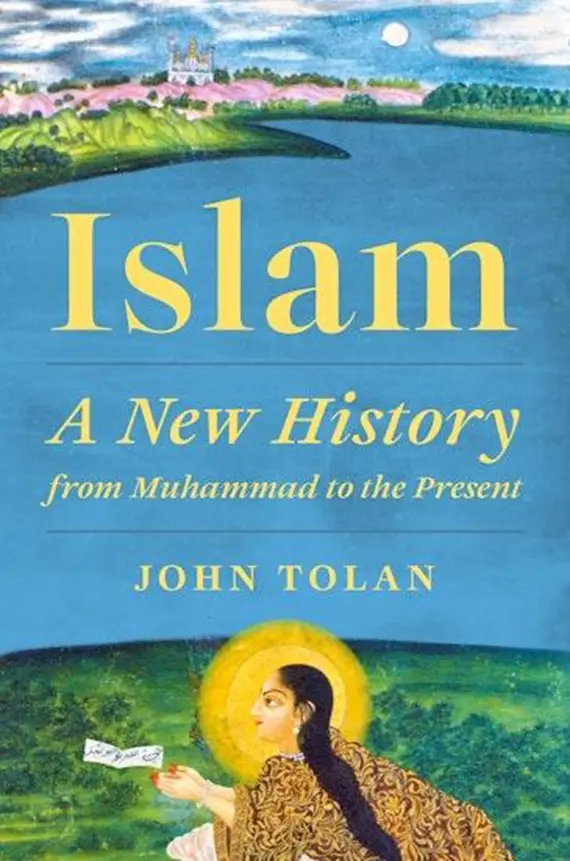
In Islam: A New History, Tolan, as a well-established academic historian, claims to offer “a new history of Islam” by taking a step back and looking at the history of Islam “in all its richness and complexity” over fifteen centuries to “transform the way we see Islam and its history” (p. xv). Though Tolan is “not a Muslim, much less a theologian” but a “historian” (p. xiv, cf. p. 250), he claims to have written “a new history of Islam” because “scholarship on the beginning of Islam has progressed in important ways over the past thirty or forty years, and this recent work is little known beyond a narrow group of specialists” (p. xv; italics mine).
Structure of Tolan’s Book
Originally published in French in 2022 as Nouvelle historie de L’islam, the English version “is not simply a translation of the French edition but a rewriting and expansion” (p. xi). Organised thematically, the book consists of ten (10) chapters covered under three main thematically organised parts: Part I, Foundations (Chapters 1-4), Part II, Expansion (Chapters 5-7), and Part III, Modernities (Chapters 8-10). In Part-I, it includes chapters on (1) The Quran and the Birth of a Community of Believers; (2) The Umayyad Dynasty and the Birth of an Imperial Religion; (3) Abbasid Baghdad: Crucible of a Multiconfessional Civilisation; and (4) The Three Caliphates of the Year 1000 [CE]. Part-II includes chapters on (5) Invasions and Reconfigurations of the Muslim World (11th-13th Centuries); (6) The World of Ibn Battuta; and (7) Muslim Empires (14th-17th Centuries); and Part-III covers the discussions and themes of the modern period: (8) Colonization and Its Discontents, 1789-1918; (9) Decolonization, Nationalism, and the Emergence of Political Islam, in the 20th Century; and (10) Between Reform and Radicalism: Being Muslim in the 21st Century.
These chapters are preceded by Acknowledgements (p. xi) and a 5-page Introduction (pp. xiii-xvii) and end with Notes (pp. 251-258), (chapter-wise) Selected Bibliography (pp. 259-264), and a rich Index (pp. 265-283).
Islam as Religion, Culture, and Civilisation
In the Introduction, Tolan begins by asking: What is Islam?—a ‘strange question since we all think we know its answer” (p. xiii), and answers it as:
Islam is a religion, with its sacred text, the Quran, revealed to the Prophet Muhammad [pbuh]. From this revelation, and from the words and acts of the prophet (collected in the hadiths, or prophetic traditions), comes a religion with its doctrines, rituals, law (sharia), and beliefs…. Islam is a religion characterised by a great diversity of beliefs and practices, a religion that has spread across an enormous territory and encompassed hundreds of languages and cultures. Islam is also a culture and a civilisation. […] Indeed, it is often difficult to distinguish between religion on the one hand and culture and civilisation on the other, so closely are they intertwined in Muslim history.” (pp. xiii-xiv)
Not a Conventional Chronological Narrative, but a Thematic Analysis of Diverse Aspects of Islamic History
The book is not a conventional, chronological narrative of Islamic history, from past to present, but a thematic history and analysis of some major events and aspects—social, political, religious, intellectual, etc.—of fifteen centuries of Islamic history, starting from 7th century Arabia and extending “across all the continents”, illustrating “the complexity and diversity of Muslim civilization” through chosen examples from the history of Islam and Muslims (p. xv). This also becomes evident from the chapter titles.
The Qur’an and the Prophet: The Message and the Messenger
In Chapter 1, “The Quran and the Birth of a Community of Believers” (pp. 3-22), Tolan analyses the major aspects of the Prophetic era, both in Makkah and Madina, by opening with the event when the Prophet received the first revelation in 610 CE. While narrating the history of the Prophet, Tolan considers the Quran as the “only document from the first century of Islam and the best source for understanding the life of Muhammad [pbuh] and his companions in Mecca and Medina”. He thinks that Hadith and the classical Sirah works, such as Ibn Ishaq/ Ibn Hisham, are the “other principal source[s] for the life of the Prophet”, which “preserve narrative elements” that correspond to the era of the Prophet (pbuh), while “other elements were clearly added later” (p. 7). Thus, in writing the biographies of great religious figures, including the biography of the Prophet, Tolan argues, “it is difficult, often impossible, to separate historical facts from pious legends, biography from hagiography” (p. 5).
Repeating the phrases like “the Muslim tradition says”/ “according to the Muslim tradition”, Tolan, in the section “Quran and Hadiths”, for example, says: “The Quran … consists of a series of revelations that, according to Muslim tradition, Muhammad [pbuh] received and transmitted to those around him over a period of twenty-two years” (610-632 CE), and further states that it consists of “6,236 verses (ayat) divided into 114 suras varying in length from 3 to 286 verses” (pp. 7, 8). Similarly, in a section on “The Coalition of Medina”, Tolan argues that in Medina, unlike the Makkan period, “Muhammad [pbuh] was a spiritual leader as well as political and military commander.” (p. 16)
Socio-Religious, Political, and Intellectual Developments from the “First (four) Caliphs” to the era of “Three Caliphates”
In the next three chapters, 2-4, of Part-1, Tolan narrates the major events, thematically, of the Pious Caliphate era (pp. 23-29) and the “Establishment of Umayyad Dominion” (pp. 29-33) in chapter 2, which gave birth to an “Imperial Religion” (p. 23); the Abbasids, as the “Crucible of a Multiconfessional Civilization” (pp. 48-71) in chapter 3; and then discusses the “Three Caliphates of the Year 1000 [CE]” (pp. 72-93) in chapter 4, referring to the Abbasids of Baghdad, “The Fatimids: The Rise of a Shia Caliphate” in Egypt (pp. 74-80), and “The Umayyads of Cordoba”, Spain (pp. 80-86). He also discusses topics like “Dhimmis”: “non-Muslims benefitting from a protected status” under the Muslim rule (pp. 41-43) and “Theology of Jihad”: which often refers to “effort in God’s path” and sometimes to “war” (pp. 43-45) in chapter 3 and the emergence of Sufism (pp. 69-71) in chapter 4, with a focus on the spirituality of Rabia al-Adawiyya of Basra (d. 810), “one of the emblematic figures at the begbeginnings Sufism” who is “venerated as a founding figure in the Muslim mysticism” and is “lauded by great Sufi masters” (p. 70).
With respect to the cultural and intellectual developments of Baghdad, Tolan says that “Baghdad remained a major cultural and intellectual centre” (p. 63), which helped not only in the “intellectual flourishing” in the areas of physical sciences, medicine, technology, and social sciences, but also in the development of religious sciences, like Muslim law and juristic schools, theology, tafsir, and “sciences of hadith” and much more (pp. 64, 65, 66, 67).
With reference to the development of medicine, medical theories and practices, Tolan writes: “many Arab authors brought complementary elements in medical theory, clinical practice, and pharmacopoeia…. Between roughly 800 and 1400, about a thousand treatises on medicine were written in Arabic. We thus see the emergence in the middle of the ninth century, on the theoretical and practical levels, of Arab medicine, a fusion of diverse traditions” (p. 64).
Regarding the three rival caliphates of Abbasids (with their capital at Baghdad), Fatimids of Egypt (with Cairo as their seat of power), and Umayyads of Cordoba, Spain, Tolan states: “The Fatimid Caliphate emerged in Ifriqiya (Tunisia) in 909 and conquered Egypt in 969, founding Cairo as its new capital. In 929, Abd al-Rahman III, descendant of the Umayyad caliphs of Damascus, proclaimed himself caliph in Cordoba. Hence, in the tenth and eleventh centuries, there were rival claimants to the title of Caliph in Baghdad, Cairo, and Cordoba. Since then, the Muslim world has been politically fragmented, yet these divisions did not prevent the constant movement of people, goods, and ideas” (pp. 72, 74).
11th-17th Centuries
In part-II, Expansion, Tolan’s book covers a period of around seven (7) centuries, from the 11th to the 17th centuries, in chapters 5-7, which respectively discuss the period of the “Invasions and Reconfigurations of the Muslim World” from 11th to 13th centuries (chapter 5, pp. 97-115), “The World of Ibn Battuta” in the 14th century (chapter 6, pp. 116-139), and “Muslim Empires” of 14th to 17th centuries in chapter 7 (pp. 140-164)—including the Ottoman Empire, which specifically highlights the contribution of Sultan Suleiman, the magnificent, and his successors (pp. 142-153), “Sultanates of India and Indonesia” like Mughal Empire, Sultanate of Aceh, etc. (pp. 153-160), and rulering dynasties of the “West Africa” (pp. 160-164).
He contextualizes this period with the developments and religio-political and intellectual diversity—in fact “tremendous diversity”—of the Muslim world, a diversity that “grew in the following centuries” as seen in the form of “the arrival of invaders from the north: Turks, ‘Franks’ (European Christians who arrived during the crusades), and Mongols”, producing “tremendous upheaval at the centre of Muslim world” (p. 97).
With respect to the developments taking place in 14th century, a period when “the world of Islam stretched from Morocco to Sumatra and from Mali to the banks of Volga” (p. 116)—a “fascinating testimony” of which is provided by the Moroccan traveler, Ibn Battuta, who traveled, among others, from the “Tangiers to Mecca and Baghdad”, the hub and heart of the then Muslim world (pp. 119-124) and from “Africa to China” (pp. 124-131) to Mali (pp. 131-133). For Tolan, when one reads Ibn Battuta’s travelogue, Rihla, one discovers “varying facets of Ibn Battuta: pilgrim, worldly traveler, Sunni Muslim meeting men and women of various religions” (p. 134), and thus summarizes aptly his travels and contribution under the heading “Ibn Battuta, Pilgrim, Scholar, and Muslim Confronts Religious Diversity” (pp. 134-139). Tolan, thus, uses this “unique testimony to paint a portrait of the Muslim world in the mid-fourteenth century in all its richness and diversity” (p. 117).
In this part, he also discusses topics like “The Crusades and the Arrival of ‘Franks’ in the Muslim World” (pp. 101-105), “The Reconquista and the Place of Subjugated Muslims in Christian Spain” (pp. 108-109), and “Counter-Crusades and the Rise of Saladin” (pp. 109-111) in chapter 5, and “Suleiman the Magnificent” (pp. 149-153) and Mughal Emperor Akbar’s Din-i-Ilahi (pp. 154-155) in chapter 7.
Islam and Muslims vis-à-vis Modernity and Modern Challenges: From Colonialism, Nationalism, and Reformism to Radicalism and Liberalism
In Part-III, Modernities, chapters 8-10 cover the period of 18th to 21st centuries and focuses on the legacy of colonialism, modern decolonization, and its impact on Islam throughout the world: chapter 8, “Colonization and Its Discontents, 1789-1918” (pp. 167-196) covers topics like British India, the dismemberment of the Ottoman empire, Egypt from Bonaparte to Muhammad Ali, emergence of the Wahhabites, French conquest of Algeria, reforms and rivalries between Egypt and the Ottoman empire, Qajar Iran, Islam and statecraft in 19th century Africa, and Arab Cultural Renaissance (Nahda) in the 19th century. Similarly, in the 9th chapter, “Decolonization, Nationalism, and the Emergence of Political Islam in the Twentieth Century” (pp. 197-221), it discusses the themes and topics like “Wahhabites and Muslim brothers from Arabia to Egypt (1925-1949)” (pp. 200-204), “France and Its Empire: Secularism at Home, Sectarianism in the Colonies” (pp. 204-207), “Decolonization and Nationalism (1945-1967)” (pp. 207-216), and “The Emergence of Political Islam” (pp. 216-221).
The last chapter, “Between Reform and Radicalism: Being Muslim in the 21st Century” (pp. 222-250), consists of two main themes: the former examines “the challenges posed to Muslims by globalization and geopolitical crises” (p. 224; cf. pp. 224-233), followed by a discussion on “Reform and Debate in Islam” (pp. 233-250) which looks at “various forces for reform that demonstrate the great diversity and dynamism of Islam” in the 21st century (p. 224). Tolan’s major argument here is that while the 20th century saw “the emergence of new forms of political Islam; the twenty-first century has seen struggles between various visions of how to reconcile Islam and politics (p. 222). He further writes: “Between the mid-nineteenth century and the beginning of the twenty-first century, Muslims all over the world have been caught up in debates about their relationship between Islam and modernity. Should Muslims modernise Islam or, on the contrary, Islamize modernity?” (p. 233; italics mine).
To answer this question, Tolan highlights (among others) the works and thoughts of Gamal al-Banna (1920-2013), whom he describes as the one of the “sharpest critics of the cult of traditional Islam” (p. 236); Indonesian Harun Nasution (1919-1998), a Muslim intellectual who sought to “revive the spirit of rationalist theology” (p. 239); Muhammad Arkoun (1928-2010), a “prominent Muslim intellectual” of present times (p. 239); and “Muslim feminists” like Amina Wadud (p. 240). He also discusses “Muslim immigration to Western countries” (p. 242) and Islam in America/ Europe/ UK/ France, etc., arguing that “Islam in Western countries is diverse” (p. 249).
In this part, Tolan also discusses topics like “Emergence of the Wahhabites” (pp. 174-177), and “the Nahda, Arab Cultural Renaissance” (pp. 189-196) in chapter 8; “The Emergence of Political Islam” (pp. 216-221) in chapter 9; and the issue of “veil or headscarf” as a controversial topic (pp. 234-236), Black Americans, Nation of Islam (pp. 244 ff.), etc., in chapter 10.
Tolan’s Book in the Eyes of Reviewers’
Having crafted a relatively short history, Tolan’s book has been critically praised by the reviewers. Publishers Weekly has described it as a “vibrant and sweeping survey” with an “impressive geographic scope and fine-grained historical detail”, making it a “masterful portrait of Islam as a religion and culture”. Booklist described it as a “compelling case for diversity, tolerance, and pluralism within Islam”, and Kirkus Reviews praised it for being “Well researched and objective” and “a Wide-ranging, compact history of Islam.”
Similarly, in a review by Jon M. Sweeney published by Spirituality and Practice, it is described as “a helpful and insightful study” that provides “Islam’s history and politics, region by region”, and is “offered in a concise and readable way, with hope for the future.”
David Abulafia (Professor Emeritus of Mediterranean History at the University of Cambridge) in The Critic, praises Tolan’s book succinctly as “a handy, thoughtful and well-written introduction to a myriad of aspects of the history of the Islamic world”.
Tolan’s Book in Sum
In the introduction, Tolan mentions that he is writing “a new history of Islam”, but not as a Muslim or a theologian, but simply as a historian (p. xiv), and at the end of this book, he repeats it (and winds up) as: “I simply dare to hope that this little book on the history of Islam written by a historian who is not a Muslim will be able to give readers an idea of the great richness and diversity of Islam throughout fifteen centuries of history and on all continents” (p. 250; italics mine). He has narrated the history of Islam, from past to present, and wraps up by concluding as: “It will be up to Muslims from across the world … to write the next chapters in the history of Islam”, daring to hope that “the much-heralded clash of civilisations will not take place” (p. 250; italics mine).
Though one cannot agree with everything Tolan describes or narrates, or the ways he interprets historical events, one cannot disagree with his perceptive style, thematic arrangement, and embracing and wrapping up all such breadth, diversity, and complexity—socio-political, religious, cultural, and intellectual—so masterfully. Summing up fifteen centuries in just 250 pages is a challenge in itself, but Tolan has done a remarkable job by such an accomplishment, though it has its limitations and flaws, which he graciously admits in the very beginning: “This book is of course partial and incomplete: I have chosen a few examples to illustrate the complexity and diversity of Muslim civilization” (p. xv; italics mine).
In fact, a Muslim—and, by extension, an academic—can question the use of the word “new” in the title of this book, Islam: A New History, as it implicitly suggests that previous scholarship on Islamic history is either outdated or unauthentic, and thus revised, corrected, and authenticated by him. Moreover, by attempting to cover the entirety of Islamic history through selected examples and illustrations, Tolan may have “bitten off more than he, or anyone, can chew.”
Despite these potential limitations, and setting aside disagreements, Tolan’s Islam: A New History is a valuable resource for students and scholars–though Muslim readers, especially students, must approach this book with caution and careful consideration–offering comprehensive coverage, insightful narration, diverse perspectives, and rich annotations that shed light on the diversity and complexity of Islamic history.
(The writer is an Assistant Professor of Islamic Studies at the Government. Degree College Ganderbal, and author of multiple internationally acclaimed books on Islamic Intellectual Tradition, Islam and Modern Challenges, and Qur’anic Studies. Views are personal.)