by Suhail Farooq
The July 9 Bharat Bandh unites workers and farmers in a nationwide protest against labour reforms, privatisation, and economic exclusion, demanding dignity, justice, and meaningful democratic engagement beyond electoral politics.

“When workers and farmers speak in one voice, it’s not disruption—it’s democracy in motion.”
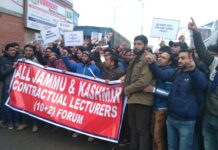
The Bharat Bandh called for July 9, 2025, is not just a shutdown—it is a showdown. At stake is not merely a day’s productivity, but the very meaning of democratic participation beyond the ballot. Called jointly by ten central trade unions and supported by hundreds of farmers’ and sectoral organisations, the bandh is the culmination of years of rising discontent, fractured trust, and deepening exclusion.
The grievances are neither sudden nor shallow. Over the past decade, workers and farmers have found themselves at the receiving end of sweeping policy changes that they argue have favoured corporate concentration while squeezing the backbone of the economy. The dilution of labour protections through the four new labour codes, the steady march of privatisation across public sector undertakings, disinvestment in critical industries like coal and steel, weakening of social security systems, and the government’s continued reluctance to guarantee Minimum Support Prices (MSP) for crops—each has left its mark. The result is job insecurity, stagnant wages, and mounting rural distress.
When ten major trade unions—from the Indian National Trade Union Congress (INTUC) to the Self-Employed Women’s Association (SEWA)—come together with farmers’ groups and transport workers, it is not merely organisational unity. It is an assertion that the margins have found a common centre.
This is not an impulsive protest. It is planned, deliberate, and growing out of lived economic desperation. The demand is not just for wages or MSP—it is for dignity. And dignity cannot be postponed, managed, or silenced.
Consider the sheer scale: more than 250 million people are expected to participate. That is not a fringe. That is a national voice. From the coal seams of Jharkhand to the agrarian belts of Punjab, from the railway yards of Bengal to the factories of Tamil Nadu, the call for justice echoes across sectors and states.
The government, meanwhile, has responded with warnings of economic losses, of inconvenience to the public. But to many, this sounds tone-deaf. When democratic engagement through policy dialogue is absent or symbolic, resistance moves beyond symbolism into action. “Democracy is not measured by voting days alone, but by listening in the days between.”
The media has responded unevenly. While some national television outlets have offered cautious or dismissive coverage, regional and digital platforms have shown the emotional and material weight of the protest. On social media, the bandh is not just trending—it is resonating.
This action is not a spontaneous street-level outburst. It is, in many ways, the logical outcome of a long silence from those in power. The bandh seeks not chaos, but correction. It is not a refusal to engage, but a demand to be engaged with.
When the government urges restraint and discipline, the workers and farmers point to a deeper truth: discipline without justice is coercion. Participation without recognition is performance.
As 9 July unfolds—with its halted trains, closed banks, silenced classrooms, and empty streets—the bigger question emerges: Who is India’s economic growth serving? Is it inclusive or is it selective? The Bharat Bandh forces us to consider whether the systems that power our nation have truly accounted for those who build, feed, and run it.
“This Bharat Bandh is not a breakdown of systems,” I believe. “It is the voice of those crushed under those very systems—now rising, now speaking, now demanding to be seen.”
In the end, the real test will not be in how many shutters are down, but in how many eyes are opened.
(The author is a Law Student, University of Kashmir. Ideas are personal.)