by Asad Mirza
The Makkah Pact brings Saudi Arabia, Türkiye and Pakistan together in a mutual-defence framework, while Russia urges India to remain patient as its implications unfold.
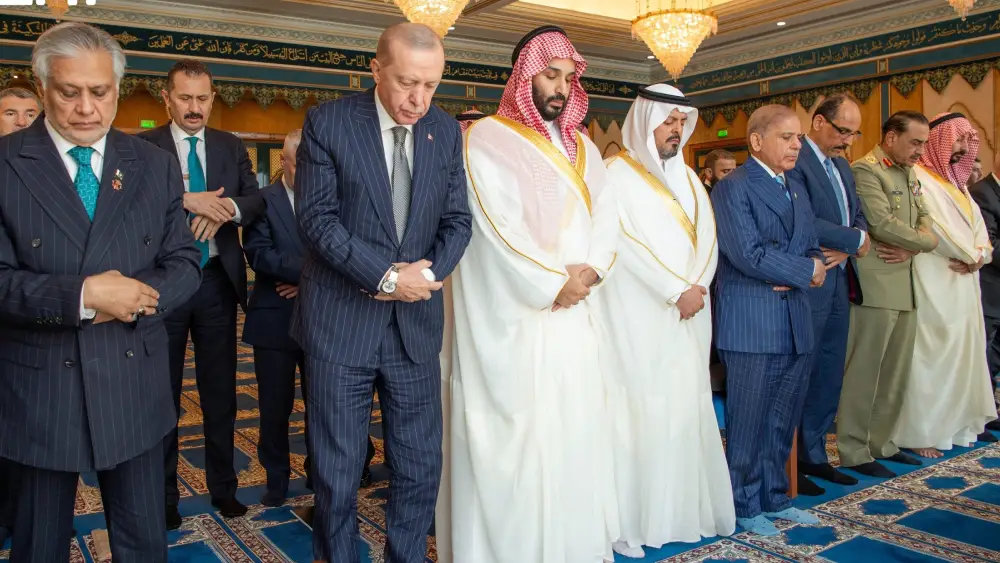
As world leaders converge on New Delhi for the 18th BRICS Summit, one geopolitical development is quietly shadowing the proceedings: the Makkah Joint Defence Agreement, the trilateral security pact signed by Saudi Arabia, Türkiye and Pakistan on August 7, 2026. With speculation swirling about which countries might join next – and what it means for India – the Kremlin has weighed in with a message of caution: don’t read too much into it yet.
Speaking to Indian media in New Delhi on September 8, Kremlin press secretary Dmitry Peskov addressed the Makkah Pact directly, describing it as a potential “key pillar of regional stability” rather than a cause for alarm. His remarks, delivered virtually at an event organised by Sputnik just days before President Vladimir Putin’s arrival in India, sought to temper anxieties in New Delhi about a security architecture that includes Pakistan, one of India’s principal strategic rivals.
Peskov’s Message: “Be Patient”
Peskov noted that Russian Foreign Minister Sergey Lavrov had already signalled that Iran could potentially be drawn into the pact as the security situation in West Asia continues to shift. “We hope that the (Makkah) pact will be another pillar of regional stability. If it is a real contribution for regional security, we would welcome the participation of important regional players, including Iran, in the process,” Peskov said. “It is new and yet to be developed. There have been no statements on the regional situation. Let’s be patient.”, he advised India.
The comments matter because they come from Moscow – a country with deep, decades-old defence ties to India, but also a growing partnership with Pakistan and long-standing links with Türkiye. Russia’s studied neutrality reflects the delicate balancing act many powers are now performing around this emerging bloc: neither endorsing it as an anti-India construct nor dismissing its long-term significance.
Makkah Pact
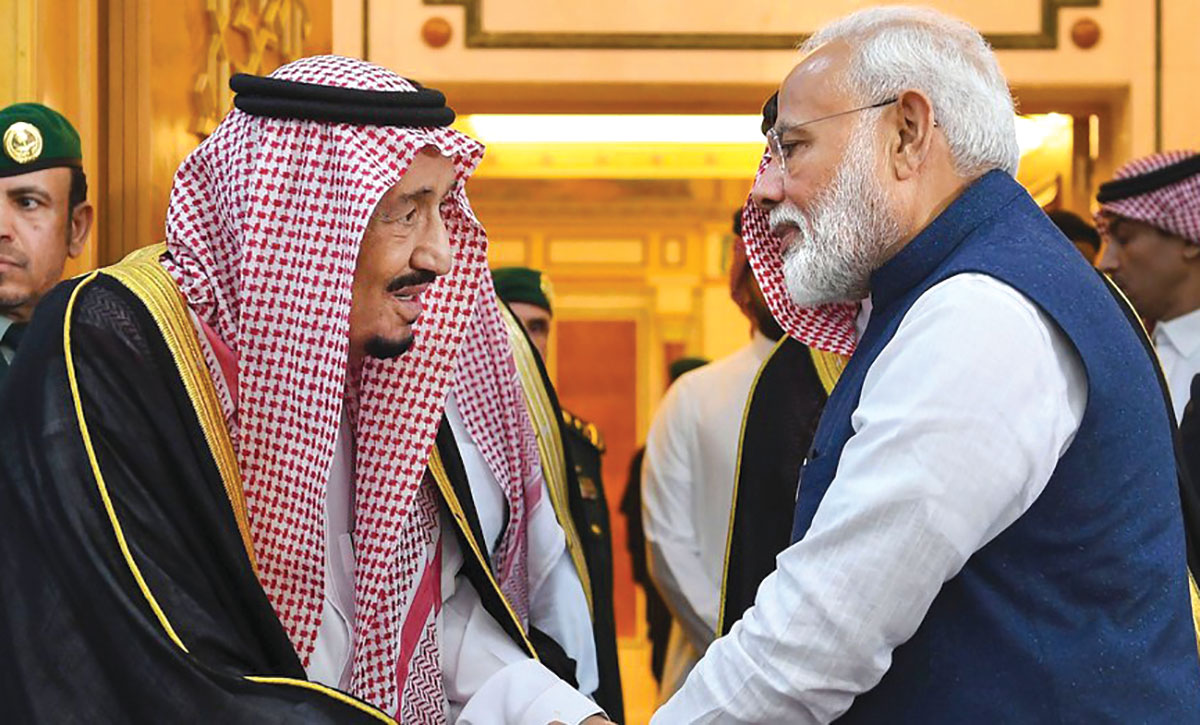
The agreement, signed in the Saudi city of Makkah by Crown Prince Mohammed bin Salman, Turkish President Recep Tayyip Erdogan and Pakistani Prime Minister Shehbaz Sharif, establishes a mutual-defence clause modelled explicitly on Article 5 of the NATO charter: an attack on one signatory is to be treated as an attack on all three.
The pact builds on the bilateral Saudi-Pakistan Strategic Mutual Defence Agreement signed a year earlier in Riyadh, and arrived amid a turbulent regional backdrop – the 2026 Iran war, Israeli strikes reaching deep into Syrian territory, and a Houthi drone attack that struck a Saudi Aramco facility within 48 hours of the pact’s signing.
A deeper analysis could describe the division of labour within the bloc as complementary: Saudi Arabia brings capital and geographic weight; Türkiye contributes an advanced defence-industrial base spanning drones, missiles and naval systems; and Pakistan supplies manpower and, crucially, the only nuclear arsenal in the Muslim world – though experts caution that Islamabad’s nuclear umbrella is unlikely to formally extend to its new partners.
Since the signing, officials from the three countries have met in Istanbul to institutionalise the arrangement, establishing a secretariat in Riyadh and beginning work on a Strategic Political and Defence Committee to convert the political declaration into operational reality.
Who Else Might Join
The pact’s architects have made no secret of their ambition to expand it. Turkish Foreign Minister Hakan Fidan has said the alliance should not “remain limited to three countries,” describing Egypt as a “natural partner” expected to formally join once unspecified “technical issues” are resolved – though Cairo’s own peace treaty with Israel and its relationship with the UAE make its calculus more complicated than Ankara suggests.
More strikingly, reports citing a senior Iranian official have suggested Tehran itself was invited to join, a development that – if confirmed – would fundamentally alter the character of a grouping built by three states with historically close security ties to Washington.
Iranian officials have cast any potential membership as vindication of Tehran’s long-standing calls for a regional security framework independent of outside powers. The informal acronym “STEP” (Saudi Arabia, Türkiye, Egypt, Pakistan) is already circulating among analysts describing what some have dubbed a “Muslim NATO”, which it couldn’t be due to various differences between the two alliances.
A Calculated Hedge
For Riyadh, the Makkah Pact is best understood not as a rupture with Washington but as an insurance policy. Saudi strategy, as described by multiple regional analysts, is one of “multi-alignment” or strategic hedging: maintaining the foundational US security relationship while simultaneously deepening ties with Türkiye and Pakistan, expanding cooperation with China, and pursuing quiet de-escalation with Iran.
The logic is straightforward – Gulf states have concluded that deep partnership with Washington, however extensive in dollar terms, does not guarantee protection when crises erupt, as the limited US response to strikes on Gulf and Saudi territory during the Iran war demonstrated.
Riyadh is not defecting from the American camp; it is building additional layers of security so that its fate does not rest on any single guarantor’s political calculations. Tellingly, when Houthi forces struck a Saudi Aramco refinery just two days after the pact was signed, Riyadh did not invoke its new mutual-defence clause, a signal, analysts say, of how much substance is still to be built into the framework Peskov described as “yet to be developed.”
The Modi-Putin Meeting
Against this backdrop, Putin arrives in New Delhi for a bilateral meeting with Prime Minister Narendra Modi on September 11, a day ahead of the BRICS summit. Peskov confirmed the agenda includes the proposed sale of Su-57 fifth-generation fighter jets, technology-transfer discussions, expansion of BrahMos missile production, new nuclear power projects building on the Kudankulam plant, and continued efforts to settle trade in national currencies – already accounting for roughly 90 per cent of India-Russia commerce.
Adding further weight to the summit is the expected presence of Chinese President Xi Jinping, in what would be his first visit to India in seven years, accompanied by a delegation of around 400 officials.
Xi’s attendance, following a recent border-de-escalation understanding and National Security Advisor Ajit Doval’s visit to Beijing, suggests a cautious thaw that both capitals hope to nurture without appearing to yield ground domestically.
The Shadow of Washington
Both threads – the Makkah Pact and BRICS itself – intersect with growing American unease. The Trump administration has repeatedly threatened BRICS members with tariffs of up to 100 per cent over any move toward “de-dollarisation” or a common currency, framing the bloc’s growing use of local-currency trade as an “anti-American” project.
Washington has also quietly welcomed the Makkah Pact’s Article 5-style framework, seeing in it echoes of past US-backed regional security initiatives, even as it watches with some concern how Gulf and South Asian partners are diversifying their strategic options beyond American guarantees.
As New Delhi hosts both Putin and likely, Xi, it finds itself navigating a rapidly reconfiguring order – one in which old alliances are being supplemented, if not replaced, by new and still-unformed architectures of power.
(The writer is a New Delhi-based senior commentator on national, international, defence and strategic affairs, environmental issues, an interfaith practitioner, and a media consultant. Ideas are personal.)