Government jobs in Jammu and Kashmir are shrinking as technology replaces manpower, with salaries rising modestly but pensions surging 251 per cent since 2016-17, reflecting an ageing workforce and limited recruitment, reports Masood Hussain
For decades, government employment in Jammu and Kashmir has served as the last refuge for job seekers in the absence of a strong private sector. The government job was not only a source of livelihood but also a guarantee of security, stability, and a defined post-retirement future. However, this long-standing equilibrium appears to be undergoing a fundamental shift.
Post-2019, as Jammu and Kashmir transitioned into a federally managed Union Territory, the government has slowed down the pace of recruitment and increasingly turned to technology-driven systems designed to “do more with less.” This shift is now beginning to show in the official numbers, where the salary bill is flattening, and even falling, while the pension bill is growing explosively.
The figures tell a story of two trends moving in opposite directions: a shrinking wage bill for serving employees and a ballooning cost of pensions for those who have retired. Together, they point to both a policy and demographic turning point in Jammu and Kashmir’s fiscal landscape.
Salaries: Expansion and Contraction
The salary expenditure of the government has gone through distinct phases over the past eight years. From Rs 15,122 crore in 2016-17, it climbed steadily to a peak of Rs 29,380 crore in 2023-24, an increase of nearly 94 per cent. This expansion was driven largely by the implementation of the Seventh Pay Commission recommendations, which gave a substantial one-time boost to government salaries across the board.
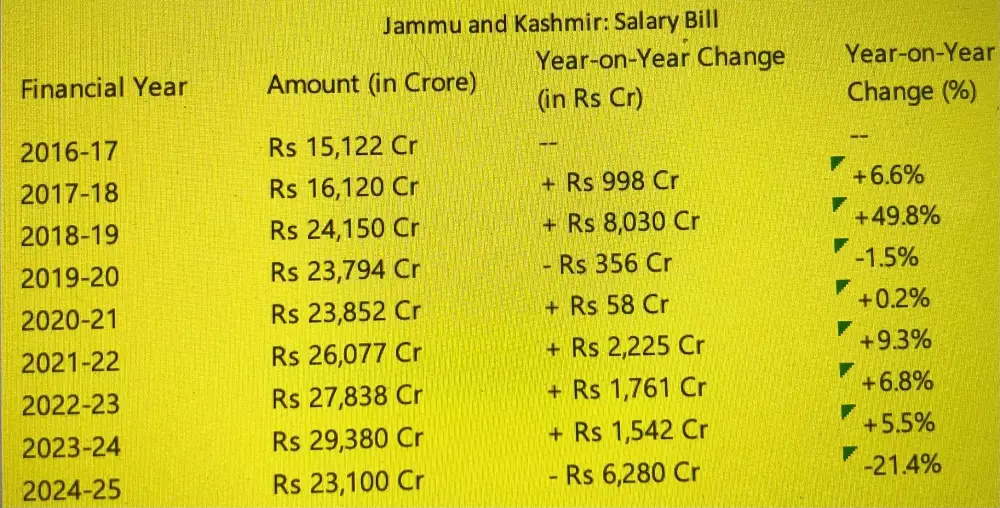
In 2018-19 alone, the wage bill jumped by Rs 8,030 crore, a staggering 49.8 per cent rise in a single year. This “step-change” transformed the government’s fiscal arithmetic. Over the next three years, salary expenditure remained stable around Rs 24,000 crore, reflecting a phase of consolidation. Since the Ministry of Home Affairs (MHA) took over the control of Jammu and Kashmir Police, the most populous department of the erstwhile Jammu and Kashmir state, it eventually took over its budgets as well. This reduced part of the burden on Jammu and Kashmir’s Consolidated Fund while taking away the power arm from the government, currently led by Omar Abdullah.
A renewed rise came between 2020-21 and 2022-23, when salaries increased from Rs 23,852 crore to Rs 27,838 crore. The growth, about 16.7 per cent over two years, was driven by annual increments and dearness allowance revisions. The year 2023-24 saw the highest salary expenditure ever recorded in the Union Territory’s accounts.
Then came the reversal. In the 2024-25 fiscal year, the government budgeted a drastic cut in salary expenditure, down by Rs 6,280 crore, or 21.4 per cent. The planned figure of Rs 23,100 crore takes salary spending back almost to pre-pandemic levels. Such a reduction is extremely rare in public finance and points to what many think is “a deliberate shift”.
Officials attribute this to multiple factors: a continuing freeze on large-scale recruitment, a policy of not filling vacancies created by retirements, and the growing use of IT-based systems to reduce human dependence in administration. The result is a visible flattening of the state’s active wage bill.
The Job Givers
The Jammu and Kashmir government has a set of agencies, which are mandated to recruit people against vacancies or new job creations. For gazetted positions, it is the Jammu and Kashmir Public Service Commission, and for all non-gazetted positions, it is the Jammu and Kashmir Service Selection Board. Jammu and Kashmir Bank, in which the Jammu and Kashmir government holds a majority shareholding, has its own separate recruitment system.

These agencies are seeking fees at the application level to take care of the examination and evaluation process. Between March 2016 and September 2020, the JKSSB collected a whopping Rs 77.09 crore from job applicants in the form of various fees. Of this, Rs 5.32 crore was collected in 2016, Rs 16.14 crore in 2017, Rs 27.77 crore in 2018, Rs 6.07 crore in 2019, and Rs 21.78 crore during the first nine months of 2020, a response to an RTI said.
In August 2025, the recruitment drive for just 75 posts of Naib Tehsildar turned into an unexpected windfall for the JKSSB, which collected more than Rs 6.43 crore in application fees. With each form priced at Rs 600 for the general category and Rs 500 for the reserved category, the figures indicate that over one lakh candidates had applied for the posts.
The JKPSC and JKSSB collectively filled 11526 vacancies – 2,175 by PSC and 9351by SSB in 2023 and 2024, according to information tabled by the government in the Assembly in March 2025. In government, an average of 10,000 people retire every year.
Pensions: Explosive Growth
In sharp contrast, the government’s pension expenditure has been galloping ahead. Between 2016-17 and 2024-25, the pension bill rose from Rs 4,216 crore to Rs 14,805 crore, an increase of Rs 10,589 crore, or 251 per cent.
While salary expenditure has grown by just over half during the same period, pensions have more than tripled. This difference in trajectory underlines a deeper structural challenge: the shrinking workforce is being replaced by a growing pool of retirees whose benefits are far more rigid and difficult to control.
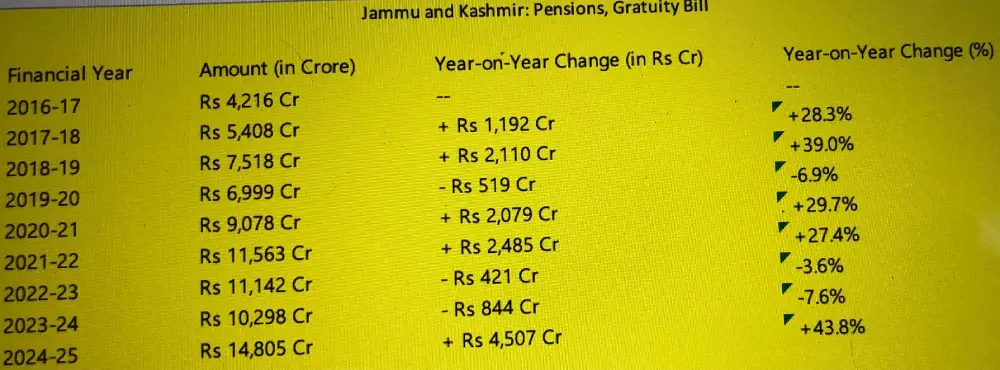
The data shows several distinct phases in this expansion. Between 2016-17 and 2018-19, pensions jumped by 78 per cent, driven by the same Seventh Pay Commission implementation that had inflated salaries.
Then came a brief correction between 2019-20 and 2020-21, before a major rebound that lifted the bill to Rs 9,078 crore. This surge likely reflected a large cohort of employees retiring around the same time, possibly those hired in the late 1990s reaching superannuation together.
The pension bill touched Rs 11,563 crore in 2021-22 before showing an unusual decline over the next two years. That dip, officials say, coincided with the introduction of the National Pension System (NPS), under which new employees hired after 2010 are no longer entitled to the old defined-benefit pension. Their pension contributions would be shared between the employee and the government and managed by pension fund regulators, slightly reducing the state’s direct burden, in the near future.
However, the brief pause was followed by an unprecedented spike in 2024-25. The latest budget projects pensions at Rs 14,805 crore, an increase of Rs 4,507 crore, or nearly 44 per cent, in a single year.
Officials suggest several possible explanations: the clearing of pending arrears, the settlement of gratuity liabilities, or a large retirement wave. But the underlying message is unmistakable: the government’s financial commitment to its retired employees is now growing faster, and more uncontrollably, than its spending on the serving ones.
The Fiscal Turning Point
A comparison of the two heads, salaries and pensions captures the emerging picture vividly. In 2016-17, pension expenditure was less than one-third of the salary bill. By 2024-25, it has grown to nearly two-thirds. In absolute terms, the gap between what the government spends on its active employees and what it spends on its retirees has narrowed from Rs 10,906 crore in 2016-17 to just Rs 8,295 crore in 2024-25, and that, after the salary cut.
For the first time in decades, pensions are growing faster than salaries, a signal that the government’s fiscal challenge has shifted from managing its current workforce to managing its past commitments.
The simultaneous fall in salary spending and surge in pension liabilities also suggests an accelerating exit of older employees without corresponding fresh hiring. This may be partly by design, a natural attrition approach to reduce the wage burden, but it also hints at a demographic transition, where the government’s workforce is ageing faster than it is being replenished.
The Policy and Fiscal Implications
The implications of this dual trend are significant. For one, a shrinking salary bill could free up fiscal space in the short term, but the ballooning pension commitments threaten to consume that space quickly. With pensions being a legally binding and non-discretionary liability, the government’s fiscal manoeuvrability is narrowing.
Second, the rapid rise in pensions points to the long-term cost of the old defined-benefit system that Jammu and Kashmir continues to carry. Even though the NPS has been in place for over a decade, its effect on reducing liabilities will take years to become visible, given the still-dominant cohort of pre-NPS retirees.
Finally, this trend reflects a broader administrative transformation. As the government increasingly digitises services and automates processes, the traditional model of employment-heavy governance is giving way to leaner structures. The fiscal outcome, falling salary outlays and soaring pensions, is a direct manifestation of that transition.
In the years ahead, Jammu and Kashmir’s public finance managers will face a delicate balancing act: keeping the administrative machinery functional while ensuring that the pension commitments do not overwhelm the budget. The current data suggests that while the government may have begun tightening its wage bill, the real fiscal test lies in managing the cost of those who have already served.