Masood Hussain analyses the maiden budget proposals for Jammu and Kashmir by Chief Minister, Omar Abdullah who emerged as the first of the three-generation Sheikhs to wear the hat of a finance minister of an erstwhile state that is now a Union Territory
“A little more than 7 years ago, tongue firmly in cheek, I was imitating the ritual of the Finance Ministers holding up their briefcases as they enter assemblies & parliament to deliver the budget,” Omar Abdullah, Jammu Kashmir’s Chief Minister wrote on X, on March 7, 2025, while holding a bag with his late friend Devinder Singh Rana. “Never in a million years, did I ever imagine I would be doing this for real.”
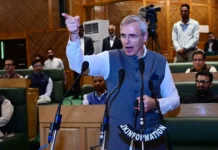
Minutes later, in a Shalwar Kameez and a blue coat with a colourful cap, Omar delivered his first speech as Union Territory’s finance minister. Reading out from his tab, Omar read it for more than 100 minutes amid frequent thumping by the treasury benches as the “people’s budget” was delivered. With this Omar emerged as the first of the Kashmir’s powerful Sheikhs’, who, by destiny was left with no option other than drafting and delivering the key policy document for Jammu and Kashmir’s public finance set up. In anticipation of the budget proposals, he did too many meetings with the stakeholders to pick up the pulse at the ground level and the meetings in itself became events. Barring a few groups, most of the people who met him were desperately trying to local their concerns in the budget.
Regardless of the contents Omar’s budget had, it was vital because for the first time after Dr Haseeb Drabu’s 2018 budget, a civilian government got an opportunity to look at public spending, its resources and the outcome. In between there were a series of interventions in the spending structure that were expected to be touched and too many trends were created to be halted. Some initiatives, taken by the LG government are doing fine on the ground and are required to be taken to the next level.
Positive Response
While the lawmakers have started going through the long speeches so that they can have their speeches in the House, the initial response has not been negative. It is being seen as a continuation rather than an intervention. The opposition thinks the budget document is a grand explanation of the centrally sponsored schemes and an endorsement of the various interventions that the federal government had through budgeting in the last more than five years. Some responses suspect Omar wishes to be popular and has resorted to freebies while ignoring the explosive unemployment crisis.
Dr Sunil Bhardwaj, BJP’s Ramnagar representative came to the assembly with Omar’s budget document and the last year’s budget that Nirmala Sitharaman read in the Lok Sabha. “Even the allocations are the same for many departments,” he shouted over the “visionless budget”, asserting, “What is the difference between the budget that bureaucrats drafted last year and a popular government presented this year?”
Omar’s detractors, a senior JKNC leader said, are not appreciating the larger reality that finance ministers in Jammu and Kashmir have historically a very small resource at hand preventing them from making grand interventions. The situation is slightly more complicated now as the federal government is a major and parallel power centre in Jammu Kashmir’s governance and would always have a bigger say, unlike in the past.
“I am not among the people who would say that the central government has not granted adequate resources,” Omar told reporters after presenting the budget. “We had adequate resources in the past and we will spend whatever is available.”
Populist Measures
Omar’s budget has a series of ‘welfare initiatives’ that are expected to touch a large mass base, mostly Antyodaya Anna Yojana (AAY) households. Some of these initiatives were part of the ambitious poll manifesto that fetched the party a landslide mandate.
Though the party had promised 200 units of free power to every family every month, the budget has finally announced that this facility will be available
for all AAY households in Jammu and Kashmir. The mechanism is that it will be integrated with the PM Suryaghar Bijli Yojana, which will facilitate the installation of grid-connected solar systems, ensuring energy security for the most vulnerable sections of society while eliminating electricity bills. The initiative would require Rs 750 crore over the next five years.
While the AAY households are drawing free rations, Omar announced that they will get an additional 10 kgs per month starting April 1, 2025. This initiative, he said will ensure enhanced nutritional support for vulnerable families.
“To further support women from economically weaker sections, I propose an enhancement of financial assistance under the Marriage Assistance Scheme from Rs 50,000 to Rs 75,000 for AAY category girls,” he said. “This increase aims to provide greater financial relief to underprivileged families.”
Omar Abdullah also announced a hike in the monthly pension for 10,07,324 individuals under the Integrated Social Assistance Scheme (ISSS) and the National Social Assistance Programme (NSAP). Now, the revised pension structure is Rs 1,250 per month for individuals below 60 years; Rs 1,500 per month for those aged between 60 and below 80 years and Rs 2,000 per month for those aged 80 years and above.
There were two initiatives that cover by and large almost all families across the erstwhile state. Under one initiative which is expected to touch almost half of the population, all women across Jammu and Kashmir, they will enjoy free ridership on government-owned public transport, including e-Buses, starting April 2025. The government has set aside Rs 50 crore for the initiative.
The other is widely hailed and was being discussed and talked about almost every time, tax structures were in debate. Under the tax system in vogue, the transfer of property by way of gifts within blood relations was invoking a stamp duty between three to seven per cent. Omar said this was discouraging formal registrations and triggering legal disputes over property transfers within families. He has done away with it and now property transfers within the families would not require any stamp duty.
Two Universities
Omar set aside Rs 50 crore for establishing a National Law University (NLU) to drive legal education reforms and research. This will offer world-class training aligned to contemporary standards empower future legal professionals and enhance justice delivery.
Besides, he proposed establishing the Jammu and Kashmir Skill and Entrepreneurship University (J&KSEU). This will provide cutting-edge training in technology, healthcare, tourism, renewable energy, and traditional crafts while fostering innovation, startup incubation, and industry partnerships. This institution, he reasoned, will bridge the gap between education and employment and reduce unemployment by creating a skilled workforce.
Besides, the budget suggested that Jammu and Kashmir’s BoPEE is being streamlined with a Pan-India seat allocation schedule and a digitised e-counselling module to ensure fair, merit-based admissions. The government will strengthen industry-academia collaboration through apprenticeships and internships, while CITaG at IIM Jammu will drive economic strategy and governance reforms with a Rs 5 crore allocation. With Jammu University attaining A++ status and the Islamic University of Science and Technology advancing in skill development, the government aims to create an industry-ready workforce.
Manufacturing Sector
Concerned that Jammu Kashmir loses Rs 135 crore every year as the wool rates have nosedived from Rs 100 to Rs 30, Omar suggested advanced wool processing technologies by the industry department. He also set aside Rs 100 crore for leather processing. For start-ups, he allocated Rs 50 crore to support financial aid, mentorship, and incubation for emerging entrepreneurs.The
MSME sector had sought the undoing of the GeM portal. Instead, he said the businesses within Jammu and Kashmir have gradually improved their supplies and reached Rs 1527 crore in the last fiscal, up by 165 per cent since 2021-22. Besides, he said the Jammu and Kashmir businesses have recorded Rs 4099 crore sales outside Jammu and Kashmir using the GeM portal.
But Omar announced the revival of the price preference for local manufacture, a 15 per cent advantage that had been rolled back earlier. This initiative, he said, will create a more level playing field, ensuring fair opportunities for Jammu and Kashmir businesses to grow and compete effectively. “We are simplifying processes, raising awareness, and providing support to help local traders benefit from GeM. Our focus is on making digital procurement an enabler, expanding opportunities, and ensuring sustained growth for J&K businesses,” he said.
Policy Shift
Omar’s maiden budget had long passages about the hospitality sector. Invoking various initiatives already in vogue, he talked about the new interventions that will take the sector to the next level. He deconstructed the 2.40 crore arrivals asserting that now visitors are being counted as per visits. A tourist who enters Srinagar is counted and once he goes to another place he is counted again. This, he explained to the media, is based on a new system that is in vogue across the country.
“To further strengthen the Tourism and Hospitality sector, I propose to constitute a multi-stakeholder Advisory Committee to address key issues and recommend policy measures,” Omar said, adding an ambitious idea. “Our goal is to increase tourism’s contribution to GSDP from 7 per cent to at least 15 per cent over the next 4 to 5 years.”
Asked if, as Chief Minister, he is willing to take costs for doubling the tourism income in an ecologically fragile place, Omar said his idea is not about mass tourism but high-end tourism.
The idea, however, is hugely ambitious given the fact that sectoral interplay in Jammu Kashmir’s economy is squeezing the primary and the secondary sectors. According to the Economic Survey 2025 that he tabled in the house on the eve of the budget presentation the primary sector makes barely 19.72 per cent of Gross Value Added (GVA), followed by 18.71 per cent by the manufacturing sector leaving an enormous 61.58 per cent to the surging services sector. Pushing hospitality to get double-contributor will take the services sector to a new status after squeezing the agriculture sector further. Jammu Kashmir’s agriculture sector is inherently getting non-remunerative owing to small land holdings and massive developmental and urbanisation pressures.
Omar’s budget comes at a time when Jammu and Kashmir’s status is fundamentally changed after it was demoted from a state into two Union Territories. While on one side the Finance Commission devolutions have been converted into grants from the Home Ministry, the MHA now manages the affairs of the Jammu and Kashmir Police. Omar said the police-related requirements were making up almost 11 per cent of the budget, which have now migrated to MHA.
Interestingly, he holds the portfolio of finance minister of Jammu and Kashmir at a time when he has the lowest number of people on his rolls – 2.34 lakh in the government departments, 25679 in the public sector, 12369 in aided institutions and 9302 in local bodies – a total of 281350. In 2024-25, according to the Fiscal Responsibility and Budget Management Act 2006, which is placed alongside the budget proposals, the staff required Rs 32183 crore for salary, a requirement anticipated to go down to Rs 28284 crore in 2025-26. The government has already admitted in the assembly that there are 32474 posts vacant and of them only 3727 posts have been referred to various recruiting agencies since October 16, 2024, when popular government came into being in this union territory.
Budget Size
Understanding Omar Abdullah’s maiden budget better requires understanding the entire income expenditure matrix. Jammu and Kashmir requires spending Rs 112310 crore in 2025-26.
Of this, the proposals suggest that Rs 58624 crore will come from the central government through MHA grants, Rs 21550 crore is Jammu Kashmir’s own tax collection, and Rs 10355 crore will be coming from non-tax resources. To manage things better, the government will create Additional Resource mobilisation (ARM) of Rs 7453 crore by asset monetisation. Still, Jammu and Kashmir would require Rs 14328 crore to raise as debt during the year. By the end of fiscal 2023-24, Jammu and Kashmir’s public debts stand at Rs 125205 crore, which is 51 per cent of its GSDP.
“I am sure that we do not raise more debts for our generations,” Omar said when asked about the surging public debt. “We are fortunate that this year our repayment liability is slightly lower.” He said that his government is strengthening debt sustainability by keeping all borrowings within approved limits and pursuing fair apportionment of J&K’s erstwhile public debt between the successor UTs. “We have also started contributing to RBI’s contingency funds—CSF for debt repayment during stress and GRF for sudden financial obligations.”

The expenditure budget is simple. The salaries head requires Rs 23894 crore, Rs 15300 will go to pension, Rs 848 crore will be required for asset maintenance and Rs 8603 crore to ‘others’ head. Power purchase is anticipated to take Rs 9000 crore.
While repayments of debt will be Rs 5669 crore, the government has to pay an interest payment of Rs 11518 crore. The government requires a sum of Rs 6205 crore for grant in aid and another Rs 4335 as its share to get the Central Sponsored Schemes funded in partnership.
This leaves an amount of Rs 17680 crore for pure developmental activity plus an additional Rs 8487 crore under CSSs.
Reactions
The House is on. There are people supportive of his ideas and opposition unhappy with the populist measures. BJP Balwant Mankotia said it is an interesting aggregation of centrally sponsored schemes in which more than 70 per cent of the population has not been taken care of. “What is there for the jobless in this budget,” he asked.
A ruling party lawmaker, talking in private, said the budget praises the NHPC in the proposals and does not even mention the JKSPDC. “The government took away power projects and gave it to NHPC and we are singing in its support,” he regretted. “We could have avoided that.”
While most of the Kashmir-based trade and industry bodies have supported the initiatives, some have voiced their anger over Omar’s failure to keep his promises. “Tell me what is exciting in this budget,” Sheikh Ashiq, a former Kashmir Chamber President now with Awami Itehad Party, told media in Srinagar. “After desperate attempts, we had made the government agree to reduce their taxes on fuels so that it helps commoners and tourism,” Ashiq said. “Now the government withdrew part of these tax concessions and it will soon hit us all.”

To fund its ARM, Omar rolled back the rebate on Petrol by Rs 1 per litre and on HSD by Rs 2 per litre besides increasing the tax rate on aviation turbine fuel to 5 per cent.
Treasury benches maintain that Omar’s budget proposals, an outcome of extensive interactions with diverse stakeholders in Kashmir and Jammu make the document a “people’s budget”. The debate is on as the show is still live.
Personally, Omar said he would ensure that if destiny pushes him to present a second budget, he would ideally prefer a non-fasting period. “It was suffocating for me to speak for such a long time,” he told media. “If I had to make it again, I assure you, it will not be in Ramzan.”