By October, the 16th Finance Commission is expected to submit its recommendations to the Government of India on how financial resources should be distributed among the constituents of the Indian federation. Yet, in a striking omission, the Commission has not visited Jammu and Kashmir, despite a clear mandate in the Reorganisation Act that specifically requires its inclusion, writes Masood Hussain
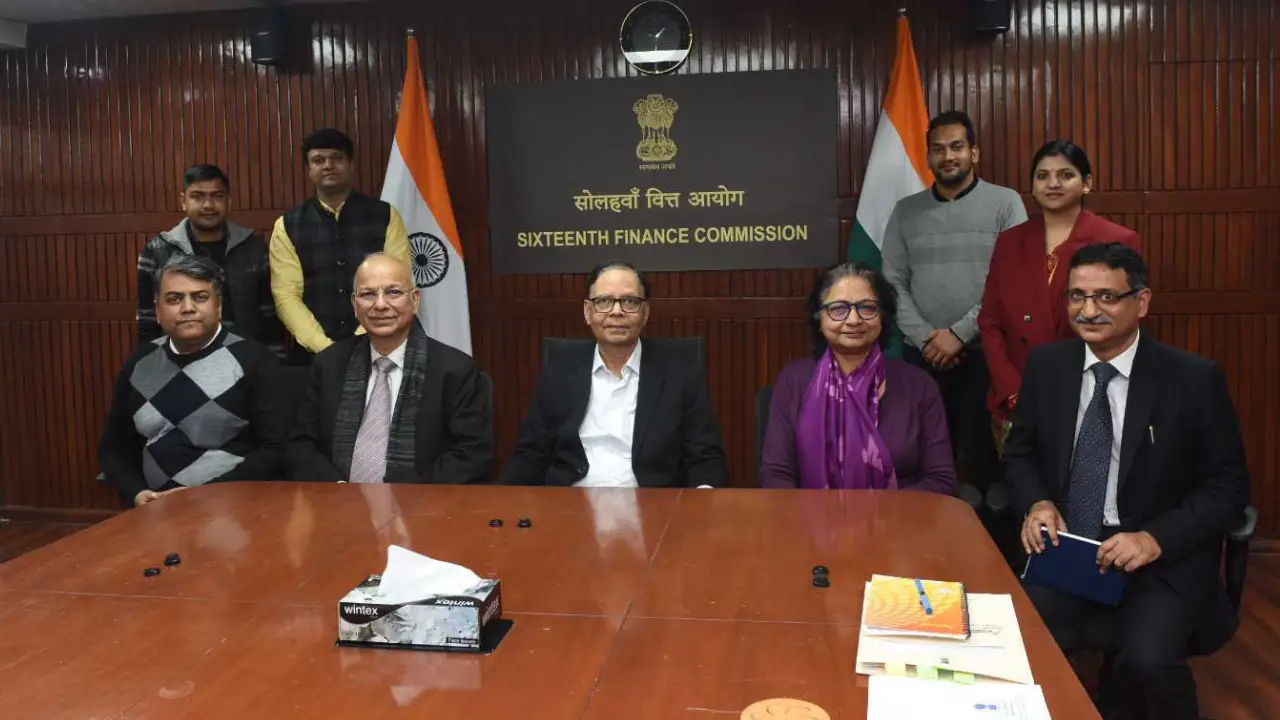
As the Dr Arvind Panagariya-led 16th Finance Commission prepares to submit its recommendations by October 2025, the rollout of which will commence from April 1, 2026, for the next five years, one region stands conspicuously unvisited and unheard: Jammu and Kashmir.
Constitutionally, the Finance Commission is neither required nor mandated to consider Union Territories. UTs are clubbed, rightly so, with the Centre. However, the case of Jammu and Kashmir, as always, is unique and complicated.
The Jammu and Kashmir Reorganisation Act of 2019, which made Jammu and Kashmir a UT, requires that it be treated as a state for the transfer of net tax proceeds. Section 83, sub-section 1 of the Act enjoins upon the Commission to take cognisance as a special case by providing that “the President (of India) shall refer to the Fifteenth Finance Commission to include Union territory of Jammu and Kashmir in its Terms of Reference and make award for the successor Union territory of Jammu and Kashmir”.
This omission so far on either side – the state government as well as the Union government — is not merely an administrative oversight; it raises constitutional, legal, and political questions that go to the heart of India’s federal structure. More importantly, it reveals the Union’s intent regarding the restoration of statehood.
The Legal Paradox
The Finance Commission, a constitutional body established under Article 280, is tasked with recommending the distribution of net tax proceeds between the Centre and the states. Union Territories, by default, do not qualify for these funds; their fiscal needs are met through grants-in-aid from the Ministry of Home Affairs. However, Jammu and Kashmir presents a legal anomaly.
Under Section 83(1) of the Jammu and Kashmir Reorganisation Act, 2019, the very legislation that bifurcated the erstwhile state into two UTs, the President of India was mandated to refer the Union Territory of Jammu and Kashmir to the Finance Commission, which is in sitting, and ensure it was awarded funds as if it were a state. This singular clause created a unique classification: a Union Territory to be treated fiscally as a state. It was a narrow yet pivotal legal wedge that hinted at a possible roadmap back to full statehood, not merely as a political assurance but as a constitutional pathway rooted in financial equivalence.

Broken Promise
Despite this clear directive, the 15th Finance Commission never visited Jammu and Kashmir. In its interim report for the financial year 2020–21, the Commission did earmark a one per cent share of the divisible tax pool for Jammu and Kashmir and Ladakh combined, but this was a limited gesture. No long-term award was made specifically for Jammu and Kashmir that matched the constitutional parity it was promised. Now, with the 16th Finance Commission in operation, the pattern continues. No formal engagement, no visit, and no indication of a differentiated treatment, even though the Act of Parliament remains in force.
This institutional apathy is not a bureaucratic technicality; it has real consequences. As per officials in the Rural Development Department, the lack of Finance Commission grants has adversely affected infrastructure planning and execution at the panchayat level. The Fifth Finance Commission for Union Territories did hold meetings in Srinagar in August 2024, but these deliberations were focused on local governance, not the larger fiscal position of the UT within the federal tax structure. The distinction is crucial: local development cannot be a substitute for constitutional recognition in national resource-sharing.
The Changes
The devolution of financial resources to Jammu and Kashmir has undergone a profound transformation, especially in the aftermath of its reorganisation in 2019. For decades, the erstwhile state enjoyed a unique fiscal relationship with the Union government, bolstered by its special status under Article 370. This status allowed it not only to operate under its own Public Finance Act but also to receive a disproportionately high share of central assistance in the form of grants, rather than loans. As a Special Category State, Jammu and Kashmir typically received 90 per cent of central assistance as grants, a reflection of both its political sensitivities and developmental deficits.
Successive Finance Commissions acknowledged this special status. From the 10th to the 14th Finance Commission, the Union extended special grants to Jammu and Kashmir, factoring in its vulnerability to conflict, natural disasters, and its underdeveloped infrastructure. The 14th Finance Commission, for instance, awarded Jammu and Kashmir a higher-than-average share in central taxes, 1.854 per cent, while simultaneously pushing the envelope on fiscal federalism by increasing the overall devolution to states from 32 to 42 per cent. This allowed Jammu and Kashmir to finance its ambitious development programmes with a degree of autonomy that set it apart from other Indian states.
However, the abrogation of Article 370 on August 5, 2019, marked a decisive break from this tradition. It fundamentally altered Jammu and Kashmir’s financial status. No longer a state, it lost its statutory share in the divisible pool of central taxes. Instead, it now receives financial assistance via grants directly controlled by the Ministry of Home Affairs, bringing it under the fiscal framework applicable to other Union Territories. Even before 2019, the region was fully integrated into the Goods and Services Tax (GST) regime, erasing the partial exemptions it once enjoyed.
In comparison, the shift from pre-2019 to post-2019 finance models reflects more than an administrative adjustment; it symbolises a deeper transformation of Jammu and Kashmir’s constitutional and political identity. Where once it had financial tools akin to those of a sovereign sub-unit, it now operates under a centrally managed system, with financial flows governed more by political discretion than federal equity.
The Federal Implication
The core issue lies in Article 270 of the Constitution, which allows only states to receive a share in the Centre’s tax revenue. However, as former Finance Minister Dr Haseeb Drabu pointed out, this is not an insurmountable hurdle. The GST Council, governed by Article 279A, already treats UTs with legislatures, like Jammu and Kashmir, Delhi, and Puducherry, as ‘states’ for tax collection and compensation. The same principle could easily extend to Finance Commission awards if the political will existed.
Moreover, courts have previously relied on Article 367 and Section 3(58) of the General Clauses Act to interpret ‘states’ contextually to include UTs. That means Jammu and Kashmir could, and arguably should, be seen as a state for financial purposes, especially given its elected legislature.
Political Stakes
The failure to press this constitutional claim is not just an indictment of the Finance Commission; it also reflects a missed opportunity by Jammu and Kashmir’s elected government. As Drabu noted, had the government pursued this matter vigorously, the narrative of fiscal equivalence could have strengthened the broader political demand for restoring full statehood. Instead, what should have been a strategic assertion of rights has been reduced to a silent compromise.
Political leaders across the spectrum have been critical. Before becoming the Speaker of the UT’s assembly, National Conference’s Rahim Rather, who has been six times Finance Minister, bemoaned the state’s failure to prepare a proper memorandum for the 15th Finance Commission, noting that earlier administrations used to engage rigorously with Finance Commissions. Senior Congress leader GN Monga echoed the sentiment, saying the present government was a “mute spectator” in a process that has potentially far-reaching consequences.
Erosion of Federalism
This silence has wider implications. If Jammu and Kashmir, a UT with a legislature and a unique legal mandate, is denied representation before the Finance Commission, what message does it send to other UTs like Delhi and Puducherry that have long sought fiscal parity? It threatens to convert cooperative federalism into coercive federalism, where constitutional rights are eclipsed by central discretion.
For now, the 16th Finance Commission continues its work, finalising allocations and formulas for state devolution without input from Jammu and Kashmir. Meanwhile, Rs 3,520 crore in Panchayat-level funding has been earmarked under central schemes for 2024–25, which may appear generous but comes without the dignity and certainty of constitutionally mandated devolution.
Post-2019, the Government of India has been transferring funds to Jammu and Kashmir as part of the Home Ministry grants. In the commentaries, it is being suggested that Jammu and Kashmir lacks a sound financial base and is literally surviving on the devolutions from the centre. Commoners take this impression home. Though the fact is that Finance Commission awards are as good as Jammu and Kashmir’s resources. It is part of the share from the central kitty to which Jammu and Kashmir, as a unit, is also contributing.
Interestingly, the bureaucracy in the Jammu and Kashmir administration is also keen that the Finance Commission visit the erstwhile state. They, however, are waiting for Chief Minister Omar Abdullah, who is also the finance minister, to bell the cat and send a formal letter to the Government of India seeking the implementation of the unambiguous mentions made in the reorganisation act.
Constitutional Clarity
At a time when Jammu and Kashmir’s political future remains a matter of national debate, its fiscal status is a litmus test for sincerity. Will it be treated as a UT with a beggar’s bowl or as a de facto state entitled to a fair share in the national pie?
The Finance Commission may be a constitutional body, but it does not exist in a political vacuum. Its silence on Jammu and Kashmir is not just procedural neglect but is being seen as a statement. Whether the government or the President acts to restore this balance in the final months before the report is due remains to be seen. But for Jammu and Kashmir, the wait is not just for funds, it is for recognition.