Once a spiritual centre built by Dara Shikoh, the 17th-century Malshahi Bagh Masjid now lies in ruin, abandoned by both its custodians, the Waqf Board and the archaeology department, reports Mir Rameez Raja
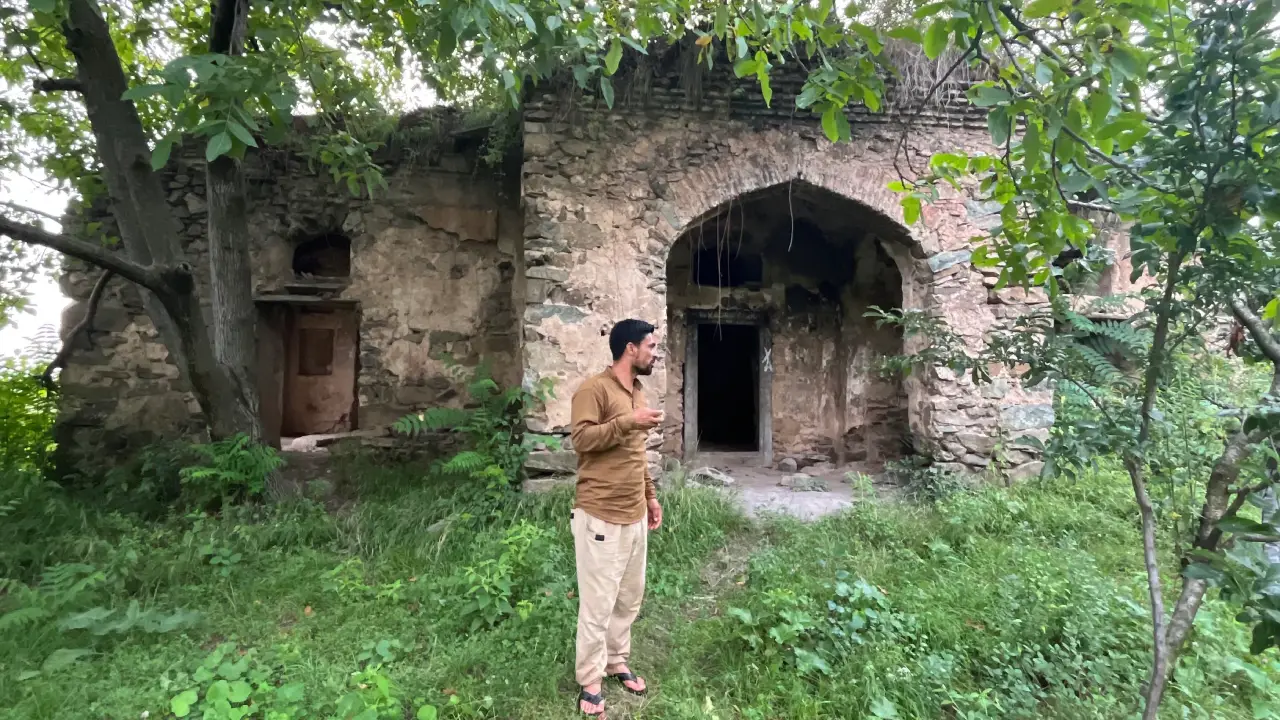
Situated in the middle of the twin idyllic villages of Malshahibagh and Beehama, surrounded by lush, green, fruit-laden trees, at an impressive yet accessible altitude, a centuries-old Mughal-era mosque lies in a state of disrepair in Ganderbal. Officially, it has custodians, but nobody seems to have taken care of the possession so far.
The tragedy of the monument is that it has two owners. For decades, the Muslim Waqf Board has owned the vast orchard in which the monument is located. In August 2021, the government gave it to the Archives, Archaeology and Museums for preservation along with 16 Kanals and 10 Marlas of land. The crisis is neither of the two has been sensitive towards the crumbling monument.
The Waqf has been harvesting the 360 kanals of orchard for decades, but nobody is spending a penny.
“Annually, the Waqf earns lakhs of rupees through this orchard, but fails to spend a single penny for Mosque reconstruction”, a resident, Altaf Ahmad, said. “Daily, we catch here dozens of youth resorting to socially unacceptable activities. They do not have any respect for the sacred nature of the space.”
Mughal Mosque
Built by Dara Shikoh, the eldest son of Mughal Emperor Shah Jahan, for his spiritual teacher Mullah Shah Badakshi, the mosque was a key piece of infrastructure for faith at one point in time. It was one of the best pieces of faith infrastructure in the area.
Legend has it that Dara Shikoh, the favourite son of Shah Jahan, sought to join the Qadriya order under the guidance of Mian Mir, the spiritual healer of Emperor Jahangir and a towering Sufi figure of the time. But by the time the prince resolved to meet him, the saint had passed away.
Grieving, Dara Shikoh travelled to Kashmir to seek solace from Mian Mir’s spiritual heir, Akhund Mullah Shah. The mystic had a profound impact on the young prince, inspiring him to commission three grand structures in his honour: the Pari Mahal overlooking Dal Lake, the Akhund Mullah Mosque at Koh-e-Maran, and a third, now lesser-known, mosque at Malshahi Bagh.
The Malshahi Bagh Masjid quickly became a centre of faith, drawing large congregations. The growing number of devotees led to the establishment of a nearby settlement at the base of the Dignibal mountains, a hamlet that owes its origins to the mosque’s spiritual draw.
While the other monuments built by Dara Shikoh have endured and continue to attract admiration, the Malshahi Masjid has suffered from neglect. Once a symbol of devotion and Mughal elegance, it now stands in ruins, overshadowed by time and indifference.
Gradual Fall
Built in rocks, clay and limestone, the mosque features a unique architectural style with arched terraces and a multi-storied hammam. Now it is in ruins. The structural damage includes collapse of the walls and the roof, and most of the entrances and the windows have seemingly been robbed. Most of the inscriptions and other artworks painted on the walls have been erased.
The structure’s lime plaster has peeled off the walls, and the ceiling has caved in. There lies a bathroom as well, which supplements the systemic destruction of the space.
The structure is partially obscured by overgrown vegetation, and nobody has even cleared it for decades. Some people dub it as Jinn Masjid, the mosque of the Djins.
The vagaries of weather added to its existential crisis. Its walls are stained with moss, and structural cracks are gradually growing wider with each passing day due to weather conditions.
Despite the damage, the mosque still retains the remnants of its erstwhile majestic nature. From a distance, it still looks like a work of art. The half-destroyed Mehrab offers the grand work that artisans put into this 17th-century structure.
Concerns
“We have brought this issue into notice of the administration several times, but they only give us fake promises,” Abdul Rasheed Wani, a Malshahibagh resident, said. “We do not know why they dilly-dally? It hurts our sentiments. We want them to start their reconstruction or give villagers full authority to do so.”
People see it as a historic monument as well as a space of faith. “This is not just a religious site but a monument of architectural and cultural history, and our village has been named after this mosque. If we do not act now, we are going to lose another chapter of our rich identity of our village”, said Mudasir Ahmad, a young man from nearby Beehama. “Modern day engineers will fail to build such a beautiful design that was built with only meagre resources several centuries ago. It deserves better than silence.”
Not Ours
Even though the monument is crumbling, nobody is even interested in intervening in its possible erasure. “This monument does not lie in our domain, it is the property of ASI (Archaeological Survey of India),” a Waqf Board official told in reporter, requesting anonymity because he lacks the authority to talk. “We only take care of the land that surrounds the monument. If ASI permits us, we will renovate the monument within days.”
The official regretted that the residents have been talking against the Board even after the Board made it clear to them that “we lack any right over it”.
Residents, however, assert that while the dual ownership of the space has created a situation akin to the Chief Minister-Lt Governor in Jammu and Kashmir, in which the monument is caving in.
“It could be a major tourist attraction if the government takes the initiative,” Amin Sofi, a Ganderbal resident, said. “If the government is not interested in restoring a d repairing it, let it permit heritage-loving groups to come up with a plan to restore the mosque through crowdfunding. It would not cost much to fix the mosque as it is made up of clay and stones.”