Houseboats, once a symbol of Kashmir’s floating heritage, are vanishing. Strangled by restrictions, rising costs, and a reducing number of skilled craftsmen, the industry teeters on the edge of extinction. As demand for shikaras grows, those who build them share their own set of fears, reports Ibtisam Fayaz Khan
In the heart of Dal Lake, Meena Bazaar is a rare floating marketplace where trade, tourism, and traditional craftsmanship converge. Located on a fleet of shikaras, it requires visitors to board a shikara itself, a wooden boat intrinsic to Kashmiri culture. As they glide across the lake, they pass fruit vendors, jewellery sellers, and the grand houseboats that line the water’s edge.
Beyond the bustling business on large watercraft, an older craft persists, sustaining both legacy and livelihood.
In four workshops scattered across the bazaar, skilled artisans labour to preserve the tradition of shikara-making. Despite mounting challenges, they ensure that these boats remain an enduring cultural symbol of Kashmir’s waterways. With plush, Mughal-inspired cushions and seating for up to six passengers, the shikara offers more than mere transport, it is an experience, seamlessly blending luxury with the raw beauty of nature.
Whether drifting along the Jhelum or Dal Lake, ferrying tourists through hidden corners of the waters, or serving as a floating marketplace for handcrafted wares, the shikara remains an emblem of Kashmiri craftsmanship and charm.
Generational Gift
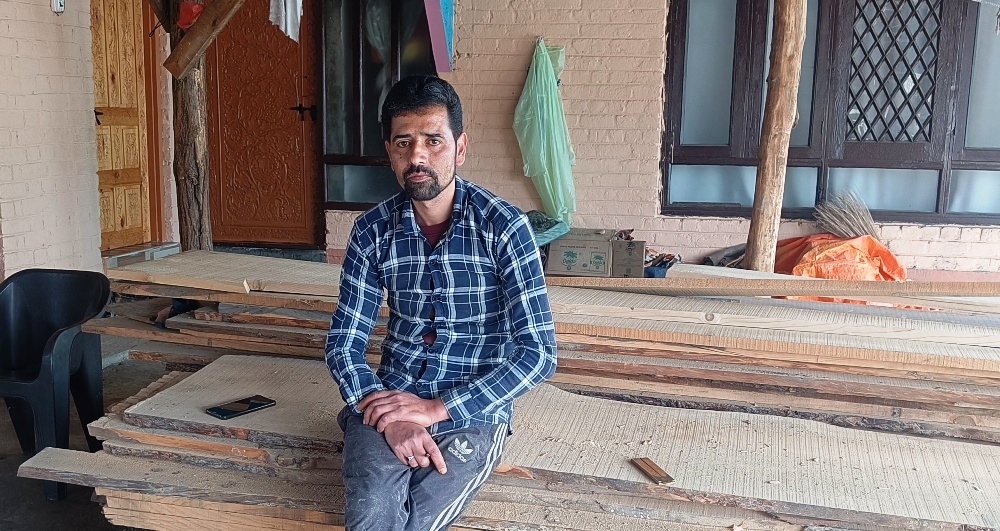
For the past two decades, shikara-making has been Nisar’s world. It is not merely a profession but an inheritance, passed down through generations. The boats are built from deodar wood, chosen for their resistance to water and durability. Sourced from Parimpora, the timber is carefully shaped into the base and sides of the vessel. Once assembled, the wood is treated and painted, giving the shikara its distinctive appearance.
“This is the season when demand peaks,” Nisar said. “As soon as we finish making a batch, they are sold. In a few days, we start again.” His work is not confined to a single location. He operates three workshops—one at Meena Bazar, another behind his home, and a third across the water. Different stages of production unfold across these spaces, ensuring a steady workflow.
However, this was not the case a few years ago.“Things were bleak for a long time,” Nisar recalled. “Boats sat unsold for months, gathering dust in workshops that had once buzzed with activity.”
A Revival
After a long hiatus of decline, an increased tourist activity has rekindled the craft and culture of shikaras. As demand soared, the artisans who had turned to other trades were gaining interest in returning to their craft. The vibrancy is being restored. “The tourists have returned, and with them, the demand for shikaras has revived,” Nisar said.
It takes Nisar a week to complete a single boat, a process requiring precision, patience and practice. “Every boat is different—each one has its balance, its finish,” he explains. Having left school after the ninth grade, he turned his workshop into a classroom. “My hands learned what books could not teach.”
Costly Custom
The cost of keeping the craft afloat is steep. Deodar wood, essential for building shikaras, sells for Rs 10,000 per cubic foot. In Nisar’s workshop, neatly stacked planks—carefully measured and set aside for future boats—represent an investment of nearly Rs 8 lakhs. A finished shikara sells for around Rs 3 lakhs, with labour charges adding another Rs 50,000.
“People admire the beauty of a shikara, but few understand the cost and effort behind it,” Nisar said, running his hand along the smooth wooden frame of an unfinished boat. “Every plank is carefully chosen, treated, and shaped to ensure it lasts for decades.”
Nisar employs a team of artisans, all trained in techniques passed down through generations. “It is not just about assembling wood; it is about balance, durability, and tradition,” he said. Two years ago, he was commissioned to build shikaras for Chandigarh’s Sukhna Lake, transporting deodar wood from Kashmir for the project. “They wanted authentic Kashmiri craftsmanship,” he recalled. “Even outside the Valley, our work has a signature that cannot be replicated.”
While the boats have evolved, their essence remains unchanged. “Just as cars have changed over the years, shikaras too need refinements,” Nisar explained. “The younger generation will not row the heavy, old models. It used to take three people to row one. Now, with a few design changes, a single person can manage it easily. The structure is lighter, the seating more comfortable, and the roof adds an element of convenience.”
Waning Waters
As the survival of shikara-making is tied to the fate of Dal Lake itself, Nisar has his fears. “Jab tak Da lhai, tab tak shikara rahega.” His voice carried the weight of generations that had relied on these waters. “As long as the lake exists, the shikara will endure. But if pollution remains unchecked, both will disappear.”
Over the years, Dal Lake has shrunk. Once spanning 22 sq km, it has been reduced to around 18 sq km. NASA’s 2023 satellite imagery revealed a 25 per cent decline in open water area between 1980 and 2018, driven by pollution, siltation, encroachments, and unchecked aquatic vegetation.
Once a lifeline for artisans, the lake now struggles under neglect. Nisar recalled the time when the lake’s waters were pristine, alive with movement. Now, he watches it shrink, sadly.
For artisans like Nisar, the lake is not just a backdrop but the foundation of their livelihood. “If Dal Lake fades away, so will we,” he said. “Our craft is tied to its waters—if it thrives, we thrive; if it suffers, we suffer.”
Motor and Mechanical
Intervention by the government to modernise water transport and introduce engine-powered boats has seen limited success. While these vessels offer speed and suitability, they disrupt the lake’s tranquillity, the very essence of its charm. Tourists, Nisar insists, prefer the quiet rhythm of a hand-rowed shikara, where the only sounds are the soft splash of the paddle and the distant calls of boat vendors. For many visitors, he said the experience is not just about reaching a destination but about immersing themselves in the unhurried pulse of the lake.
“A real traveller understands that the joy of the ride is in its stillness,” he said, “they do not want noise or haste; they want to feel the lake breathe.”
Many, he added, even requested that the boatman avoid using an engine, offering extra money for a slower, quieter ride “to see life unfold on the lake, without the hum of a motor breaking the silence.”
Recently, Uber, while combining technology, heritage, launched Asia’s first water transport service, Uber Shikarain Dal lake, to offer a seamless and modern way for tourists to experience the traditional ride.
Enduring Expertise
He recalled one of his most significant projects from 2001, when a client from Mumbai commissioned four custom boats. These were unlike traditional Kashmiri shikaras—each spanned 25 feet, fitted with three-seater sofas on both sides and a table in the centre. “It was one of my proudest works,” he said, a flicker of nostalgia crossing his face.
And so, the craft endures—rooted in history, shaped by necessity, and carried forward by those who refuse to let it fade. As long as Dal Lake exists, its shikaras will glide across its waters, and somewhere in the heart of the floating market, the sound of wood being carved and shaped will continue to echo.
History Etched in Waters
Kashmir’s history is inseparable from its waters. For centuries, Kashmir’s waterways were dominated by small boats rowed by three people and larger doongas, which doubled as floating homes. By the 16th century, Emperor Akbar commissioned the grand Takht-i-Rawans, river palaces inspired by Bengal’s zamindar houses. Thousands of these vessels were built, and their presence was immortalised in Mughal paintings. Chronicler Abu’l Fazl noted that Kashmir had over 30,000 boats, yet none suited the emperor until skilled artisans transformed them. Later, in 1655, Aurangzeb attempted to rival European navies by launching Italian-built warships in Kashmir, but the experiment failed.
Meanwhile, boats remained central to daily life. The swift shikara, the cargo-laden bahat, and the resilient tsatawar transported goods, people, and even news. Srinagar’s intricate water routes earned it the title of Venice of the East.
By the 19th century, Kashmir’s water transport adapted to tourism. Houseboats evolved from doongas and initially functioned as floating camps, adapting the native doonga design with added amenities—front lounges replaced walls, and wooden panels took the place of straw-matted windows.
British visitor MT Kennard is credited with introducing the first houseboat, Pamila(1883–88), and later constructing the two-storey Victory (1918). Swami Vivekananda’s visit in 1897–98 further highlighted Kashmir’s boat culture when he stayed on houseboats and famously worshipped his Muslim boatman’s daughter as the goddess Uma.
Historian Saleem Beg noted that boats in Kashmir historically served multiple functions beyond transportation, including housing, fishing, vegetable selling, and bulk transport of goods such as wood and rice. Waterways, particularly the Jhelum and Nala Mar, once formed the region’s primary transport arteries, carrying people and commerce across the Valley.
By the late 20th century, Kashmir’s boats became the face of its tourism industry. In 1978, the Clarion agency of Calcutta designed the Jammu and Kashmir tourism logo—a shikara silhouetted against the mountains—ushering in a new golden era.
Kinzoo’s Legacy
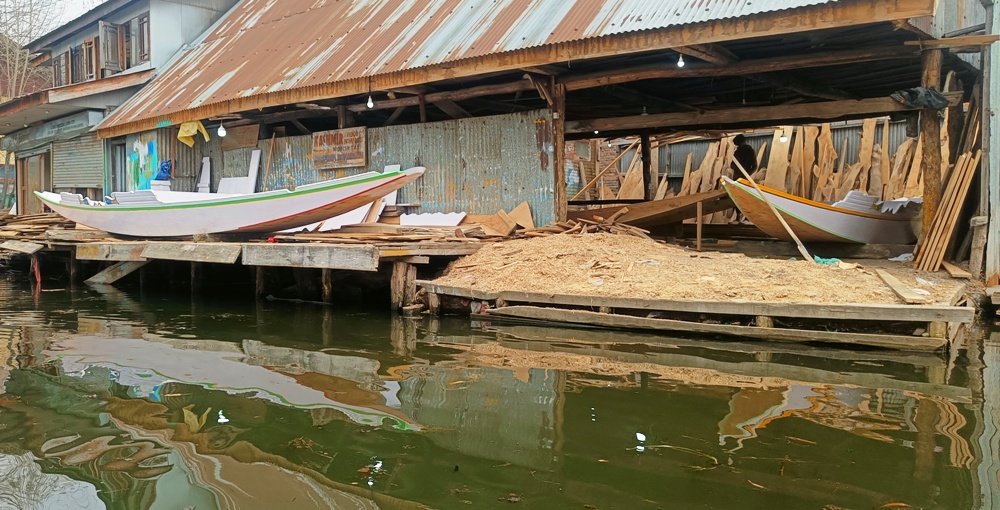
Beyond the bustling Meena Bazar, where vendors call out to passing tourists and floating shops brim with souvenirs, lies another workshop—quieter, but just as full of life. Here, the steady rhythm of hammering fills the air as planks of deodar wood take shape, the sound echoing across the still waters. The scent of sawdust mingles with the deep, earthy fragrance of hookah smoke, curling into the air as Ghulam Nabi Kinzoo exhales slowly. A chisel-worn pencil rests above his ear, the bubbling of the jajeer punctuating his words.
His workshop, tucked away at the water’s edge, has sent shikaras across India—from Mount Abu in Rajasthan to Purulia Lake in Bengal, where Mamata Banerjee herself inaugurated one, to Mansar Lake in Jammu, Delhi, and even Hotel Banjara in Hyderabad. Yet, despite his success, a hint of exhaustion lingers in his voice—the weight of years spent perfecting his craft, the strain of long hours, and the unrelenting demands of his work.
Determined to Drive
Kinzoo was not yet fifty, and his craft was not part of a centuries-old family lineage. It was his father who had ventured into shikara-making. Once a labourer, his father had worked under different karigars, learning as he went, until he stepped out on his own. He had no mentor, no guide—only his determination.
“This is my passion,” Kinzoo said, adjusting his hookah pipe. “I make sure my sons learn this craft, just as my father made me learn it. They will study, of course, but they must also carry this forward.”
For him, it was not just about building boats; it was about preserving a tradition that was slowly fading. “If my sons do not learn, then who will?” he asked, watching his workers smooth a freshly carved plank. He believed that heritage was best carried forward by those who grew up immersed in it, whose hands instinctively knew the weight of the tools, whose eyes could recognise the perfect curve of a well-shaped hull.
“A child raised in an environment learns what he sees,” he added, nodding towards his eldest son, who often lingered near the workshop, watching, absorbing, unknowingly inheriting the craft.
Ignored Inheritance
In the background, workers chiselled, sanded, and hammered, shaping wood into something that would glide across the water for decades. Each stroke of the chisel, each measured cut, was a testament to years of practice—skills passed down through generations, yet now in danger of being lost.
“A shikara, if taken care of, can last forty years. There are houseboats here that are over a century old,” said Kinzoo, visibly disturbed while talking about prospects.
The houseboats of Kashmir, once a defining symbol of Kashmir tourism and cultural heritage, had been steadily disappearing from its waters. At their peak in the 1970s, nearly 3,000 houseboats floated across Dal Lake, Nigeen Lake, and the Jhelum River. Today, only around 750 remain operational.
The decline began in 1982 when the Jammu and Kashmir government banned the registration of new houseboats, citing the need to protect the region’s fragile water bodies.
“This ban did not just stop new houseboats from coming up; it slowly strangled the ones that were already there,” Kinzoo said. “Even when repairs were finally allowed, the process became so tangled in red tape that many owners simply gave up. Waiting for approvals feels endless, with paperwork dragging on for months, sometimes even years.”
By 2010, another setback came: the Jammu and Kashmir High Court banned houseboat repairs due to pollution concerns. While new guidelines introduced in 2020 permitted limited repairs, Kinzoo said that the bureaucratic hurdles made restoration an exhausting process. “Multiple government clearances were required, causing delays that left many houseboats in disrepair.”
A Tradition in Decline
Environmental concerns have hastened the decline of Kashmir’s houseboats. Strict regulations aimed at curbing lake pollution have inadvertently accelerated their disappearance, while the dwindling number of skilled craftsmen threatens the survival of this centuries-old tradition. Once the Crown of Kashmir, houseboats now face an uncertain fate, caught between conservation efforts and conserving the craft.
The stakeholders allege that the government has largely turned a blind eye, leaving the legacy as a liability. Amid uncertainty, the existing craftsmanship is shrinking and younger generations are not interested, leaving workshops once filled with vibrancy eerily vacant.
“There will come a time when permissions will be granted again, money will flow, and people will want houseboats built again,” Kinzoo said. “But there will be no one left to make them.”
Kinzoo alleges that the government’s indifference stifled the craft itself. Despite official announcements, he said the schemes meant to revive traditional craftsmanship, the shikara industry received little attention. “The cost of materials continued to rise, skilled labour was dwindling, and there was no structured support to sustain the craft.”
Floating Future
The struggle was not just about making a living, it was about preserving craft for posterity. Learning the craft took time. “A year is not enough. Five years, at least, are needed to truly master it,” Kinzoo explained. It was not just about cutting and joining wood; it was about understanding the nature of deodar, how it bent, how it resisted, and how to make it last for decades. Those who grew up in the trade, surrounded by its sounds, its scents, its rhythms, were the ones best placed to carry it forward.
But with fewer young artisans entering the profession, the future of shikara-making remained uncertain, suspended between tradition and neglect.
However, as of now as orders kept pouring in, the work never stopped. The question of who would carry this legacy forward lingered, unanswered.
In between, the work continued. The wood was shaped, the hookah bubbled, and the deodar planks slowly took form. Their future rested in the hands of those who chose to carry the craft forward or let it disappear into history.