SRINAGAR: Rainfall is declining significantly at five of six meteorological stations across the Kashmir Valley, while Srinagar is witnessing an upward trend in annual rainfall, raising concerns over urban flood preparedness, according to a study analysing decades of precipitation data in the Jhelum River basin. The research identifies substantial variations in rainfall across seasons and locations, with declining spring rainfall emerging as a key concern for water availability, agriculture and regional livelihoods.

The study, Exploring Temporal Patterns of Rainfall: A Time Series Assessment of Variability, Trends, in the Kashmir Himalayan Ecosystem, finds statistically significant annual rainfall declines at Gulmarg, Pahalgam, Kupwara, Qazigund and Kokernag. Srinagar, in contrast, recorded a significant increase in annual rainfall, highlighting the need for location-specific climate adaptation and water management strategies. The paper was published in Discover Geoscience, a Springer Nature journal, in 2025.
The findings are based on statistical analysis of rainfall records from six meteorological stations in the Jhelum basin. The researchers caution, in effect, against treating Kashmir as a uniform climatic zone, as rainfall trends differ considerably across stations and seasons.
Station-wise Trends
The researchers, Princess Mahapara, Humaira Hamid and Sandeep Samantaray, all affiliated with the National Institute of Technology (NIT) Srinagar, examined rainfall patterns at Srinagar, Gulmarg, Pahalgam, Kupwara, Qazigund and Kokernag.
The study used rainfall data from the India Meteorological Department (IMD), under the Ministry of Earth Sciences, and applied statistical tests to identify long-term trends, their magnitude and possible shifts in rainfall patterns.
The paper’s abstract reports annual rainfall declines at five stations, with Sen’s slope values of −1.979 for Pahalgam, −6.744 for Kupwara, −5.174 for Qazigund, −11.058 for Gulmarg and −1.637 for Kokernag. Srinagar, meanwhile, is reported to have a significant positive annual trend.
However, the detailed station-wise Mann–Kendall results presented in the paper show a more nuanced picture: Gulmarg and Kupwara have statistically significant annual declines, while the annual trends for Pahalgam and Qazigund are not statistically significant in the reported table. This distinction is important when interpreting the overall findings.
Gulmarg recorded a significant annual decline, with a p-value of 0.025, while Kupwara’s annual decline had a p-value of 0.022. The researchers also found significant declines in March rainfall at several stations, underlining the importance of examining monthly and seasonal changes rather than relying solely on annual averages.
Srinagar’s Rainfall
Srinagar presents a contrasting pattern in the study, particularly during January, when rainfall showed a statistically significant increase. The Mann-Kendall test recorded a p-value of 0.014, a Z-value of 2.458 and Kendall’s tau of 0.258, indicating an upward trend.
The researchers say the finding has implications for flood preparedness in the Valley’s principal urban centre. They argue that the changing rainfall pattern should inform urban planning, drainage infrastructure and flood management.
The paper notes that rising rainfall in Srinagar could increase flood-related hazards, particularly during high-precipitation periods. It calls for improved urban drainage and flood-resistant infrastructure, alongside stronger preparedness in flood-prone communities.
The study does not, however, establish that Srinagar has experienced an increase in extreme rainfall events or that rainfall trends alone explain flooding. Its focus is on historical rainfall variability and trends, rather than a direct attribution of flood events.
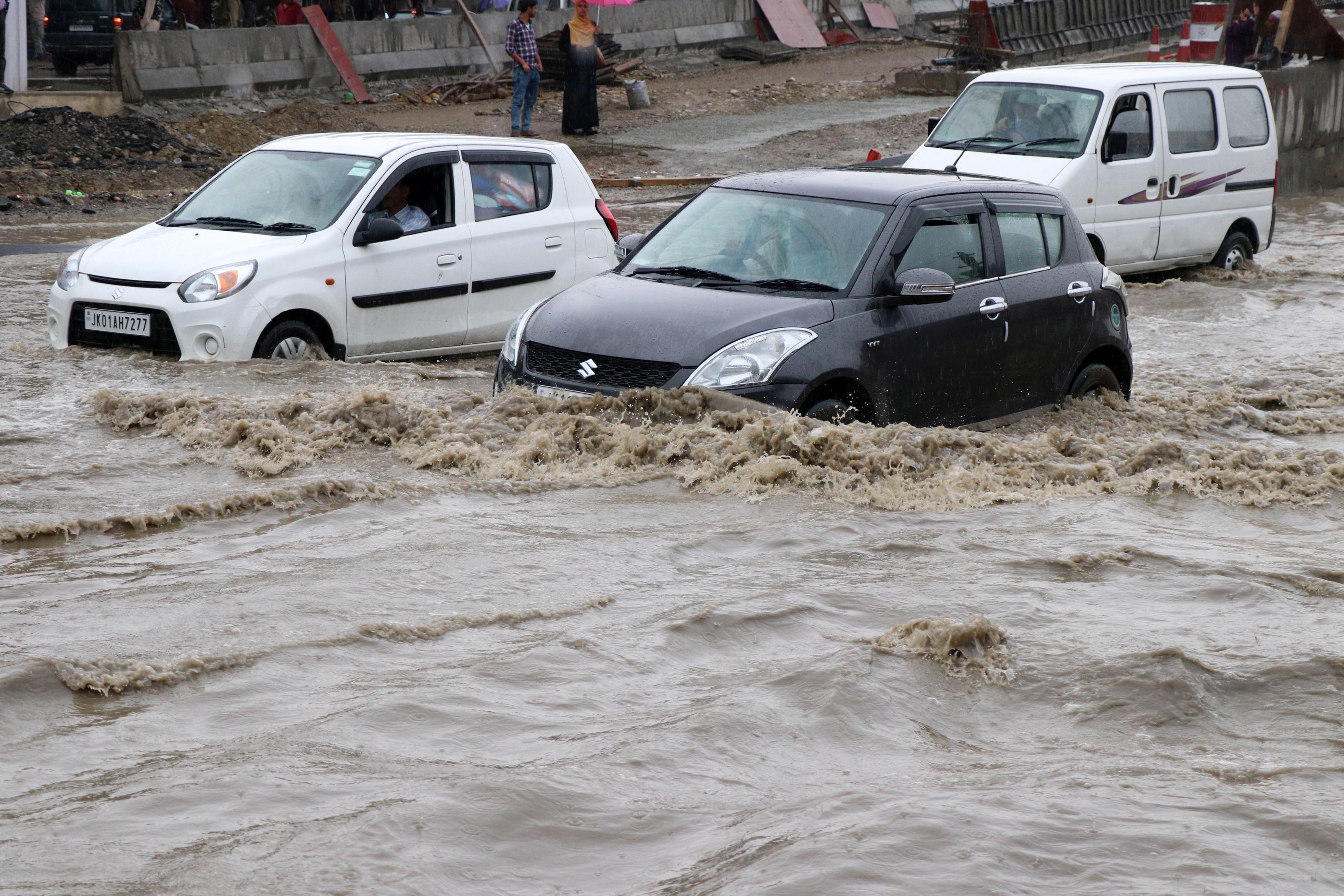
PHOTO BY BILAL BAHADUR
Spring Decline
Spring emerged as a critical period of declining rainfall across the basin. The researchers found significant downward trends at multiple stations, including Gulmarg and Pahalgam, while Kupwara also showed a pronounced decline.
The study links these changes to potential challenges for agriculture, water availability and other activities dependent on seasonal precipitation. A reduction in spring rainfall could complicate agricultural scheduling and increase pressure on water resources, although the research does not directly measure crop losses or economic impacts.
The authors suggest region-specific adaptation measures, including water conservation, more efficient irrigation and the use of less water-intensive crops. For areas experiencing declining rainfall, they also point to rainwater harvesting and stronger water-conservation infrastructure.
The findings reinforce the need to tailor water management to local conditions instead of adopting a single strategy across the Kashmir Valley.
Rainfall Shifts
To assess rainfall variability, the researchers used the non-parametric Mann–Kendall test to identify trends and Sen’s slope method to estimate their magnitude. Pettitt’s test, the Standard Normal Homogeneity Test, Buishand range test and Von Neumann’s ratio test were used to examine possible shifts in rainfall records.
The change-point analysis identified notable shifts, particularly during the late 1990s and early 2000s. Gulmarg, Kupwara and Qazigund featured prominently in the reported changes, with spring and annual rainfall among the time scales showing notable discontinuities.
At Gulmarg, for instance, the Pettitt test identified a significant change in spring rainfall around 1998. Kupwara showed a significant shift in March 1996, while Qazigund recorded significant changes in spring and annual rainfall.
The authors say such shifts matter for understanding regional hydroclimatic variability and developing appropriate water management strategies.
Data Analysis
The study also employed machine-learning techniques, Decision Tree and K-Nearest Neighbours (KNN), to estimate missing rainfall values. The combined approach produced an R-squared value of 0.67, indicating that the models explained approximately 67 per cent of the variance in the rainfall data.
Geospatial techniques, including inverse distance weighting, kriging and spline interpolation, were used to map rainfall patterns across the basin.
The researchers acknowledge limitations in their work. The study does not deeply investigate the climatic drivers behind rainfall variability, such as the El Niño-Southern Oscillation (ENSO) or the Indian Ocean Dipole (IOD). It also does not use high-resolution climate models to project future rainfall.
They recommend integrating climate models, remote sensing, expanded ground-based observations and socio-economic assessments into future research.
Climate Planning
The researchers conclude that rainfall variability across the Kashmir Himalayan ecosystem requires localised climate adaptation plans, sustained monitoring and coordination among climatologists, hydrologists, urban planners and policymakers.
They emphasise that Srinagar’s rising rainfall trend calls for stronger flood preparedness, while declining rainfall in parts of the basin warrants greater attention to water conservation, agricultural adaptation and ecological resilience.
The study also recommends real-time rainfall monitoring and improved communication of scientific findings to communities and other stakeholders, so that climate adaptation can be informed by observed data.
The authors stress that further research should examine how rainfall variability interacts with land-use changes, urban and rural development, and the socio-economic conditions of communities dependent on water resources.