Study recommends balancing irrigation and nitrogen use, finding that severe water restrictions save more water but cut rice yields by nearly 40 per cent

SRINAGAR: Irrigation at field capacity can reduce water use in Kashmir’s transplanted rice cultivation by 66 to 69 per cent while limiting yield losses to around three per cent, according to a 2026 scientific study that identifies a more efficient way of managing water and nitrogen in the Valley’s temperate agricultural conditions.
The study, Optimising irrigation and nitrogen levels for improved soil nitrogen dynamics and use efficiency in temperate ecology of Kashmir, found that combining irrigation at field capacity with the recommended dose of nitrogen offered an effective balance between crop yield, nutrient uptake and fertiliser efficiency. While more severe water restrictions saved up to 87 per cent of irrigation water, they also reduced rice yields by about 39 to 40 per cent, underlining the trade-off between water conservation and agricultural productivity.
Published in Scientific Reports, a journal of Springer Nature, the research is based on field experiments conducted during the 2021 and 2022 rice-growing seasons at the crop research farm of Sher-e-Kashmir University of Agricultural Sciences and Technology of Kashmir (SKUAST-K) at Wadura, Sopore.
The paper was authored by Mohd Salim Mir, Waseem Raja, Raihana Habib Kanth, Eajaz Ahmad Dar, Zahoor Ahmad Shah, Danishta Aziz, Laila A. Al-Shuraym, Lamya Ahmed Alkeridis, Parmeet Singh, Amal Saxena, Lal Singh, Umer Fayaz, Satyapriya, Amged El-Harairy, Ahmed A. A. Aioub and Samy Sayed.
Mir, Raja, Kanth, Saxena, Singh and Fayaz are affiliated with different divisions of the Faculty of Agriculture at Sher-e-Kashmir University of Agricultural Sciences and Technology of Kashmir, Wadura-Sopore. Dar is affiliated with SKUAST-K and the University of Florida’s West Florida Research and Education Centre in the United States. Shah is associated with SKUAST-K’s Division of Agricultural Extension, while Aziz is affiliated with its Division of Entomology. Singh is also associated with the university’s Directorate of Research.
Satyapriya is affiliated with the Division of Agricultural Extension at ICAR-Indian Agricultural Research Institute, New Delhi. Al-Shuraym and Alkeridis are associated with the Department of Biology, College of Science, Princess Nourah Bint Abdulrahman University, Riyadh, Saudi Arabia.
El-Harairy is affiliated with the Albrecht Daniel Thaer Institute of Agricultural and Horticultural Sciences at Humboldt-Universität zu Berlin, Germany, and the Desert Research Center in Cairo, Egypt. Aioub is affiliated with the Department of Plant Protection at Zagazig University, Egypt, while Sayed is associated with the Department of Economic Entomology and Pesticides at Cairo University.
The research was supported by the Princess Nourah Bint Abdulrahman University Researchers Supporting Project in Riyadh.
Findings
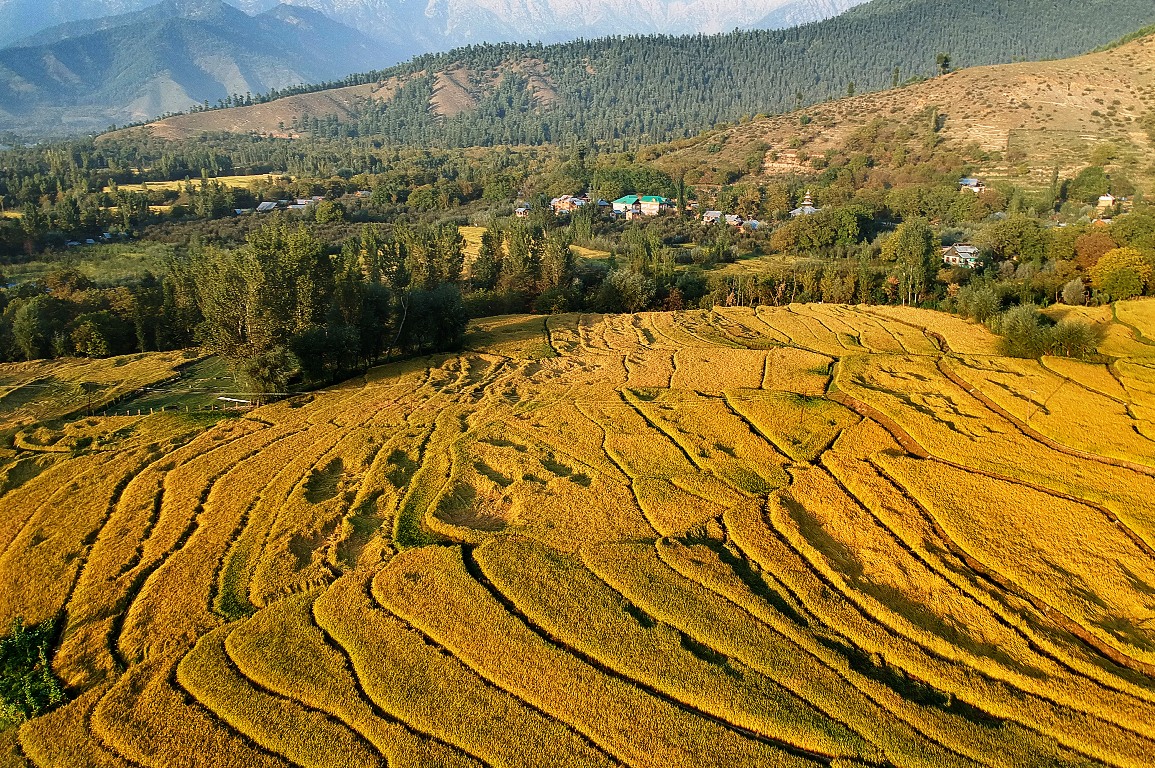
The findings are significant for Kashmir, where rice is the principal staple crop, and agriculture depends on the availability of water and healthy soils. The researchers examined how different irrigation schedules and nitrogen application rates affected nitrogen uptake by rice grain and straw, the nutrient remaining in the soil after harvest, crop water productivity and the efficiency with which plants used applied fertiliser.
The study found that adequate soil moisture supported higher nitrogen uptake and grain production, while excessive fertiliser application did not produce a proportionate improvement in nutrient-use efficiency. Its central recommendation is to manage irrigation according to soil moisture conditions and apply nitrogen at the recommended rate rather than relying on excessive water or fertiliser inputs.
Field Trials
The experiments used a split-plot design involving four irrigation regimes and four nitrogen levels, with each treatment replicated three times. The irrigation treatments comprised the recommended irrigation schedule, irrigation at field capacity, and irrigation after soil moisture depletion of 10 per cent and 20 per cent from field capacity. Nitrogen treatments consisted of an unfertilised control and applications equivalent to 75 per cent, 100 per cent and 125 per cent of the recommended nitrogen dose.
The researchers cultivated Shalimar Rice-4, an early-maturing, cold-tolerant variety developed by SKUAST-K and recommended for irrigated lowlands in Kashmir. Soil moisture was monitored at six depths, extending from the top 10 centimetres to a depth of one metre, to assess changes before and after irrigation.
The team recorded crop performance over both growing seasons and analysed the results using statistical methods. The study noted that nitrogen concentration and uptake in both grain and straw were significantly affected by irrigation scheduling and nitrogen application.
Water Savings
The comparison between irrigation regimes showed that irrigation at field capacity delivered substantial water savings without the steep production losses associated with more severe deficit irrigation.
Under the recommended irrigation schedule, the researchers applied 2,150 millimetres of irrigation water in 2021 and 2,000 millimetres in 2022. Irrigation at field capacity reduced these amounts to 660 millimetres and 680 millimetres, respectively, translating into water savings of 69.30 per cent in 2021 and 66 per cent in 2022.
The corresponding yield losses were only 3.61 per cent and 2.97 per cent compared with the recommended schedule.
More aggressive water conservation produced substantially different results. Irrigation after 10 per cent depletion from field capacity saved 83.25 per cent of irrigation water in 2021 and 81 per cent in 2022, but reduced yields by 25.05 per cent and 25.59 per cent.
The 20 per cent depletion treatment saved 86.97 per cent and 85 per cent of irrigation water in the two years, respectively, but resulted in yield losses of 39.04 per cent and 39.88 per cent.
The findings suggest that, under the conditions tested, irrigation at field capacity provided a more favourable compromise between conserving water and maintaining production than imposing severe moisture stress.
Nitrogen Uptake
The study also established a strong relationship between soil moisture and nitrogen uptake by the crop. Recommended irrigation scheduling recorded total nitrogen uptake of 146.08 kilogrammes per hectare in 2021 and 143.36 kilogrammes per hectare in 2022. Irrigation at field capacity followed closely, with uptake of 140.14 and 137.61 kilogrammes per hectare, respectively.
By contrast, the 20 per cent depletion treatment recorded total nitrogen uptake of 89.76 kilogrammes per hectare in 2021 and 87.24 kilogrammes per hectare in 2022, a reduction of approximately 38 to 39 per cent compared with the recommended irrigation schedule.
Nitrogen application also influenced nutrient uptake. The 125 per cent recommended dose produced the highest total nitrogen uptake, at 139.02 kilogrammes per hectare in 2021 and 136.91 kilogrammes per hectare in 2022. However, the results were statistically similar to those obtained with the 100 per cent recommended dose, which recorded 133.77 and 131.24 kilogrammes per hectare, respectively.
The unfertilised control consistently recorded the lowest nitrogen uptake.
These results indicate that applying more nitrogen can increase the amount absorbed by the crop, but the additional uptake does not necessarily justify exceeding the recommended dose when fertiliser-use efficiency is considered.
Residual Nitrogen
The amount of nitrogen remaining in the soil after harvest also varied significantly according to irrigation management.
The researchers found the highest residual nitrogen levels under the 20 per cent depletion treatment, indicating that less nitrogen had been removed from the soil by the crop under the more restrictive irrigation regime.
In 2022, available nitrogen in the top 15 centimetres of soil stood at 261.39 kilogrammes per hectare under the 20 per cent depletion treatment, compared with 214.55 kilogrammes per hectare under the recommended irrigation schedule. At a depth of 15 to 30 centimetres, the corresponding values were 222.84 and 190.09 kilogrammes per hectare.
The paper attributed the higher residual nitrogen under deficit irrigation principally to reduced plant uptake. It also discussed the possible role of moisture stress in limiting microbial activity and nitrogen mineralisation.
Higher nitrogen application rates likewise left more available nitrogen in the soil after harvest. The authors cautioned that nitrogen supplied beyond crop demand can accumulate in the soil, while some of the applied nutrient may be lost through leaching, denitrification and ammonia volatilisation.
The findings therefore highlight the importance of distinguishing between nitrogen that remains in the soil, nitrogen absorbed by the crop and nitrogen that contributes to grain production.
Fertiliser Efficiency
The researchers assessed nitrogen-use efficiency through several measures, including agronomic efficiency, partial factor productivity, apparent nutrient recovery and physiological efficiency.
Irrigation at field capacity recorded the highest agronomic nitrogen-use efficiency, at 18.27 kilogrammes of additional grain per kilogramme of nitrogen applied in 2021 and 18.09 kilogrammes in 2022. These results were statistically comparable with the recommended irrigation schedule.
Among nitrogen treatments, the 100 per cent recommended dose recorded the highest agronomic efficiency, at 17.91 and 17.83 kilogrammes of additional grain per kilogramme of nitrogen in the two years. Efficiency declined under the 125 per cent dose.
The study also found that the 100 per cent recommended dose achieved the highest apparent nutrient recovery, while the 75 per cent dose performed best for partial factor productivity and physiological efficiency. These indicators measure different aspects of fertiliser performance and should not be interpreted as interchangeable measures of overall productivity.
Deficit irrigation improved physiological efficiency in some comparisons and increased crop water productivity. However, the advantage came at the cost of lower total nitrogen uptake and, under the more severe treatments, sharply reduced grain yields.
The authors concluded that irrigation at field capacity combined with the recommended nitrogen dose offered the best overall balance between nutrient uptake and nitrogen-use efficiency. They also noted that the interaction between irrigation scheduling and nitrogen levels was not statistically significant for several of the measured nitrogen-use efficiency indicators.
Farm Returns
The economic analysis, based on pooled results from the two growing seasons, found that irrigation at field capacity combined with 125 per cent of the recommended nitrogen dose generated the highest net returns and benefit-cost ratio among the treatment combinations.
This combination produced net returns of Rs 98,997.50 and a benefit-cost ratio of 1.64. Irrigation at field capacity combined with 100 per cent of the recommended nitrogen dose generated net returns of Rs 96,159.20 and a benefit-cost ratio of 1.60.
The difference is important: although the 125 per cent nitrogen treatment delivered the highest recorded financial return under the prices and production costs used in the experiment, the researchers’ broader assessment favoured the 100 per cent dose as a balance between yield and nitrogen-use efficiency.
The lowest benefit-cost ratio, 0.30, was recorded under the 20 per cent depletion treatment without nitrogen fertiliser.
The economic results thus reinforce the need to evaluate irrigation and fertiliser decisions together, taking into account not only the quantity of water saved or grain harvested but also the cost of cultivation and the efficiency of inputs.
The study’s conclusion is that improved irrigation management, rather than simply applying more water or fertiliser, offers a practical route towards more efficient rice cultivation in Kashmir. Its results support further assessment of field-capacity irrigation under local farming conditions, particularly its potential to conserve water while maintaining yields and limiting unnecessary nitrogen application.