In a small, dimly lit shop in Srinagar’s Habba Kadal, a relic of the past endures, defying obsolescence. Ibtisam Fayaz Khan explores the city’s last surviving typewriter repair workshop, where nostalgia, resilience, and an unbroken bond with history persist—one keystroke at a time.
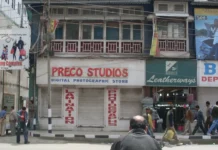
Amid the ceaseless commotion of Srinagar’s Habba Kadal, where honking vehicles merge with the hurried footsteps of pedestrians, stands an old three-storey building with glass-fronted windows on the ground floor. It houses the Ahangar family’s ancestral workshop, and within it lies a world seemingly frozen in time—a typewriter repair shop, the last of its kind in the city.
The rhythmic clatter of keys —once the defining sound of offices and newsrooms—still lingers, resisting the tide of obsolescence. The shop is run by Shabir Ahmad, a reserved man who shuns the camera but has spent his life tending to typewriters. The craft was passed down through generations, once thriving in an era when these machines were essential to clerks, journalists, and legal professionals. Though demand has waned, Shabir remains at his workbench, his quiet persistence unwavering. Asked about the future of his trade, he merely shrugs. “Jab tak chalega tab tak chalayenge,” he said. “As long as it lasts, we will continue.”
Vanishing Craft
Above the workshop, another remnant of the past endures on the building’s second floor. Shabir’s uncle, Ghulam Mohammad Ahangar, has run a stenography centre since the 1970s, teaching a skill once indispensable in offices and courtrooms. The rapid march of technology, however, has all but erased its necessity.
“This is gone now,” he regretted. “Stenography is not what it used to be. It is all about speed now.” Yet he continues to teach, not just out of duty but as a custodian of a craft that once held great value. He believes typewriters instilled a certain discipline. “Today, there is spellcheck and autocorrect. A typewriter forces you to be careful. Every keystroke is permanent. Every mistake must be corrected by hand. It made people more attentive.”
Typing on these machines, he explains, is a dance of nine fingers working in harmony, linking hands with the brain in a way digital devices do not demand. It is a cognitive precision that, he argues, is slowly being lost.
A Legacy
The Ahangar family’s connection to machines dates back to the pre-1947 era when Mohammad Amin Ahangar’s father was a skilled gunsmith. As demand for locally crafted firearms declined, the family pivoted to repairing typewriters, establishing Marshall Typewriter Co in Srinagar in 1936.
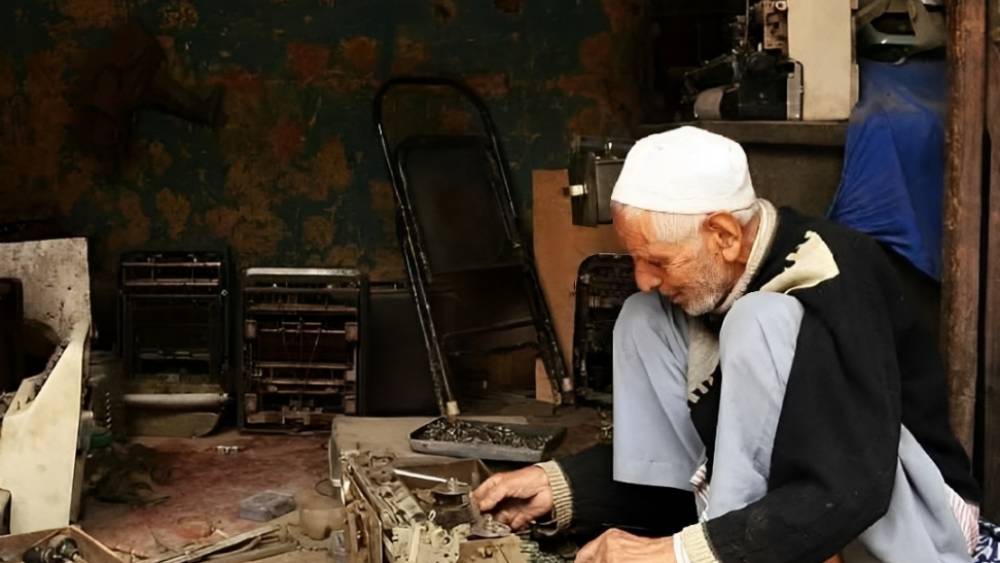
“In those days, there were just 64 typewriters in the entire state,” recalled Ahanger, who inherited the craft from his father. With imported parts scarce, they often hand-crafted components, ensuring that every machine could be restored to working condition. His sons, Mohammad Yusuf and Ghulam Mohammad grew up surrounded by these mechanical wonders and eventually joined the family trade.
By the 1970s, recognising the need for skilled typists, Ghulam Mohammad founded the Modern Era Stenographic Institute on the floor above the workshop, training generations of students. Though enrolment has dwindled, he remains committed. “People still ride bicycles despite scooters—why should typewriters disappear just because we have computers?”
The late Mohammad Amin Ahangar, who died in 2023 on the verge of turning 100, dedicated his life to typewriter mechanics. Serving the state government, he worked as a typewriter and duplicator mechanic when only 50 typewriters were imported for Srinagar and another 50 for Jammu. With mechanical expertise inherited from his father and the rare ability to manufacture broken spare parts, he earned both written and verbal commendations from the government for his exceptional skill and service.
A Fading Legacy
The Ahangars’ have a long history in typewriter repair and stenography. Decades ago, customers lined up outside their shop for equipment repairs, new machines or shorthand lessons. “I remember when government servants, students and writers used to come here and leave their typewriters behind,” Shabir said, dusting off a Remington and pressing its keys, still cushy under his touch.
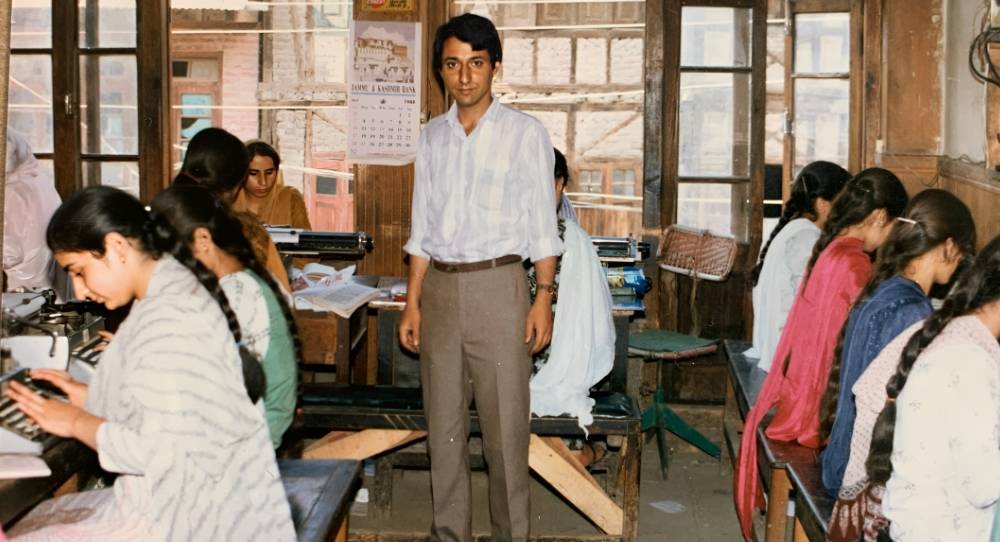
Mementoes from the shop’s past adorn the walls—vintage advertisements, a chart of typewriter keys, faded photographs of past generations working over rows of machines, and certificates from a time when stenographers were in high demand. Wooden shelves stacked with typewriter ribbons, ink rollers and spare keys fill the air with the scent of oil and paper—a smell once synonymous with bustling offices.
But times have changed. Computers replaced offices, digital documentation supplanted paper records, and the steady stream of customers has all but vanished. Today, spare parts are difficult to source, and repairs are rare. Yet, the shop remains—a defiant relic of a bygone era its owners refuse to let disappear entirely.
Nostalgia and Reality
To the younger generation, typewriters are relics—objects found in old films, antique shops, or the corners of libraries. Once the lifeblood of newsrooms and the tool of choice for writers, they are now little more than nostalgic novelties. Yet, in a small, dimly lit shop tucked between modern storefronts, their rhythmic clatter endures.
Outside, the city hums with neon lights, blaring horns, and people absorbed in their screens. Inside, time appears to stand still. The air carries the scent of old paper and machine oil, while the steady tap of keys and the soft hum of machines create a familiar, unhurried rhythm.
At the centre of this quiet space, Shabir worked over an old Olympia, his hands moving with precision. Ink ribbons and spare parts lay neatly arranged around him, each one waiting to restore a machine that had long since seen its prime. Although few sought his expertise, he remained committed, preserving the stories of every typewriter he repaired, regardless of its brand or origin.
“Sometimes, a customer arrives,” he said, adjusting a machine with care. “Court reporters still bring their typewriters for repairs. Writers come in, wanting to feel the joy of ink on paper.” While technology pressed forward, this small shop kept a fading craft alive—one letter, one click at a time.

A Companion to Time
Up a narrow wooden staircase, Ghulam Mohammad sat behind a well-worn desk. Now in his late seventies or early eighties, he carried the quiet grace of a man who had watched his trade diminish with time. Around him, stacks of old shorthand books leaned against the walls, their spines worn from years of use. Black-and-white photographs hung nearby, reminders of an era when stenography was a valued skill and his classes were filled with eager students.
For him, the stenography centre was more than a workplace—it was a steadfast companion. His sons had long since left, one settling in France, the other in the United States. In their absence, he remained in his homeland with his wife, returning each day to the familiarity of his trade.
“I come here to keep myself busy and pass the time,” he said with a quiet smile. “It gives me something to do, something familiar.”
As the world moved on, the rhythmic clatter of typewriter keys remained his constant—a bridge between a past of purpose and a present shaped by routine.
A Dying Craft
Although typewriters had long been replaced by modern technology, they still held an enduring appeal. Lawyers, a handful of traditional journalists, and collectors continued to seek repairs, drawn to the mechanical precision and permanence of typewritten documents. Occasionally, an enthusiast arrived, captivated by the tactile satisfaction of pressing the keys and the distinct “clack” that followed.
While most had moved on to computers and smartphones, a small number of younger students were exploring stenography, seeing speed typing as a useful skill. Ghulam Mohammad Ahangar, who had spent decades teaching the craft, viewed the trend with mixed emotions.
“In the past, stenography was essential for employment,” he said. “Now, young people take it up for different reasons. Some see it as a requirement for government jobs, while others use it to improve their typing speed in an era dominated by automation and artificial intelligence.”
Among his students were children from the Gen Alpha generation, raised in a world of touchscreens and voice commands. They approached stenography not as a relic of the past but as a competitive skill. One student remarked that their father often emphasised the importance of typing speed. “This is the age of AI,” the student said. “Typing fast is essential, not for the courts of the past, but to keep pace with today’s speed.”
Though the golden age of typewriters had passed, their legacy endured in unexpected ways. Some sought them out for nostalgia, others for discipline, and some simply to sharpen their skills. The rhythmic sound of typing, once a symbol of productivity, now connected generations in new ways.
Yet, the reality remained unyielding. The once-thriving business was fading, its survival increasingly uncertain. It would not be long before this last typewriter repair shop shut its doors, leaving its machines together dust and its keys to fall silent forever.
Final Battles With Time
Shabir paused as he oiled the gears of an ageing Olympia typewriter, his hands steady from years of practice. He reflected on the significance of his work. “People tell me to close the shop and move on,” he said. “But how does one move on from something that has been their entire life? This is what I have learned and lived with. It is the legacy of our forefathers.”
For now, he remained, preserving not just machines but the memories they carried. As long as his workshop stood, the sound of typewriter keys would persist—a quiet defiance against time’s relentless advance.
Outside, the city remained loud and fast-moving. But behind him, inside that dimly lit shop, the clatter of keys continued. A typewriter sat on the workbench, its worn keys being adjusted, its ribbons replaced—a relic of the past refusing to fade into silence.