SRINAGAR: A new study has reconstructed more than two centuries of summer rainfall variability in the Kashmir Himalaya, revealing recurring droughts, prolonged wet periods and significant shifts in hydroclimatic conditions between 1802 and 2023. Published in Quaternary Science Advances, the study, titled “A 221-year summer precipitation reconstruction using tree rings reveals hydroclimatic variability in the Kashmir Himalaya,” uses tree-ring records from Pinus wallichiana in the Pir Panjal Range to reconstruct May-August precipitation over 221 years.
The research was conducted by Nadeem Ahmad Najar and Irfan Rashid of the Department of Geoinformatics, University of Kashmir, Hazratbal, Srinagar, and Uttam Pandey and Naveen Gandhi of the Centre for Climate Change Research, Indian Institute of Tropical Meteorology (IITM), Ministry of Earth Sciences, Pune.
The researchers believe that the Pir Panjal mountain range is particularly sensitive to hydroclimatic fluctuations because the Kashmir Himalaya lies within a transition zone influenced by both the Indian Summer Monsoon and mid-latitude Western Disturbances.
Tree Evidence
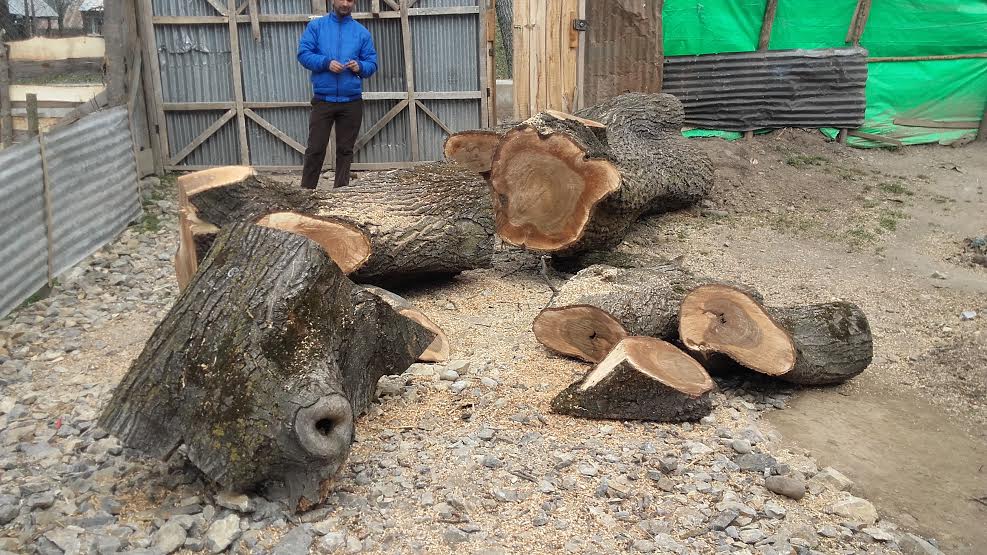
To extend the relatively short instrumental climate record, the researchers developed a 245-year tree-ring chronology spanning 1780-2023 using Pinus wallichiana. The chronology was based on 180 successfully cross-dated increment cores from 97 trees at the main sampling site in the Ferozpora watershed of the Pir Panjal Range.
The tree-ring chronology showed a significant relationship with May-August precipitation, with a correlation coefficient of 0.61. Using this relationship, the researchers reconstructed summer precipitation for 1802-2023, with the model explaining 38 per cent of the variance in observed precipitation at Srinagar.
Drought History
The reconstruction shows that Kashmir’s summer precipitation has experienced substantial fluctuations from year to year as well as across decades.
The researchers identified 87 dry years and 110 wet years during the reconstruction period. The most severe and persistent drought occurred between 1802 and 1809, while other prolonged dry phases were recorded during 1819-1825, 1860-1871, 1934-1941 and 1962-1968.
The year 1803 emerged as the driest year in the reconstruction, with estimated May-August precipitation of only about 5 millimetres. During the 1802-1809 drought, reconstructed summer precipitation averaged approximately 84 mm.
Wet Phases
The study also identified several prolonged periods of above-average summer precipitation.
Major wet phases occurred during 1810-1816, 1974-1982, 2003-2011 and 2013-2023. The researchers describe 2013-2023 as the longest continuous wet spell, lasting 11 years in the reconstructed record.
The most intense wet phase occurred during 1810-1816, when reconstructed May-August precipitation ranged from approximately 232 to 368 mm, with an average of 278.8 mm. The wettest individual year was 1813, with reconstructed precipitation of about 368 mm.
Regional Signal
The researchers found that the reconstructed precipitation record broadly corresponds with historical records and earlier hydroclimatic reconstructions from the northwestern Himalaya.
Major drought periods such as 1802-1809, 1934-1941 and 1962-1968 were found to correspond with drought phases identified in other regional reconstructions. Similarly, wet periods including 1810-1816, 1892-1895 and 1974-1982 showed agreement with earlier studies.
Spatial correlation analysis further showed a significant relationship between the reconstructed rainfall series and precipitation across the Kashmir Himalaya and adjoining northwestern Himalayan region, with correlations reaching approximately 0.60 around the study area.
Climate Cycles
Wavelet analysis identified precipitation variability operating across several timescales, including approximately 8-12 years, 12-20 years and 64-80 years.
The authors note that these periodicities broadly correspond to variability associated with the North Atlantic Oscillation (NAO), Pacific Decadal Oscillation (PDO) and Atlantic Multidecadal Oscillation (AMO). However, the study found no statistically significant direct relationships with individual climate indices, suggesting that multiple regional and large-scale atmospheric processes may be involved.
Climate Baseline
According to the researchers, the long-term reconstruction provides a historical baseline against which recent and future hydroclimatic changes in Kashmir can be assessed.
The study concludes that the Pinus wallichiana chronology captures a spatially coherent regional precipitation signal and can help improve understanding of droughts, wet periods, water-resource sustainability and ecosystem resilience in the western Himalaya.
The researchers believe that such long-term climate records are particularly valuable because instrumental observations in the Himalayan region are comparatively short and spatially limited, making tree-ring records an important source of information about climate variability before the modern observational period.