Kashmir’s gold market is in turmoil as prices surge to record highs, straining affordability for buyers and traders alike. People are now hunting for alternatives to sustain the low for precious metal, reports Syed Shadab Ali Gillani
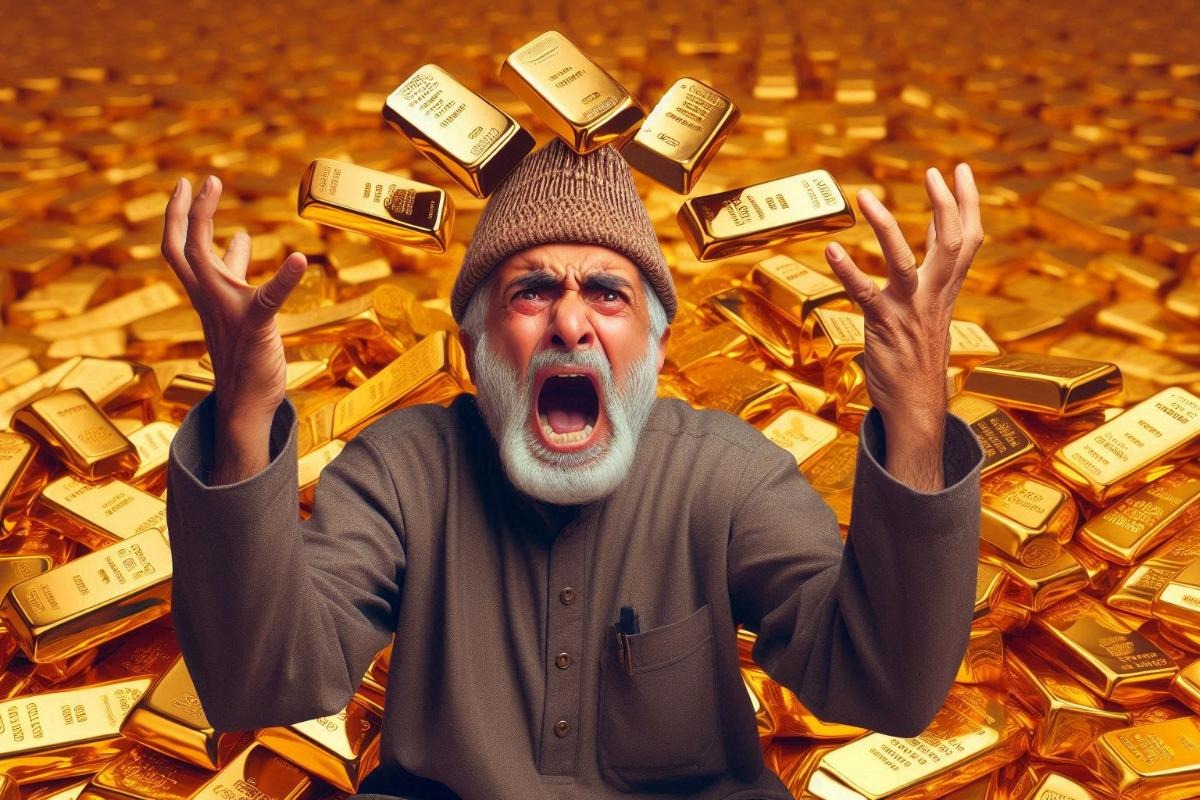
In Kashmir, the price of precious metals recently reached an unprecedented high of Rs 88,000 per 10 grams, leaving retailers and consumers bewildered. This historic rise sparked curiosity, concern, and heated debate about the factors driving the surge and its implications for the market.
It followed India announcing a significant reduction in import duties on gold from 15 per cent to 6 per cent in the 2024 budget. The basic duty on gold and silver bars, coins, and findings was also reduced to 6 per cent, while the duty on gold and silver ore was cut to 5.35 per cent. Even customs duty on silver was reduced. The move was met with widespread approval. These changes came when gold prices, after a prolonged upward trend, experienced a sharp decline of up to Rs 5,000 per 10 grams—the steepest drop in years.
However, this respite was short-lived. After a brief period of stability, gold prices began to climb once more, reaching new heights and leaving many buyers frustrated.
Frustrated Brides
For Raima, a bride-to-be in Kashmir, the fluctuating bullion market turned a cherished dream into a disappointment. Months before her wedding, she set out to purchase a gold maatha patti, a traditional headpiece she had longed for since childhood. Her excitement evaporated.
“The price of gold has gone up, ma’am,” the jeweller informed her. “It has risen by a significant margin.” Unwilling to burden her family further, she reluctantly abandoned her dream and returned home empty-handed.
Sanna, another soon-to-be bride, shared a similar sentiment. She had recently purchased gold for her wedding but now regrets her decision as prices continue to soar. “The prices were a little lower when I bought it, but now it is becoming very difficult to afford,” she said. “I invested more than I should have, and I am not happy about it.”
“Gold prices are rising every day. Everyone wants to buy it at lower prices, but what about those who cannot afford it? Even when prices were down, gold was always a costly affair. Now, it has become even more unattainable,” she regretted.
The bullion volatility has left buyers and traders grappling with uncertainty. For many in Kashmir, where gold holds significant cultural and economic value, the situation remains fraught with tension.
For 67-year-old Sameena, the soaring prices have become a significant obstacle in her plans to marry off her elder daughter. “I do not want to give her impure jewellery,” she said. “Buying gold is not just about acquiring something valuable; it is an investment. And I want that investment to be proper.”
Sameena’s desire to gift her daughter at least one gold necklace is rooted in tradition and a sense of security. “I want her to feel safe when she is at her in-laws’ home,” she explained. However, the current prices have made this dream seem unattainable. “It is mentally exhausting not being able to buy something pure for my daughter.”
Shabnam, who is preparing for her older son’s wedding, faces a similar dilemma. “The prices are too high,” she lamented. “I cannot even afford to buy a gold coin for my daughter-in-law.”
In Kashmir, where gold holds immense cultural and economic significance, these rising costs are more than just a financial burden—they strike at the heart of tradition and familial expectations.
Gold Loans
Amid the soaring prices, the trend of gold loans has gained traction in Kashmir. Several banks, including HDFC Bank and the Jammu and Kashmir Bank, now offer this facility, allowing borrowers to pledge their gold articles as collateral for loans.
The Jammu Kashmir Bank, the region’s largest financial institution, has emerged as a leader in this space. According to a senior officer at the bank, the gold loan facility is available at around 150 branches, making it highly accessible. “Other banks do not have such a wide network, so we lead in this area,” the officer explained.
The loan amount is typically up to 80 per cent of the gold’s current market value, based on its quality and caratage. Borrowers can access loans of up to Rs 30 lakh for a year, with the option to extend the term after revaluation.
“The interest rate is 10.8 per cent for loans up to Rs 10 lakh, and 10.3 per cent for amounts above that,” the officer said. “For women borrowers, the rate is half a per cent lower.”
For Arshad Hussain, 56, the gold loan facility has been a practical solution during emergencies. “One can sell gold, but often there are emotional factors that prevent people from doing so,” he said.
In Kashmir, where family heirlooms are passed down through generations, selling gold ornaments is often seen as a last resort. “The gold loan facility helps people overcome this dilemma,” Arshad added. “It allows them to retain their cherished possessions while addressing immediate financial needs.”
The Significance of Gold
Gold has long been valued not just as an adornment but as an integral part of ceremonies, particularly weddings, where it symbolises wealth and status. Gold jewellery is often passed down through generations, forming a tangible link to family heritage. The metal has also played a pivotal role in shaping economic landscapes, spurring the creation of markets such as Srinagar’s Saraf Bazaar, a hub of gold trade and commerce.
Over the past several months, gold prices have been on an upward trajectory, continuing a record-setting trend. Last week, it reached a new lifetime high of Rs 86,070 per 10 grams in Delhi. The increase was driven by a depreciating rupee and losses in the stock market, according to traders.
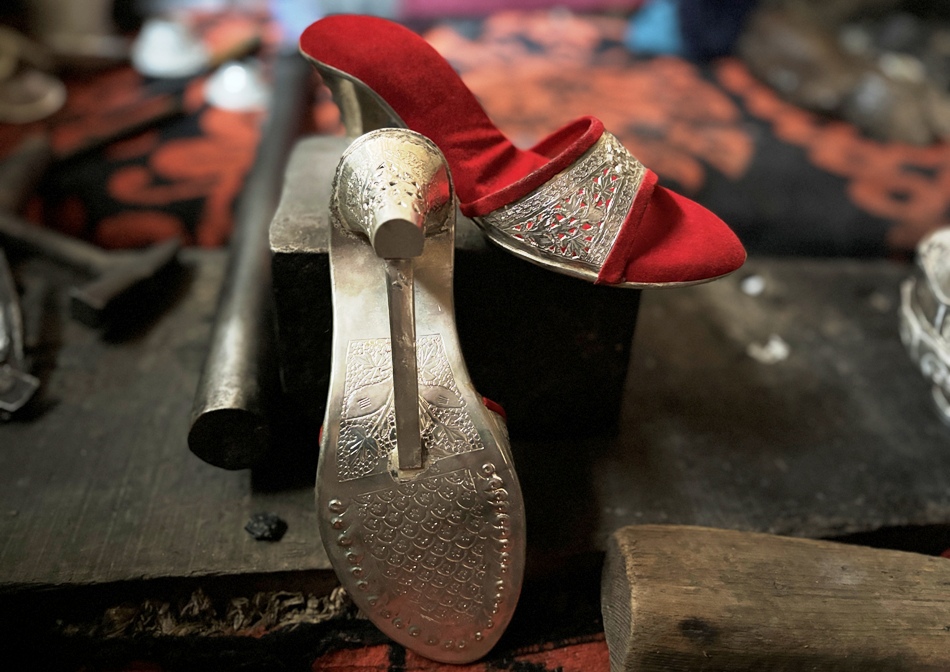
Notably, Kashmir is currently in a season when families start preparations for weddings, purchasing gold and managing the bridal trousseau. The weddings will start after the Ramzan, the Muslim month of fasting is over. People who lack enough resources and are ‘unbankable’ usually resort to silver but that also sells at slightly less than a lakh a kilogram.
The Alternatives
In the bustling lanes of Jehangir Chowk, Yasmeen carefully selects designs for her daughter-in-law at a local jeweller’s shop. Accompanied by her husband, she opts for heavier pieces crafted in 16-carat gold, ensuring they appear grand while remaining within budget. “I want to buy a Jodha set, a grand one for the bride, but I cannot afford it in 22 or even 18 carats,” she explains. “It would cost tens of lakhs. So, I am choosing larger sizes with lower carat weight.”
For Yasmeen, the decision is driven by a desire to avoid making her daughter-in-law feel left out. “I am trying my best to buy whatever I can afford, even if it is not in the purest form,” she says, her focus fixed on the gleaming designs before her.
Yasmeen is not alone in her predicament. Shereen, who had long dreamed of gifting her mother a gold ring, found herself repeatedly disheartened by the escalating prices. “Every time I visited a shop, my heart sank at the cost,” she recalls. “I thought I might never be able to surprise or pamper my mother with such a gift.”
After consulting a friend, Shereen decided to purchase an 18-carat ring. “It is beautiful and does not look cheap or impure,” she says. “When I gifted it to my mother, I felt like I was floating. I hope to buy her a pure gold ring one day, but for now, this is a blessing in disguise.”
The trend of opting for impure gold has become increasingly common in Kashmir. Afraid, a bride-to-be, echoes this sentiment. “I bought 18-carat earrings for casual use at a low price,” she says. “These days are tough, and we barely managed to get one pure set of jewels made of gold.”
A Personal Struggle
For many, the rising cost of gold has turned what was once a joyous tradition into a source of stress. A 55-year-old woman, who recently purchased an 18-carat ring for her niece, shares her experience. “My brother gifted me gold twice for my children’s weddings,” she says. “Now, when it’s my turn to return the love, the prices have skyrocketed. He gave me a gold coin in 2017 that cost around Rs 26,000. Today, it’s at least three times that amount.”
Another woman in her mid-forties is searching for an 18-carat gold chain to gift her nephew, who recently cleared his class tenth examinations. “I have not gone to my brother’s home to congratulate him because I have nothing in hand,” she said. “In our culture, you don’t go empty-handed. He needs to have a gold item, at least.”
Adapting A Shift
One jeweller, who primarily deals in affordable items, has turned to social media to attract customers. “Buying gold has become a distant dream for many,” he said. “People stopped visiting my shop after the prices went up. So, I started selling silver and imitations.”
Despite holding a social media giveaway to promote his business, the response has been tepid. “I sell 18-carat and 15-carat gold, as well as pure gold, but the number of customers has dwindled,” he admitted. “However, since prices have dropped slightly, I am hopeful that business may pick up again.”
He views alternative jewellery as a lifeline for both buyers and sellers. “It is a blessing in disguise,” he said. “We need to earn our bread and butter too. It is heartbreaking to see how customer influx has declined over the years due to factors beyond our control.”
“The trend here leans towards 18-carat jewellery, whereas in other parts of India, 22-carat is more common,” a top jeweller noted. This disparity often leads to misunderstandings when selling gold outside the region, particularly concerning resale value. With hallmarking now mandatory, buyers can verify their jewellery’s authenticity through the Hallmark Unique Identification (HUID) number. “Customers can use the BIS app to check the purity of their jewellery by entering the HUID number,” the jeweller advised.
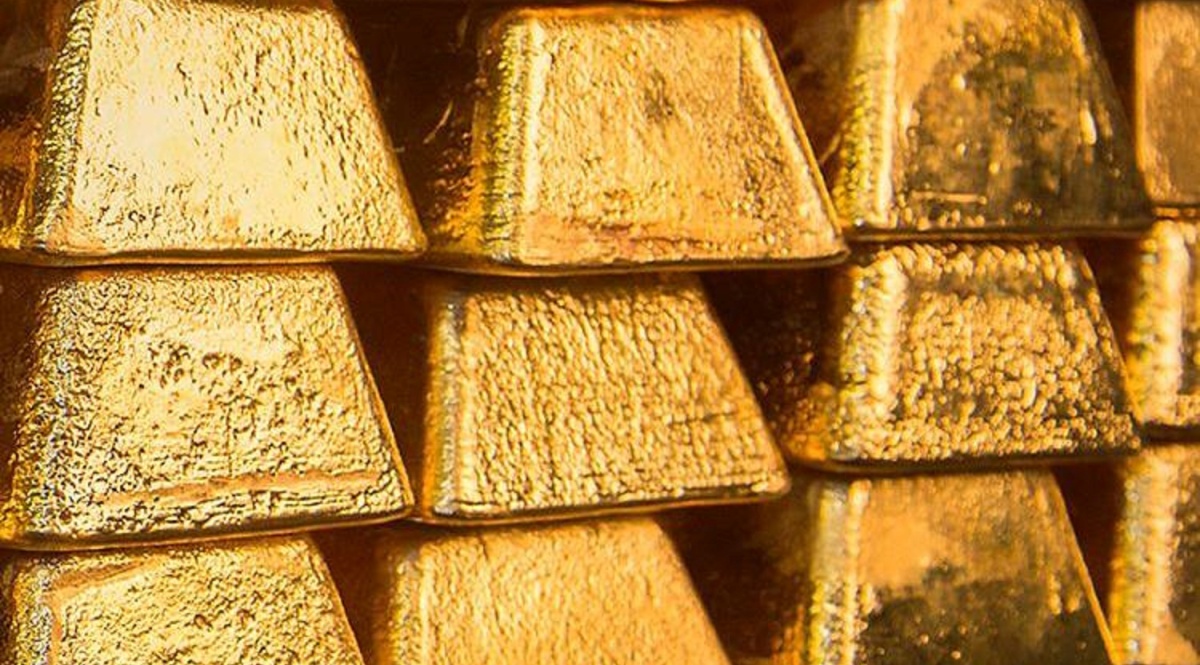
As gold nears the one-lakh-rupee mark per 10 grams, experts recommend that those purchasing gold purely for investment should opt for 24-carat in the form of biscuits or coins, which come with certificates and are globally tradable. “While 18-carat gold is more durable for jewellery, it has a lower resale value compared to 22 or 24-carat.”
The traditional preference for Edward coins in Kashmir is also shifting. “Now, people prefer MMTC-certified 24-carat gold coins, which come with a certificate and guaranteed purity,” he noted.