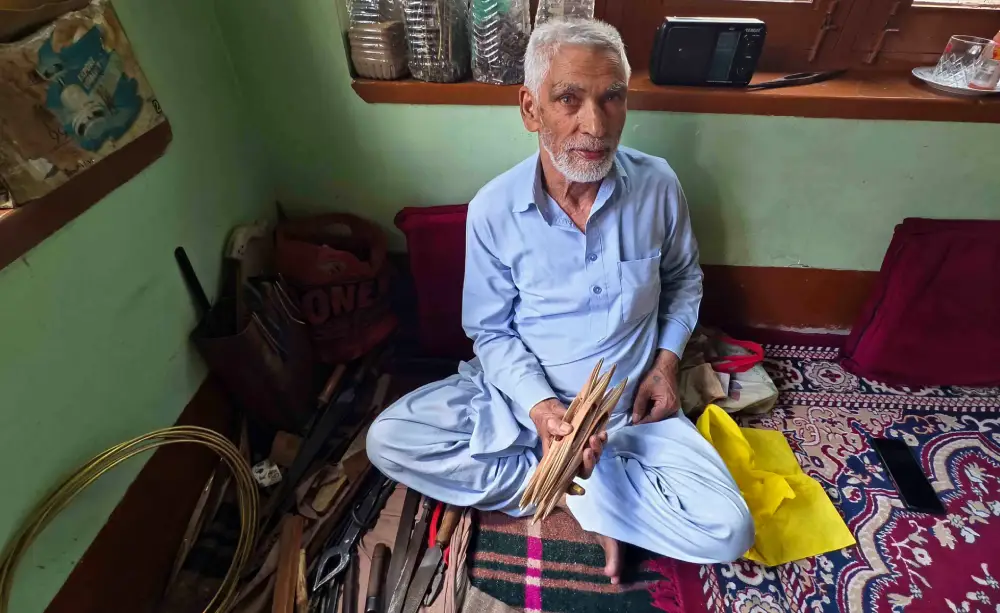
For 50 years, 75-year-old Abdul Majeed Zargar has hand-carved the wooden shuttles that bring Kashmir’s famed Pashmina to life. In a conversation with Afreen Ashraf, he speaks of his fear that the centuries-old craft will disappear with his generation
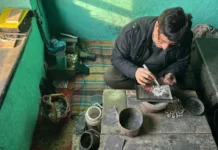
For more than five decades, Abdul Majeed Zargar has been making Mukh, a small wooden shuttle that carries thread back and forth across a handloom, making the weaving of Kashmir’s renowned Pashmina shawls possible. At 75, he still carves each of these shuttles entirely by hand, using simple tools and techniques that he learned five decades ago.
Zargar is believed to be the last handmade Mukh maker, a little-known craft that has entirely supported the region’s handloom weaving for generations. As handlooms are steadily replaced by power looms and younger generations drift away from traditional crafts, Zargar fears the art he spent a lifetime mastering may not survive him. His workshop stands as one of the last places where these wooden shuttles are still made by hand.
Long before Zargar became the traditional Mukh maker, he was a teenage boy searching for a livelihood. A resident of Bund Khar Mohalla, a neighbourhood with skilled hands and inherited crafts, Zargar moved from one trade to another.
“I first started working with silver making and then turned to knife making,” recalls Zargar. “After trying my hand at both crafts, I realised neither skill worked for me.”
Later, he decided to learn the craft of making Mukhs. The beginning, however, was anything but promising. “It took me almost a whole year to get my hands on the skill,” he recalled. Every piece he made that year had imperfections. ” I was exhausted and began to think that even this craft was not meant for me,” he remembers. “I was about to leave this field.”
A Turning Point
But Zargar decided to give it one last chance. Carrying a few handmade Mukhs, he went from one workshop to another, hoping someone would buy them. Most turned him away. Then came a door that changed his life altogether.
Zargar met a sazvari, a trader who bought and sold weaving tools, in Khayam. The sazvari, on seeing him at his doorstep, inquired what he had come to sell. “I told him I make Mukhs,” Zargar said. Instead of refusing him, the man asked him to come upstairs, where a few experienced craftsmen were already working. “While walking up those stairs, I was so scared”.
A nervous Zargar showed them his work. They carefully examined each piece and asked the price. Rs 40, he remembers his response.
The craftsmen did not hide the truth. They pointed out several flaws in the Mukhs and explained why they were not good enough. Yet, before Zargar left, they bought three pairs.
Their support did not end there. They told other weavers and traders in the area that if anyone needed a new Mukh or wanted an old one repaired, they could find Zargar. Slowly, people started coming to him. What began as a single sale soon turned into a growing circle of customers.
A few months later, Zargar returned to the sazvari. To his surprise, he saw the Mukhs he had sold still hanging on a wall. They had never been used. Reason: they were faulty and unsuitable for weaving.
“I asked them, ‘ Then why did you buy them?” he remembers. And they responded, “If we had not bought them, you would have lost hope.”
Over the years, his Mukhs became known for their quality and durability, and demand grew. There were times, he said, when weavers had to wait for months to get one of his handmade shuttle boats. Looking back, Zargar believes that his five-decade-long career began with three imperfect pieces sold and a few craftsmen who chose encouragement over criticism.
Heart of Weaving
Mukh, also known as a shuttle or throw shuttle, is one of the most essential tools used in traditional handloom weaving. It carries the weft thread back and forth across the loom, allowing the fabric to take shape. Every handwoven Pashmina or Tos shawl begins with this simple movement. Without the Mukh, the loom cannot function, and the intricate weave that Kashmir is known for cannot be created.
“It is the basis of Pashmina,” Zargar said. “If this is missing, Pashmina cannot be made”.
For the weave, the Mukh is the starting point of an entire craft ecosystem. Once the weaving is complete, the shawl passes through dyers and embroidery artisans before going to market. But before any of that can happen, the thread must first travel across the loom. “If the first step is missing, the whole system stops.”
Small Innovations
Over the years, Zargar has also made small improvements to the traditional design. Earlier, the metal parts of the Mukh were made of iron, which would rust. He replaced it with brass, making the shuttle durable and resistant to corrosion.
Today, many weavers buy factory-made shuttle boats, which are cheaper and easier to find, but they cannot match the handmade Mukh.
Fading Legacy
Despite decades of recognition, including support from the Department of Handicrafts, Zargar said awards alone cannot keep a craft alive. “What matters is that the craft should continue,” he said. At 75, his greatest concern is the absence of young apprentices willing to learn the intricate art of carving wooden Pashmina shuttles.
After unsuccessful attempts to train others, he is now teaching his son, hoping the skill will survive. “I do not know what will happen after me,” he said. “But as long as I can hold my tools, I will keep making them.”