Rooted in centuries of history, Kashmir’s copperware industry balances tradition and survival, confronting labour shortages, mechanisation, and market shifts while artisans and young entrepreneurs strive to keep the craft alive, reports Asrar Syeed
For over two millennia, copper has occupied a quiet but enduring place in Kashmir’s material culture. Archaeologists may not have conclusively located the copper plates believed to have recorded the proceedings of the Fourth Buddhist Council, held in Kashmir under the Kushan emperor Kanishka in the first century CE, but the popular belief itself is telling. It reflects a civilisational memory that associates copper with permanence, authority, and record-keeping. Long before steel and glass entered Kashmiri kitchens, copper was understood as a metal meant to last.
Historically, Kashmir sourced its copper locally. Mines in Anantnag, Kupwara, and Baramulla supplied the region’s needs, while iron ore extraction also continued until the early twentieth century. Much of this metal fed the royal mints; for everyday use, earthenware dominated common households. Copper and brass utensils, however, were markers of privilege, used by kings, aristocrats, and religious institutions. With improved metallurgical techniques and sustained cultural exchanges with Central Asia during the medieval period, copperware gradually became both fashionable and functional, an artisanal tradition that has survived into the present.
Still in Vogue
In Srinagar’s Shehr-e-Khas, copper has not lost its symbolic value. Even today, families invest in copper utensils as long-term assets for their daughters, particularly at the time of marriage. While glass and steel have made inroads into Kashmiri kitchens, they have only partially replaced copper. For decades, Zaina Kadal has remained the epicentre of this trade.
A walk through the market reveals rows of polished utensils displayed along shopfronts, but it is the interiors that tell the real story. The rhythmic hammering of copper sheets, sharp, metallic, relentless, breaks the otherwise subdued silence of the old city. Despite changing consumer habits and increased competition, the number of shops has not declined; if anything, it has grown.
Mohammad Yaseen, proprietor of Yaseen Copper House, has witnessed these shifts firsthand. “Our family has been in this business for generations,” he said, noting that he has personally managed the shop for nearly 53 years. He remembers the days when he sat on a waguv, the traditional straw mat, selling handi, plain, raw copper sheets that artisans later transformed into utensils.
“This sector has seen many difficult phases, yet it has survived,” he said. Now president of the local market association, Yaseen notes that traditional practices have evolved. “Earlier, families would purchase large quantities of copperware for their newly married daughters. That custom has declined. But demand for gift items and decorative pieces is rising. People prefer smaller, affordable products today.”
In recent years, consumer preferences within Kashmir’s copperware market have undergone a subtle but significant shift. While traditional items such as samovars, lotaas, degchis, and traamis continue to dominate wedding purchases and religious use, urban buyers, particularly younger households, are gravitating toward minimalist, utility-driven designs. Sleeker water bottles, copper tumblers, desk accessories, lamps, and planters now account for a growing share of sales, reflecting changing lifestyles and space constraints in modern homes.
Tourism, when stable, plays some role in shaping these trends. Visitors increasingly seek smaller, portable items that combine utility with aesthetics. Shopkeepers acknowledge that tourists are less inclined to purchase heavy cookware but show strong interest in engraved décor pieces, customised souvenirs, and wellness-related products such as copper bottles marketed for health benefits. This has encouraged artisans to experiment with lighter designs, contemporary motifs, and fusion aesthetics while retaining traditional hammering techniques.
Learning as Worship
Tucked into one of the narrow lanes of the Zaina Kadal market is the shop of Manzoor Ahmed Khan, among the oldest establishments in the area. Khan joined the family business in 1980 at the age of 17. “I was asked to take it up, but I was also genuinely interested,” he admitted.
The market today has nearly 50 shops, many renovated with modern interiors. Khan pauses before reflecting on the past. “Things were different when I started. You had to work hard and learn every detail. If today I can distinguish between a handmade and a machine-made product at a glance, it is because our elders taught us to treat work like worship, never casually, never carelessly.”
Kharkhanas Disappear
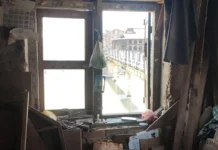
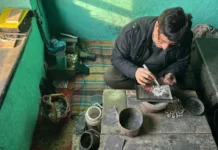
Behind the polished storefronts lie the kharkhanas, traditional workshops where copperware is shaped from raw sheets into finished products before reaching the market. These spaces, once central to the industry, are steadily disappearing.
Labour shortages and the influx of machine-made products have forced many workshops to shut down. Working conditions inside kharkhanas are harsh: extreme heat, continuous hammering, and minimal safety infrastructure. Over time, many artisans have developed serious health issues.
In Nowhatta, downtown Srinagar, the sound of hammering is so loud that conversation requires raised voices. Among the workers here is Shakeel Ahmad, who began working at a young age due to financial hardship. “Initially, I only observed our elders, woustaas, as they worked,” he recalled. “Later, I was given smaller tasks: shaping glasses, removing dents, correcting errors.”
Shakeel notes that workshops once employed large numbers of artisans. “Today, there is a severe labour shortage. Most young people are educated and unwilling to work in conditions where clothes get dirty, and the heat is unbearable. Even if they are unemployed, they prefer office jobs.”
Last year, Shakeel himself was forced to stay away from work for months due to a severe cough. “Shops have modernised, but kharkhanas have not. The conditions remain the same, pushing workers to seek alternatives,” he said.
Entrepreneur’s Bet
Jammu and Kashmir is currently grappling with one of its worst unemployment crises. As of November 2025, official data shows over 3,57,328 registered unemployed youth, 2.08 lakh in the Kashmir division and 1.50 lakh in Jammu.
Against this backdrop, Abid Abdullah, a man in his thirties, chose an unconventional path. After his tour and travel business collapsed during the Covid-19 lockdowns, Abdullah opened a copperware shop named Panun Traam. “A friend suggested I explore copperware,” he said. “I studied the trade carefully before starting.”
The initial period was difficult, he admitted, but perseverance paid off. “There are many unexplored sectors in Kashmir. Society needs to encourage young people to take up business.” He credits younger entrepreneurs for revitalising the trade. “Earlier, shops were poorly presented. Today, redesigned interiors and better displays matter to customers.”
A Union Under Strain
The Kashmir Copperware Union, established in 1955 and headquartered in Rajouri Kadal, has long served as the industry’s watchdog. Ghulam Qadir Daya, the first president, was known for the strict enforcement of rules.
Former union president Mohammad Yusuf Kakroo highlights the challenges posed by machine-made products. “Handmade copperware has sharper detailing and far greater durability,” he said. “Customers are often deceived into buying machine-made items sold as handmade.”
In 2006, the Jammu and Kashmir Assembly passed the Prohibition on Manufacture of Specified Utensils by Machine Act, making the manufacture or sale of machine-made copper utensils punishable with up to one year’s imprisonment. However, enforcement remains weak.
“Our union has been fighting for nearly two decades,” regretted incumbent chairman Jan Mohammed Misgar. “If the law exists, why is it not enforced strictly?”
The Handicrafts Department, however, disputes these claims. Tanveer Ahmad, Quality Control Inspector, said inspections are conducted daily. “We have introduced QR-based labels that provide details about the artisan, date of manufacture, and certification,” he said, adding that imprisonment is a matter for the courts.
Sustainability Issues
At a time when sustainability has become a global concern, Kashmir’s handmade copperware industry finds itself paradoxically aligned with modern environmental values. Unlike mass-produced steel or plastic utensils, copperware is recyclable, durable, and often passed down through generations. Artisans point out that a well-maintained copper vessel can last several decades, reducing the need for repeated consumption.
However, sustainability for the industry itself remains fragile. Rising raw material costs, erratic demand, lack of institutional credit, and limited access to modern safety infrastructure threaten long-term viability. Workshop owners argue that without targeted government support, particularly in improving working conditions inside kharkhanas, the craft risks losing its skilled labour base.
Technology Threat
The debate over technology remains deeply polarised within the trade. While machine-made products are widely seen as a threat to traditional craftsmanship, some younger shop owners argue that selective technological integration, such as mechanised cutting or polishing, could reduce physical strain without compromising artistic value. The resistance, they say, stems from the absence of clear guidelines that distinguish supportive technology from full-scale mechanisation.
Digital platforms, too, remain largely underutilised. Despite growing interest in Kashmiri handicrafts globally, most copperware businesses rely entirely on footfall-based sales. A handful of young entrepreneurs have begun experimenting with social media marketing and online orders, but logistical challenges, lack of branding support, and limited digital literacy have slowed broader adoption.
The Health Argument
Beyond tradition and economics, copperware continues to find relevance in public health discourse. Medical experts point to copper’s antimicrobial properties, which help eliminate harmful bacteria and support immune health.
“Copper utensils used for cooking and storage offer significant health benefits,” admitted Dr Altaf Hussain Shah, Senior Unani Physician with the AYUSH Department, District Hospital Pulwama. “Copper supports digestion, immunity, and nervous system function through its role in neurotransmitter activity.”
In Kashmir, where the clang of hammer on copper still echoes through narrow lanes, the industry survives at the intersection of heritage, livelihood, and belief, still beating strong, against time and odds.