by Mursaleen Bashir
An exploration of sympathy, empathy, and compassion as the foundations of humanity, illustrated through history, faith, and personal reflection, emphasising mercy, wisdom, and purposeful kindness.
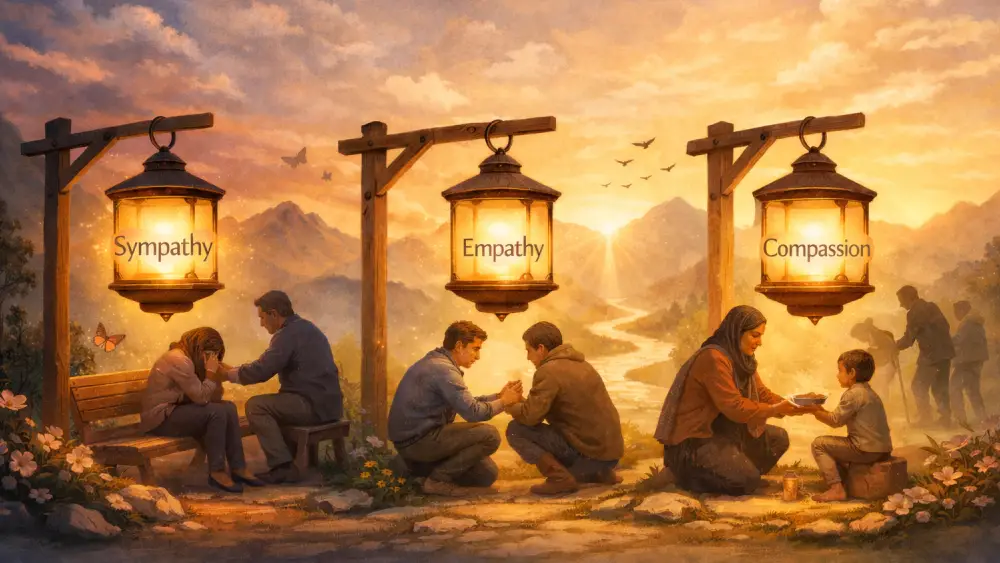
Some words in life are more than just sounds; they are like lanterns in the darkness, carrying within them the very essence of our humanity. They are not just ink on paper but emotions that bridge distances between hearts. Among them, three such words stand as guiding stars: sympathy, empathy, and compassion. At first, they might sound similar, but each has its own depth, its own power. Together, they are the pillars upon which the meaning of humanity rests.
Sympathy is the first step of this sacred journey. It is the gentle acknowledgement of another’s suffering, even if we do not fully understand it. When we whisper, “I’m sorry for your loss,” or sit silently beside someone in grief, that is sympathy in its purest form. It is like standing in the sunlight, watching another person endure a storm. We remain dry, yet we recognise their rain and honour their struggle. This simple act of recognition can be a lifeline, reminding people that their pain has not gone unnoticed, that they do not suffer in total solitude.
Yet sympathy alone is not enough. To move closer to the heart of another is to step into empathy. Empathy is the courage to slip into someone else’s shoes, to see the world through their eyes, to feel their burdens as if they were our own. Sympathy may say, “Don’t worry, things will be fine,” but empathy says, “I understand your fear, because I too have stood where you stand.” Empathy is not looking from a distance—it is walking beside. It is not standing at the edge of the storm—it is entering the rain and saying, “I know how it feels to be drenched.” This creates a bond that words alone cannot achieve.
But the crown of these virtues is compassion. Compassion is the point where sympathy and empathy are transformed into action. It is when awareness and feeling merge into deeds. Compassion does not merely recognise pain or understand it; it seeks to ease it. Sympathy sees a hungry child, empathy feels the pangs of that hunger, but compassion feeds the child with bread. Compassion is love translated into movement, kindness given hands and feet, mercy turned into service.
Among the many examples of compassion throughout human history, none shines as brightly as the life of the Prophet Muhammad. He was called Rahmatul-lil-Alameen, a mercy to all worlds. His compassion was unselective, not limited to ties of kinship or community, extending to the poor, the orphan, the widow, the wayfarer, even animals and the environment. He would feed the hungry before he fed himself, mend his own clothes, and visit the sick without regard to their faith or status.
When an elderly woman who used to insult him fell ill, instead of responding with anger or indifference, he went to her house to tend to her. In amazement, she asked why he would come when she had shown him nothing but hatred. He said compassion is not a bargain; it is a way of life. It should be given selflessly because it is the nature of mercy. Such acts did not weaken him; they magnified him. His compassion softened the hardest of hearts, healed broken spirits, and transformed a society divided by cruelty into one bound by justice and kindness. His life reminds us that true strength lies not in domination, but in mercy. This is the true power of compassion; it does not comfort the sufferer alone; it reshapes the world.
These three words are, for me personally, my greatest happiness. When I see someone in distress and can provide even slight relief, I feel complete. It does not always take money; sometimes it is a few minutes of my time, a listening ear, or a simple smile that becomes a source of comfort. These acts make me feel alive because they give meaning to life itself.
Yet I also know that boundless compassion, if unrestrained, may be hazardous. If we make ourselves endlessly available, some may exploit our kindness, leaning on it not out of true need but out of habit. That is why compassion must always be tempered with wisdom—helping without being consumed, giving without losing oneself.
History has given us glimpses of what is possible. Mahatma Gandhi’s sympathy for the oppressed lit the spark that ignited a revolution built on non-violence. Mother Teresa’s empathy took her into the slums of Kolkata to touch the untouchables and give dignity to the forgotten. Nelson Mandela’s compassion forgave enemies and rebuilt a fractured nation. Each proved, in his or her own way, that greatness does not lie in crowns or titles but in the courage to care. And when we are long gone, we will be remembered not for what we possessed, but for how gently we touched the hearts around us, how deeply we understood others, and how often we lifted the burdens of those who struggled to stand. Sympathy is the spark, empathy the flame, and compassion the warmth that spreads beyond our sight, leaving ripples of goodness long after we are gone.

After all, it is not wealth, power, or prestige that truly matter in life; it is the acts of kindness we extend, the burdens we carry for others, and the love we share.
The great, famous, and revolutionary Kashmiri poet Mehjoor put it succinctly:
Shakl chus insaan, magar insaniyat nish baikhaber.
It means, “One may appear human in form, yet remain unaware of what it truly means to be human.”
This is because egg cells in oogenesis are generated through asymmetrical divisions, whereas they result from equal divisions in spermatogenesis.
(The author is a B.Tech from NIT Srinagar. Ideas are personal.)