In Srinagar’s Old Fateh Kadal, Mohammed Hanief Bhat preserves Kashmir’s fading turquoise jewellery craft, battling neglect, situation and pandemics to keep a dying art alive, reports Asrar Syeed
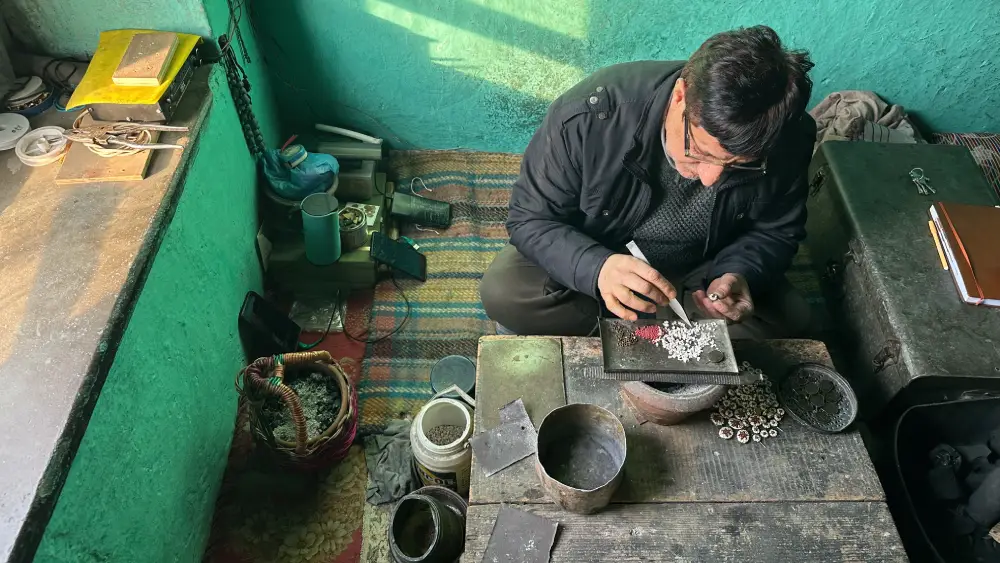
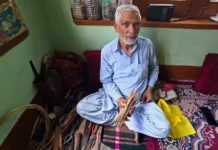
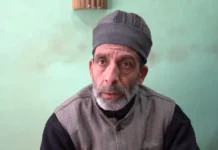
Amid the narrow lanes and congested neighbourhoods of Srinagar’s Shehr-e-Khas is Old-Fateh Kadal, where Mohammed Hanief Bhat, 60, opens his turquoise jewellery workshop daily around 10 am. The shop is part of his inheritance.
It was Hanief`s father, Ghulam Mohiuddin Bhat, who started the art of producing Turquoise Jewellery, locally popular as Manari. As a child, Hanief used to watch his father working with patience and complete determination. This is when he picked the skill.
Turquoise denotes both a distinctive bluish-green colour and a valuable opaque gemstone that ranges from blue to green in hue. Mineral experts believe that turquoise is a hydrated copper–aluminium phosphate, formed through the combination of copper compounds that contain water molecules within their crystalline structure with aluminium, phosphorus, and oxygen. In Kashmiri craftsmanship, turquoise is traditionally sourced in its raw, creamish-green form, locally known as Ladakhi Pashm or Hakkih.
Father’s Loss
The process of working turquoise involves several carefully executed stages: mining, cutting, shaping, and polishing. Mining requires particular care, as turquoise is a relatively soft and brittle mineral prone to damage. Once extracted, artisans cut and shape the stone according to the customer’s desired size and design. The process concludes with meticulous polishing, which enhances the stone’s natural colour, texture, and lustre.
“My father used to earn a nice living from his workshop. There were at least 15-16 people who used to work under him,” Hanief said with sobs and sighs. “During those days, more than 60-70 families used to earn their living through this art. Such was the demand for this product during those days”.
Hanief remembers, as if yesterday, that he was studying in sixth grade when his father`s health started deteriorating quickly. “One day, while lying in his bed, my father called me with a weak voice and told me it`s time you start learning this art and you will carry my legacy forward,” he recalled. “At first, I was very reluctant, but it was my father and people who used to work here who guided me through those early days and with their blessings I learnt this art”. Eventually, his father passed away after a few months, leaving Hanief to manage the business he had created over the decades.
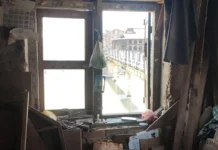
“After my father departed, I shifted my workshop from our house to this little room, which belongs to the local mosque and started working here,” Hanief said. “I introduced new designs over time and tried to create some new products to attract more customers”.
Militancy Erupts
In the late 1980`s, Kashmir witnessed the eruption of militancy, which led to long curfews and crackdowns, bringing business to a standstill. “Business was going well, and I had almost 7-8 workers associated with my business when militancy erupted, resulting in a sharp decline in tourist footfalls,” Hanief recalled. “I was not doing much in sales and could not pay my workers, which forced them to look for other jobs. I, too, started a small STD shop and ran it for several years, then I picked up the skill of electric fitting and practised it for almost two years.” Those days were challenging.
In 1998, Hanief`s sister, who lives in Bangalore, told him to visit Bangalore and participate in one of the exhibitions organised by the than state government for artisans hailing from various states of India. “I took this opportunity and landed in Bangalore and participated there, and to my surprise, people were shocked to find such handmade art still being practised in Kashmir,” he said with surprise of rediscovery. “I sold some of my products and made some good profits”.
Over the years, Hanief used to prepare his products here in Kashmir for six months and then travel to different states across India, such as Kerala, Goa, and Mumbai, to sell them for the rest of the year.
The Lone Artist
“I received a lot of support from governments outside Jammu and Kashmir; they helped me to participate in various exhibitions and often helped in advertisements for my work,” a thankful Hanief admitted. “But some governments in Jammu and Kashmir never paid much attention to this art.”
Srinagar, he said, had several people who were talented and were specialists in this art, but they did not receive any attention or support from the government. “Eventually, this art vanished, and I am perhaps the only artisan who continues to practice this”.
In 2020, when COVID-19 spread across the country and a lockdown was announced by the government, Hanief had to stop his travel to different states, which again led to a sharp decline in his sales.
“I do not want the government to support me financially; rather, they should try to facilitate my participation in exhibitions so an artist like me can showcase his talent to people,” Hanief demanded. “Government should ideally help artisans like me to advertise in advertisements, so our Art reaches the masses”.
Hanief regretted that in Kashmir, the department is encouraging other crafts but is not doing anything that pertains to this ‘dying’ art.
“Even in routine, there were so many workshops in Kashmir taking place about Shawl weaving, carpet weaving, papier mache, wood carving, where the art works were displayed, appreciated and sold,” Hanief pointed out. “Over the years, we have seen a sharp decline in these workshops, which should not have happened.”
The government, Hanief pointed out, must understand that these art forms are not for display, and these are sold, and it involved hundreds of artisans. “If these arts do not get the proper encouragement, the artisans will be forced to shut their shops,” Hanief said. “Maybe this art of turquoise will also die with me.”