In Gojwara’s ageing lanes, Lateef Ahmad Zargar keeps alive Kashmir’s centuries-old silversmithing legacy, even as imports, generational indifference, and absent state support threaten its final breath, reports Tehreem Parvaiz.
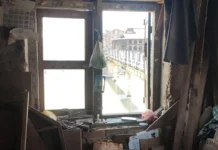
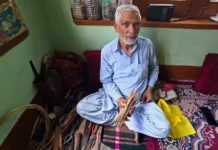
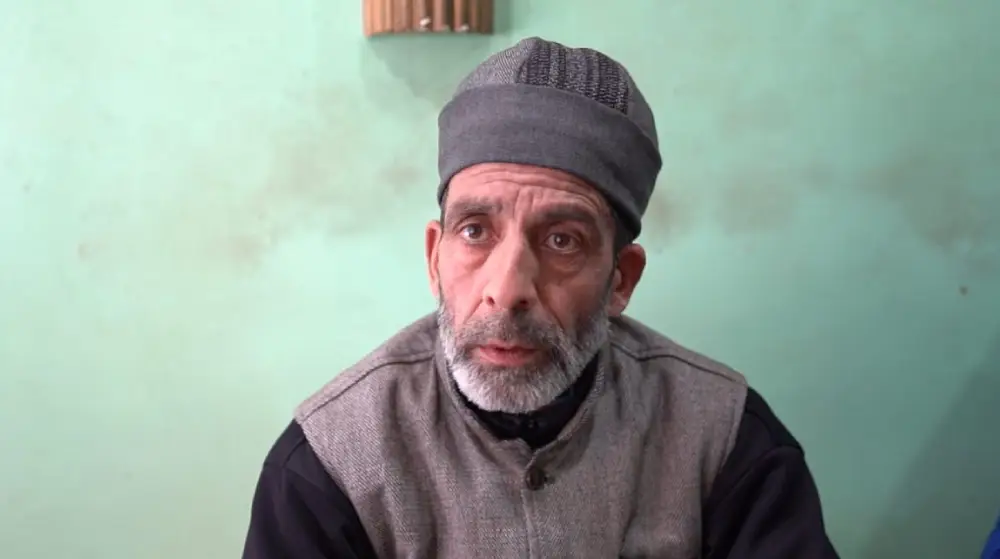
Downtown Srinagar’s oldest quarter, the Shehr-e-Khas, has long been the cradle of Kashmir’s finest crafts. Within its dense, winding lanes lies Gojwara, and within Gojwara, a silver shop that has not closed its shutters since the 1930s. Its board reads GM Bahudin Zargar. Behind the counter sits Lateef Ahmad Zargar, 70, the keeper of a legacy now balanced on the edge of extinction.
Silversmithing is presumed to have arrived in Kashmir in the 14th century from Iran. The knowledge the migrants brought spread across the valley and took permanent root. Over generations, the craft became one of Kashmir’s most defining art forms, woven into the identity of its people and the ceremonies of its brides.
The Zargar family stood at the centre of this world for decades. Lateef’s grandfather, Ghulam Mohammad Zargar, led the Kashmir Anjuman-E-Zargaraan, the unified body of the valley’s silversmiths and goldsmiths. When he passed, Lateef’s father, Bahudin Zargar, assumed that responsibility. Lateef himself entered the trade at 16, learning at his father’s side, and has never left it.
A Handcraft
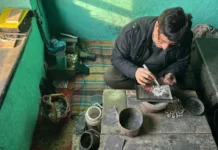
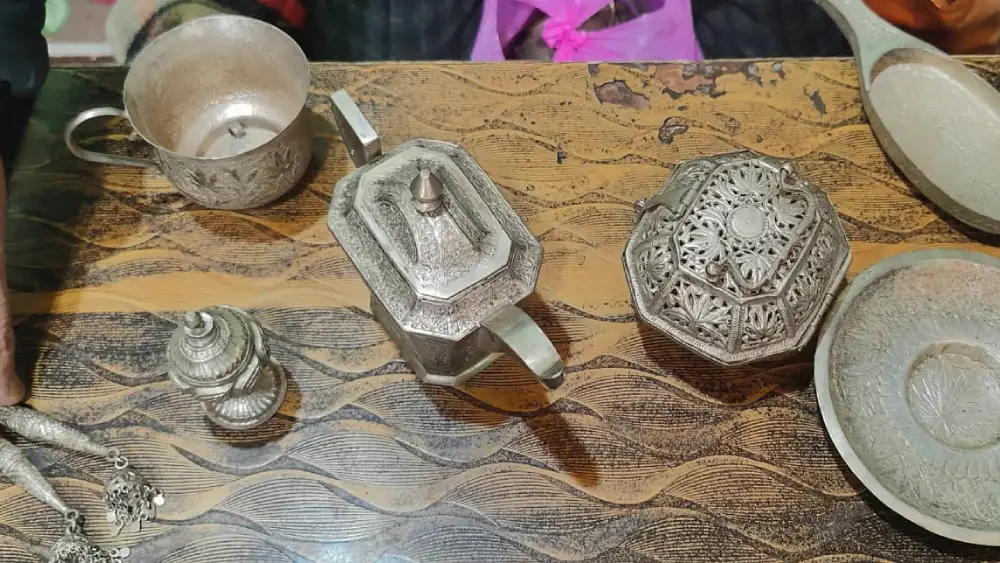
To understand what is being lost, one must first understand what was made. Silversmithing, as Lateef practised it, was a craft of patience and precision. Silver was melted in a bathi, a crucible, and the molten metal was shaped with a tool called an Onguch into blocks. These blocks were then hammered into sheets, and a designer would prepare a Naqsha, an intricate pattern traced over iron, before the engraving began.
The designs drew from the floral landscape of the valley itself: Chinar leaves, lotus, and poppy. Fire was coaxed using a nale, a blow-pipe operated by the craftsman’s own breath, with the named tools of the trade specific and irreplaceable: Dhokur, Bhond, Manan, Punk, Nale and Onguch.
After engraving came the final stages, cleaning, polishing, and gilding, a process that could span days or weeks for a single piece. Brides were among the most important patrons.
“We used to make ornaments for brides, silver combs, silver clips, boxes made from silver, necklaces, rings, silver sets,” Lateef recalled. Every piece was made to a customer’s specification, by hand, from start to finish. His business, he said, was very popular while his father was alive. “Our silver business was very popular till my father was alive. Silver was the gold of that time.”
The Shift
The decline came not from a single blow but from a slow accumulation of pressures. Duplicate silver began flooding in from outside the valley. Machine-made products, faster and cheaper to produce, displaced the hand-crafted. Lateef is clear that the difference between the two remains visible, but the market stopped caring about the distinction. Demand shrank, and with it, livelihoods.
A few decades ago, the whole of Downtown Srinagar was alive with silversmiths. Today, only scattered workshops remain in Khawaja Bazar, Maharaja Gunj, Habba Kadal, Rainawari, and a few shops in Ali Kadal. Even these, Lateef asserted, do not see enough footfall to survive comfortably.
Mew Generation
Lateef’s generation, he admitted, had few alternatives. “Our generations were not focused on studies as much as this generation is,” he recalled. “So our option was only business or any other skilled work.”
For the generation that followed, education opened new doors, and the craft was left behind. No new silversmiths came to replace the ageing masters. The old artisans departed, and no apprentices arrived to fill their place. Among his own brothers, Lateef alone chose to stay, the others preferring jobs over the art. “The old left and the new didn’t learn,” he regretted quietly, “because there is no such demand for this work now. Eventually, this craft will die soon.”
His own children are studying. Asked if they might take over the shop one day, he is matter-of-fact. “First, they will look for jobs. If they don’t find any, then silver-making will be the last option for them.” His eyes filled with tears as he added, “I used to make it on my own. After my father’s death, my three generations are connected with this work. Only I, among my brothers, stayed, and yet it is heartbreaking to see it declining.”
A Plea
The masters of silversmithing who gave this craft its golden era are no longer alive. Lateef raised his hands in grief as he spoke of them, offering a quiet prayer. He carries on, not out of optimism, but because at 70, this shop is all he has. “Many times I wanted to leave this profession,” he admitted, “but this is the only thing I have left now, and because of my age I am not able to do anything else.”
What he wants, above all, is for the government to see what remains and act before it vanishes. The craftsmen still working by hand, spread thinly across a few old bazaars, need support and funds to survive. Without intervention, they will eventually stop.
“I know a couple of people still making silver products by hand,” he informed, “but they may leave this profession too because of the unavailability of support and funds. From your platform, I want to appeal to the government to support the remaining silversmiths, so that it helps to revive this profession and our survival.”
The craft that immigrants from central Asia brought to Kashmir six centuries ago, that clothed brides in silver, that gave Shehr-e-Khas its identity, will die not with a proclamation, but with a locked door and a faded shop sign.
Once a gift. Now a struggle.