by Muhammad Nadeem
While revered as a Sufi saint, Mir Syed Ali Hamdani’s identity as a scholar and author is equally profound. His works on governance, like Zakhirat-ul-Muluk, reveal a thinker attuned to statecraft, while Chehl Asraar and Minhaj-ul-Arifeen showcase his literary and mystical depth.
Mir Syed Ali Hamdani, (may Allah be pleased with him) (712–786AH) fondly remembered in Kashmir as Shah-e-Hamadan, Amir-e-Kabir or Ali Sani (the second Ali) is a towering figure in Islamic history, revered primarily as a Sufi saint of the Kubrawi order. However, his remarkable contributions as a scholar and author, with over 100 books and treatises attributed to him, remain less celebrated. Writing predominantly in Arabic and Persian, Mir Syed Ali Hamdani produced works spanning theology, mysticism, political philosophy, ethics, and poetry, leaving an indelible mark on Islamic scholarship and the cultural landscape of Kashmir.
His intellectual output not only complemented his spiritual mission but also positioned him as a transformative thinker whose ideas continue to resonate.
Mir Syed Ali Hamdani (may Allah be pleased with him) was born in Hamadan, Iran, in 1314 CE, into a noble family with a lineage tracing back to Imam Zain-ul-Abideen (may Allah be pleased with him), a descendant of Prophet Muhammad (peace be upon him). His father, Syed Shahab Uddin, served as an official in Hamadan, while his mother, Syeda Fatimah, linked him to the Prophet through seventeen generations.
His early education came under the guidance of his maternal uncle, Sayyid Ala-ud-Din Simnani, a distinguished Kubrawi Sufi master from Semnan, Iran. This rigorous training in Islamic sciences, including Quranic studies, was further enriched by spiritual mentorship from Sheikh Sharafuddin Mazdaqani. These influences shaped Mir Syed Ali Hamdani (may Allah be pleased with him) into a scholar-saint dedicated to both intellectual pursuit and societal reform, preparing him for his extensive missionary travels.
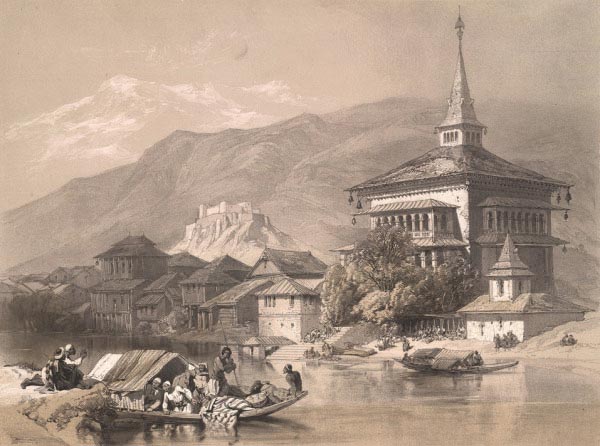
Mir Syed Ali Hamdani’s journeys took him across Central Asia, the Middle East, and South Asia, with tradition suggesting he completed three global tours to spread Islam. His most profound impact occurred in Kashmir, where he arrived during visits in 1372, 1379, and 1383 CE, accompanied by hundreds of disciples, including scholars and artisans. Engaging with rulers like Sultan Qutb-ud-Din, he influenced governance by advocating ethical leadership and mediating peace with the Delhi Sultanate.
Beyond religion, he introduced Persian crafts such as shawl-making and carpet weaving, revitalizing Kashmir’s economy, and establishing the region’s first Islamic library, enhancing access to knowledge. His holistic approach, merging spirituality with practical reform, affirmed his scholarly vision, which found expression in his vast literary corpus.
His writings reflect his versatility, addressing diverse audiences, rulers, spiritual seekers, and common folk while tackling subjects from governance to mysticism. Below, his key works are explored, followed by others attributed to him, providing a comprehensive view of his intellectual legacy.
One of Mir Syed Ali Hamdani’s (may Allah be pleased with him) most acclaimed works is Zakhirat-ul-Muluk, a Persian treatise on political ethics and governance. This book offers a blueprint for just rule, urging leaders to embody justice, tolerance, and mercy as divine mandates.
Mir Syed Ali Hamdani (may Allah be pleased with him) portrays rulers as God’s vicegerents, accountable for upholding Sharia and ensuring societal welfare, including the rights of non-Muslims (dhimmis). Scholars note its emphasis on peaceful coexistence, rooted in divine mercy, while affirms its enduring relevance. Widely circulated in Persianate societies, it influenced governance models into the Mughal era, showcasing Mir Syed Ali Hamdani’s practical engagement with political philosophy.
Another cornerstone of his legacy is Awraad-ul-Fatehah, an Arabic collection of prayers and invocations emphasizing God’s unity and attributes. Recited daily in Kashmir after Fajr and Maghrib prayers, it remains a vital part of the region’s spiritual fabric. Its accessibility reflects Mir Syed Ali Hamdani’s intent to connect with both scholars and laypeople. This work shows his ability to distil profound theological concepts into practices that endure centuries later.
Mir Syed Ali Hamdani’s poetic genius shines in Chehl Asraar (Forty Secrets), a Persian collection of forty poems praising Allah and Prophet Muhammad (peace be upon him). Blending mysticism with literary artistry, makes complex spiritual ideas approachable, aligning with Kubrawi’s themes of divine love and unity.
Risala Nooriya, though less documented, is widely accepted as Mir Syed Ali Hamdani’s work on spiritual illumination. Written in Persian, it explores the inner dimensions of faith, focusing on divine light (nur) and heart purification, core Kubrawi concepts. This treatise exemplifies Mir Syed Ali Hamdani’s focus on the metaphysical aspects of Sufism, complementing his practical writings.
Maktubat, a collection of letters in Persian, offers a window into Mir Syed Ali Hamdani’s role as a spiritual and intellectual guide. Addressed to disciples, rulers, and peers, these epistles provide advice on Islamic practice, spirituality, and ethics.
Notably, a letter to Sultan Qutb-ud-Din critiques unislamic marital practices, illustrating Mir Syed Ali Hamdani’s willingness to engage rulers directly, blending scholarship with reform.
Minhaj-ul-Arifeen, a Persian guide for spiritual seekers, outlines the Sufi path from repentance (tawbah) to gnosis (ma’rifah). Rooted in Quranic exegesis and Sufi ethics, it provides clear steps for enlightenment, reflecting Mir Syed Ali Hamdani’s structured approach to mysticism.
Beyond these widely accepted texts, numerous works are attributed to Mir Syed Ali Hamdani (may Allah be pleased with him), though their authorship is less certain. Kitabul Mawdah Fil Qurba compiles Hadith on love for the Prophet’s family, reflecting his Shafi’i leanings and reverence for the Ahl al-Bayt. Kitabus Sab’ina Fi Fadha’il Amiril Mu’minin lists seventy virtues of Ali ibn Abi Talib (may Allah be pleased him), merging Hadith scholarship with spiritual symbolism.
Arba’ina Amiriyah is a forty-Hadith collection on ethics and piety, while Risala Istilahat-e-Ilm-ul-Qiyafah defines Sufi terminology for clarity and Haqaa’iq Tawbah explores repentance’s metaphysical dimensions. Some of his books delve into physiognomy, linking physical traits to character, and Sharh Qasida Khamriyya interprets Umar ibn al-Farid’s poem metaphorically as divine intoxication.
Some of his booklets outline chivalric ethics, while Wasiyyat-nama and Khilafat-nama are directives to his son, Mir Muhammad Hamdani (may Allah be pleased with him), on spiritual and administrative duties. Dah Qa’idah lists ten Sufi principles, and Rawdhat al-Firdaws abridges Manazil al-Salikeen, focusing on spiritual stages. Miraatu Taibeen, written for a follower, details repentance across four chapters. These works require further verification, but they illustrate the breadth of his intellectual pursuits.
Mir Syed Ali Hamdani’s scholarship transcended theoretical exploration, directly shaping Kashmir’s society. Zakhirat-ul-Muluk influenced rulers like Sultan Sikandar to adopt ethical governance, while Awraad-ul-Fatehah embedded itself in daily worship, fostering spiritual unity. His establishment of khanqahs, like the Khanqah-e-Mualla in Srinagar, built under his son’s supervision, served as centres for learning and charity, reflecting his vision of integrated reform. These institutions, alongside madrasas and libraries, institutionalized his teachings, amplifying his scholarly impact.
His influence extended to Kashmir’s cultural and economic spheres. By introducing Persian crafts, he sparked industries like shawl-making, credited as absent before his arrival, enhancing livelihoods and trade. This practical application of scholarship shows his role as a civilizational architect, merging religion, economy, and ethics into a cohesive framework.
Mir Syed Ali Hamdani’s interactions with local mystics, notably the Rishis, further amplified his legacy. His son, Mir Muhammad, built on this by integrating the Rishi order into Kubrawi Sufism, with Sheikh Noor-ud-Din (Nund Rishi) carrying forward his mission. This synergy of Central Asian and Kashmiri mysticism owes much to Mir Syed Ali’s foundational scholarship, which bridged cultures and traditions.
While revered as a Sufi saint, Mir Syed Ali Hamdani’s identity as a scholar and author is equally profound. His works on governance, like Zakhirat-ul-Muluk, reveal a thinker attuned to statecraft, while Chehl Asraar and Minhaj-ul-Arifeen showcase his literary and mystical depth. His letters in Maktubat and prayers in Awraad-ul-Fatehah show his mentorship and spiritual accessibility. Even the less-verified works attributed to him, spanning Hadith, ethics, and metaphysics, demonstrate his encyclopedic curiosity and influence across Islamic disciplines.
In Kashmir, Mir Syed Ali Hamdani (may Allah be pleased with him) is hailed as the “Shah I Hamdan,” a title earned through his scholarly and championing efforts. His teachings shaped the region’s religious identity, blending Sufi spirituality with local ethos into what became known as Kashmiriyat, a syncretic culture of tolerance. The Khanqah-e-Mualla and his writings remain living testaments to his impact, with Awraad-ul-Fatehah still echoing in Kashmiri mosques.
Mir Syed Ali Hamdani’s legacy endures beyond Kashmir, influencing Central Asia and South Asia through his disciples and manuscripts. His emphasis on justice, compassion, and spiritual growth offers timeless lessons, relevant amid modern challenges of extremism and division. His books, preserved in oriental libraries and recited in daily life, affirm his role as a scholar whose ideas transcended his era.
Mir Syed Ali Hamdani (may Allah be pleased with him) was a multifaceted intellectual whose scholarly contributions matched his saintly stature. His authenticated works reveal a thinker of immense depth, while the broader list of attributed texts shows his versatility.
(The author is a book reviewer, independent researcher, and translator with over a decade of editorial experience in the media and publishing industries. His diverse portfolio includes reviews, essays, and short stories, published in national and international magazines, journals, and anthologies. He is the Founding Editor of Mountain Ink Magazine, and Contributing Editor at Gulshan Publications. He currently serves as a Copy Editor at Kashmir Life. Ideas are personal.)