Perched above the Suru River, where Kargil’s rugged terrain rises in stone and shadow, a small museum safeguards the legacy of a once-thriving Silk Route hub. Humaira Nabi visits Munshi Museum, a space that is more than a collection of artefacts—a gateway to Kargil’s past, preserving the region’s rich history of trade, enterprise, and cultural exchange.
In the heart of Kargil, where the Suru River carves its course through the rugged terrain, a winding path rises toward a place of quiet significance. From this vantage point, the town reveals itself in layers—clusters of homes nestled between the imposing peaks of the Zanskar Range, their shadows stretching across the tangle of market streets below.
A few steps further, where the path converges with history, stands one of Kargil’s most treasured landmarks: the Munshi Aziz Bhat Museum. More than a repository of artefacts, it is a chronicle of the town’s past, preserving the stories of a time when Kargil lay at the heart of trans-Himalayan trade routes.
Named after Munshi Aziz Bhat, a pioneering trader of the early 20th century, the museum was established in 2004 by repurposing the first floor of a family residence. The initiative was led by his grandsons, Gulzar Hussain Munshi and Ajaz Hussain Munshi, who now serve as the museum’s director and curator.
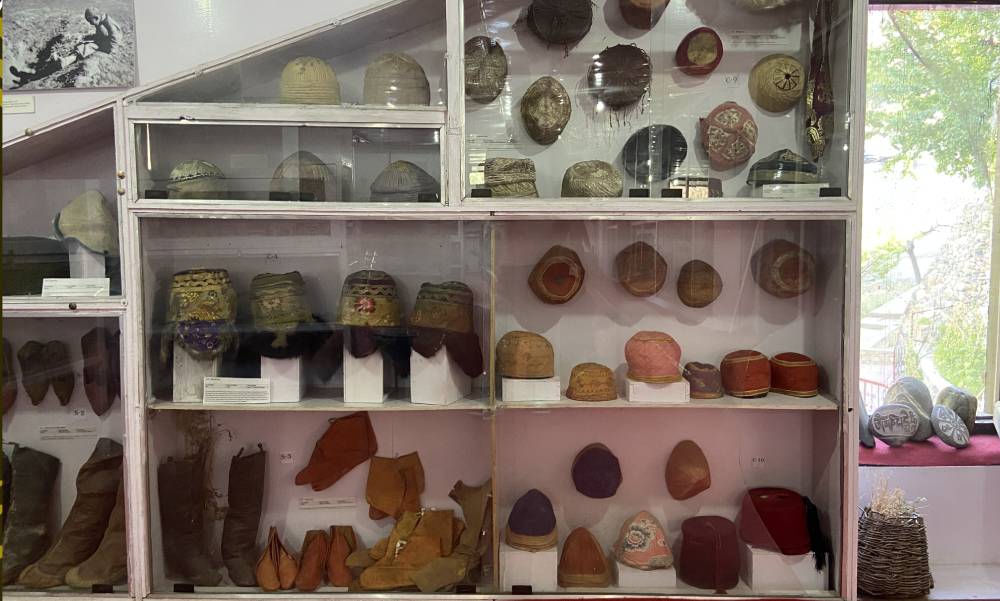
Visitors approach the building by ascending tiled steps from the roadside, their journey culminating in an entryway that opens onto a meticulously arranged collection. Inside, a wealth of objects offers glimpses into the region’s commercial and cultural heritage. Traditional clothing, antique utensils, ancient coins, and battle armour stand alongside relics of long-forgotten trade networks, each item a silent witness to a bygone era.
Munshi, The Merchant
Munshi Aziz Bhat held a pivotal role in Kargil’s administration as the region’s official petition writer under Maharaja Hari Singh. This position placed him at the centre of local governance and economic affairs during a time when trade was dominated by Punjabi Sikh and Hoshiarpuri Lala merchants, who controlled the flow of goods along the trans-Himalayan routes.
Born with an acute sense of commerce, he began his career in the revenue department as a patwari. However, in 1915, drawn to the world of trade, he resigned from his government post to establish a business. That same year, he partnered with Sardar Kanth Singh, an experienced Punjabi Sikh merchant, and together, they set up a retail and wholesale enterprise in Kargil. The business flourished, serving the steady stream of traders passing through the town.
By 1920, confident in his experience, Munshi Aziz Bhat ended his partnership and founded his firm, Munshi Aziz Bhat and Sons, with the support of his two sons and a cousin. The venture expanded rapidly, leaving a lasting imprint on Kargil’s commercial landscape.
Understanding the challenges faced by traders traversing the Himalayan routes, he took a bold step that same year. He constructed Ek Sarai, a vast rest house designed to accommodate merchants and travellers journeying from distant trade hubs such as Kashgar, Yarkand, and Khotan. Measuring 100 by 110 feet, it could shelter between 400 and 500 caravans at a time, providing essential respite for those navigating the harsh terrain.
For decades, the Sarai stood as the epicentre of commerce in Kargil. Merchants from Central Asia, Tibet, and the Indian subcontinent gathered there, not only to trade but to share news and traditions. More than a place of lodging, it became a symbol of Kargil’s crucial role in the trans-Himalayan trade network.
Forgotten Legacy
In 1998, as the Munshi family prepared to demolish the long-abandoned Sarai to make way for a shopping complex, they uncovered an extraordinary collection of artefacts hidden within its crumbling walls. Scattered among the debris were remnants of centuries-old trade—exquisite leather skins, embroidered garments, jewellery, and finely woven carpets from Central Asia. British horse saddles, Italian-crafted buttons, and opulent items from the workshops of the Nizam of Hyderabad lay preserved in the dust of time.
News of the discovery spread quickly, sparking discussions about preserving these relics in a museum. However, the idea seemed ambitious and difficult to realise. Then, an unexpected turn of events reshaped their vision. Anthropologist Jacqueline Fawaks from the University of California arrived in Kargil, carrying a century-old letter written by Munshi Aziz Bhat to a merchant. The letter described a shipment of goods—many of which matched the artefacts unearthed from the Sarai. Intrigued, Fawaks asked to see the full collection.
This encounter led to a week-long exhibition, drawing visitors from across Ladakh and beyond. The overwhelming response reignited interest in Kargil’s mercantile history. Residents, inspired by the display, began donating artefacts of their own, strengthening the call for a permanent institution to safeguard the region’s Silk Route heritage. What had begun as an unexpected discovery evolved into a determined effort to preserve Ladakh’s past, laying the foundation for what would eventually become the Munshi Aziz Bhat Museum.

A Silk Route Archive
The Munshi Aziz Bhat Museum has become a centre for research, drawing scholars from across the world to study its extensive collection of more than 3500 artefacts. It stands as a testament to Kargil’s historical role in trans-Himalayan trade, linking the region with commercial hubs such as Yarkand, Kashgar, Tibet, and Baltistan.
Ajaz Munshi, the museum’s curator, described it as a tribute from the Munshi family to Kargil. “This region once held great significance on the global trade map but has since faded from prominence,” he said. The family’s commitment, he added, is to preserve and promote Kargil’s mercantile past so that its legacy continues to inspire future generations.
Among the museum’s most striking collections is an array of arms and ammunition, including locally crafted Matchlock guns, swords, and Ladakhi bows and arrows, known as Da and ZJu. The display also includes weapons made from Ibex horn and materials used in ammunition production, such as Matchlock bullets called Rindi, sulphur matches from AE Matcheswala, and pellets sourced from Japan and Germany.
Trade and transport played a crucial role in the region’s history, and the museum preserves a remarkable collection of handmade saddles, known locally as Zgah. These include a Mongol wooden saddle decorated with painted papier-mâché and ivory work, an English tooled-leather saddle set, and a Central Asian wooden saddle adorned with metal studs and cloth flaps. Accessories crafted for trade animals, such as engraved copper and silver ornaments, embroidered straps from Central Asia, and beaded bells that signalled the movement of caravans, reflect the region’s rich craftsmanship. A notable artefact is a leather horse strap bearing a British Crown engraving, displayed alongside Central Asian leather straps featuring intricate goldwork.
Textiles and carpets from Central Asia are among the museum’s most prized possessions. Wool and silk carpets from Tajikistan, Kyrgyzstan, Kashgar, Yarkand, and Tibet were highly valued, often exchanged as gifts or used in monastic ceremonies. One of the most distinctive pieces is a red rug featuring floral motifs and a black-necked crane at its centre. Another significant exhibit is a rare Bokhara Namdah, woven in 1822, depicting a tiger and inscribed with the name Mohan Lal, an associate of Sir Alexander Burnes, the Scottish explorer and diplomat involved in the Great Game.
Other sections of the museum explore weights, coins, utensils, and clothing from a vast geographical expanse, stretching from Russia to Britain and across Central Asia. These artefacts provide insight into the intricate web of cultural and commercial exchanges that defined the Silk Route and illustrate the diverse influences that shaped the region’s history.
Kargil and Silk Route
Kargil, historically known as Purig, once served as the region’s capital, including the town itself, the Suru Valley, Shaghkar Chiktan, Pashkyum, Bodh Kharbu, and Mulbek. Governed from Skardu under Baltistan’s administration, it was more than a mere settlement; it was a bustling trade centre strategically located at the intersection of four major markets. Its importance transcended local commerce as it played a crucial role in the trans-Himalayan trade network.
Kargil stood as a vital waypoint along the Treaty Road, a significant branch of the Silk Route that linked China to Central Asia via Kashmir. This route facilitated the exchange of goods, ideas, and cultures across vast and varied terrains. The town boasted a large sarai, or rest house, which provided refuge for weary caravans. Its post and telegraph office enabled long-distance communication, cementing Kargil’s status as an essential hub for trade and transit.
Bustling Bazaar
“Merchants and travellers who arrived in Kargil rarely left without visiting the small market at its centre,” Ajaz Munshi, a local historian, said. The bazaar, though modest in size, was a hive of activity, offering tea, sugar, cotton from Bombay and Manchester, kerosene, glass ornaments, and handcrafted goods. Traders from Kashgar, Khotan, and Kashmir flocked to this lively hub.
Among the market’s most prized commodities were silks and gemstones, whose shimmering presence lent an air of enchantment to the bustling scene. “Kargil’s significance reached far beyond the region. Caravans from Uzbekistan, Tajikistan, and Kyrgyzstan frequented the town, while merchants from Kashgar, Urumqi, and Yarkand brought jade, porcelain, and tea,” Munshi added. “In return, they sought pashmina wool and Kashmiri saffron, making Kargil a melting pot of cultures and commerce.”