by Iqbal Ahmad
For centuries, Kashmir’s ancient past remained fragmented. Modern archaeological and numismatic research has reconstructed the region’s Greek, Scythian and Parthian connections, reshaping understanding of north-west India’s early history.
There were several significant chapters of ancient Indian history which, till late, were almost in shambles, and no systematic account was available to understand the historical picture of ancient India, particularly of its north-western parts, which also included Kashmir.
Since time immemorial, the north-western parts of India have witnessed invasions of foreign tribes and rulers. (Here I am referring to undivided India, which included parts of present-day Afghanistan, Pakistan, and North India.) Since these regions are geographically located to the south of the great Hindu Kush, the rising tribal powers towards the north of the Hindu Kush in the Bactria region (modern-day Balkh) would always attempt to cross over the Hindu Kush to occupy the north-western parts of then India.
In this context, mention may be made of a few significant tribes, which included Indo-Greeks, Indo-Scythians, Indo-Parthians, Kushans, Kidaras, and Huns. These tribes, one after the other, crossed the Hindu Kush and occupied the north-western regions of then India, which included parts of Jammu and Kashmir. These developments are now well recorded in modern historical records and are believed to have taken place from circa 230 BC to 700 CE. In fact, the first three foreign tribes in indigenous Indian records are also mentioned by Indian terminology. For example, the Indo-Greeks are called Yavanas, Indo-Scythians are known as Śakas, while Indo-Parthians are referred to as Pahlavas.
Archaeological Researches
Indeed, the literary sources to know about their history are not so common. There are no such written records available from that period for historians. In fact, these have been slightly mentioned in a few Chinese and Greek sources and in certain indigenous records, but not so systematically and elaborately.
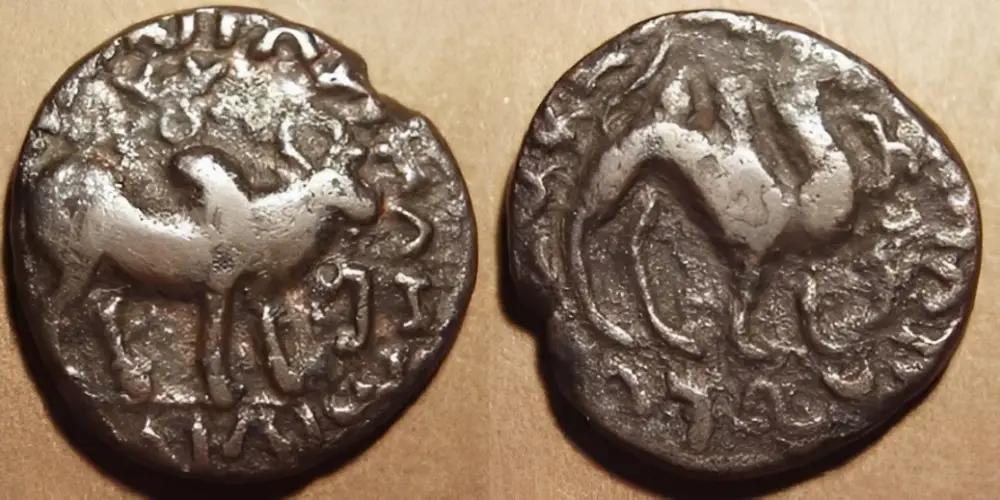
However, with the introduction of modern archaeological research during the 19th century, archaeologists, numismatists, and epigraphists of the modern age did a tremendous job in discovering and studying archaeological and numismatic materials of these ancient civilisations, which included the material culture of these foreign tribes.
The modern-age numismatists and archaeologists, through their outstanding research, have provided a scientific account of these foreign tribes of the subcontinent. In view of these accounts, Indian history was reconstructed, and a new picture of ancient Indian history was uncovered, which provided an authentic view of these periods.
Numismatic Researches
Experts have done a great job in deciphering early Greek, Scythian, and Parthian coins and epigraphs which have been encountered and found in these parts. These coins are inscribed in classical Greek and Kharoshthi scripts, which carried names of their issuers—besides kings, religious symbols were also displayed on these coins. These aspects helped numismatists to interpret the coins.
It was not an easy task to decipher these coins and read their legends, but European experts, with their extraordinary talent and knowledge, did this job. They deciphered and arranged the coins in chronological order. The European experts to whom credit is due for this type of research include James Prinsep, Alexander Cunningham, C.J. Rodgers, E. Thomas, Lassen, Wilson, and Brown. These are the archaeologists and numismatists who set up a tradition of numismatic research and decipherment.
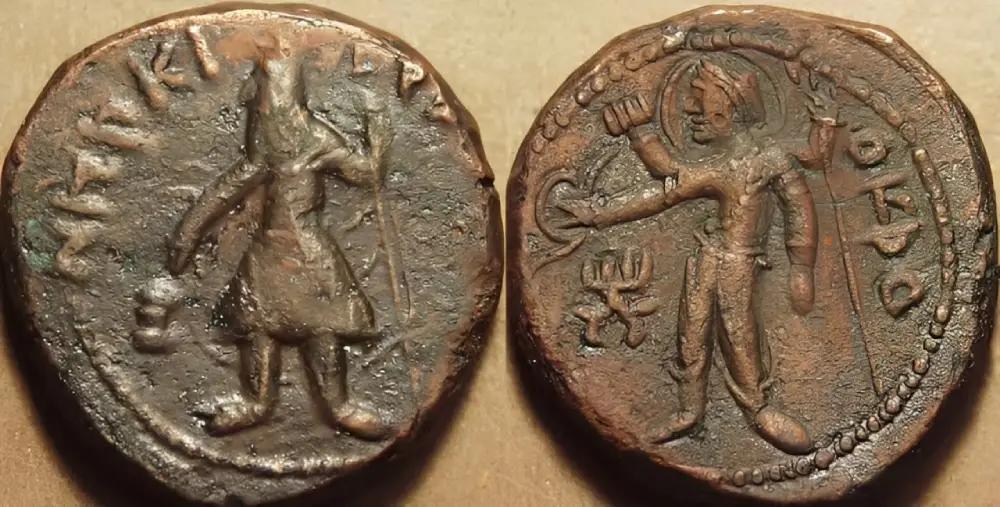
It is based on their research that several monographs on such coins were authored by later scholars. The most interesting and perhaps the oldest monograph on coins is that of Von Sallet, whose scholarly acquirements and solid numismatic judgement enabled him to correct many points in the theories of his predecessors. James Fergusson’s and Prof. Cowell’s researches have also been of great value.
Nowadays, many catalogues of Greek, Scythian, and Parthian coins are available. Most numismatic collections from India, Pakistan, and Afghanistan that reached Europe stand well identified, documented, and catalogued.
The British Museum has its own well-published catalogues of Roman, Greek, and Scythian coins found in India, Pakistan, and Afghanistan. Many South Asian museums have good collections of artefacts and coins about the Greek, Scythian, and Parthian tribes. The Kabul Museum (Afghanistan), Peshawar Museum (Pakistan), Punjab Museum Lahore (Pakistan), Indian Museum Kolkata, and Kashmir Museum Srinagar have good collections of these coins. In a few of these museums, these coins are also well published, but at several places in India, Pakistan, and Afghanistan, these coins are still to be studied and interpreted.
On the other hand, contemporary archaeologists and numismatists are carrying forward the mission of their predecessors. As a result, more monographs are coming to the book market with more scientific approaches and observations. Difficult questions bearing on old studies have also been addressed well.
The book Greeks in Bactria and India by NK Narain opened up new phases of research into the Greek occupation in Indian regions. Renowned numismatists such as Dr David MacDowall, Dr PL Gupta, Michel Mitchiner, and Osmund Bopearachchi, besides deciphering these coins, have carried out systematic studies and documented their find-spots.
Michel Mitchiner, in his monumental book Classical World, assigned a chapter to Jammu and Kashmir, where he documented several Indo-Greek and Indo-Scythian coins, which he believed were issued in parts of Jammu and Kashmir. It was because of these scientifically based researches that the Greek and Scythian occupation of the subcontinent during the 2nd and 1st centuries BC was established, and more than thirty-three Bactrian-Greek and Indo-Greek rulers were identified as having ruled over the north-western parts of the subcontinent, including Punjab and Jammu and Kashmir.
Ancient Greeks
When we talk about evidence of ancient Greeks in the Indian subcontinent, we have to take into account three consecutive phases of the Greek period and discuss them in light of evidence found within the borders of this land. In earlier times, the Greek period of northern India remained largely unexplored. However, in modern times, several researchers have thrown light on Greek evidence found in the north-western parts of India and erstwhile Jammu and Kashmir.
Broadly speaking, the Greek period is classified into three major phases:
The first period relates to the expeditions of Alexander the Great in the mid-4th century BC.
The second period is associated with Bactrian Greeks, emerging from Bactria (Balkh) under Diodotus I in the mid-3rd century BC.
The third phase is associated with Indo-Greeks, emerging under the dual leadership of Demetrius and Eucratides around 150 BC.
Although ancient Greek, Scythian, and Parthian evidence from Afghanistan, Pakistan, and northern India has been documented, the chapter of Jammu and Kashmir largely remained unexplored. Very little research was undertaken by a few European and Indian experts. Alexander Cunningham was the first European scholar to identify Greek and Roman influences on Kashmiri architecture and claimed to have found Indo-Greek and Indo-Scythian coins from the upper Jhelum Valley.
In the year 2000, I also undertook research and documented some of this foreign evidence, interpreting it in light of published works by PNK Bamzai, GMD Sufi, and SL Shali. I first wrote a booklet titled Greek–Kashmir in 2004, documenting and cataloguing silver Greek, Scythian, and Parthian coins found in museum showcases. These coins reached the museum around 1900, though their find-spots were unrecorded.
I presumed that these coins reached the museum either through gifts or purchases, with their find-spots likely in Punjab or Jammu and Kashmir. GB Bleazby, the first museum keeper, mentioned these coins but did not record their provenance. This was the first systematic cataloguing and documentation of these coins. Similar coins were found catalogued in the British Museum, which helped me decipher and publish them in my first numismatic paper.
Later, I wrote a paper titled “Ancient Greeks in Kashmir”, published in 2008 on the Kashmir Forum Blog by Dr Vijay Sazawal.
My first book, Greek–Kashmir, attempted to establish missing links in ancient Kashmiri history through numismatic evidence. It provided a systematic study of Greek, Scythian, and Parthian coins found in Kashmir.
Nilmatpurana and Rajatarangini
These works invited debate and mixed responses. While many scholars appreciated them, some argued that Nilmatpurana and Rajatarangini were sufficient sources. However, it is precisely through written sources that physical evidence from archaeology and numismatics can be interpreted scientifically.
My later book, Ancient Greeks in Kashmir (2011), published by a Delhi-based publisher, attempted to reconstruct missing links using coins and artefacts, clearing uncertainties surrounding shadowed periods.
Kalhana’s Rajatarangini presents unclear accounts of several ancient events. Modern archaeological and numismatic research since the 20th century, adopted in Jammu and Kashmir from 1913 onwards, has helped frame a more data-based historical picture.
Alexander the Great
Although Kashmir is not mentioned in Alexander’s records, he appears in local tradition as Sikander-e-Azam. Persian literature, especially the Sikandarnama, narrates his expeditions. A Kashmiri translation by Maulvi Siddiqullah was published in 1979.
Alexander’s silver tetradrachm is preserved in the SPS Museum, Srinagar, and stands well documented.
Local Storytellers
Traditional Kashmiri storytellers (Dastan-gou) narrated tales of Sikander-e-Azam, Rustam-Sohrab, and others in night-long gatherings. Greece is locally known as Younan, a term also associated with Unani medicine, widely practised in Kashmir.
Alexander is also known as Yavan Raza or Wan Raz, referring to a fair-complexioned prince, possibly Alexander, Demetrius, or Menander.
Yavan Raj Kingdom
The Indo-Greek (Yavan Raj) Kingdom was a Hellenistic empire extending from Bactria into Afghanistan, Pakistan, north-west India, and parts of Jammu and Kashmir. Founded by Demetrius in the 2nd century BC, it was ruled by over thirty kings, with Menander (Milinda) being the most famous.
Kalhana mentions Yavanas and Mlecchas as foreign tribes. Folk traditions preserve terms like yava and yavana raza, referring to fair-complexioned rulers.
Hellenistic Evidence and Architecture

Hellenistic influence is evident in Kashmiri terracotta, stone, and bronze sculptures from sites such as Ushkar-Baramulla, Harwan, Parihaspora, Semthan, Devesar, and Ambren-Akhnoor. Architectural remains, locally called Pandav Lari, show strong Greek influence, as observed by Alexander Cunningham in his essay on Kashmiri temple architecture.
These ruins, stretching from Uri to Martand, reflect remarkable craftsmanship comparable to ancient Greece and Rome.
Finally, archaeology, numismatic, and epigraphic studies must not remain confined to museums but should be actively studied and interpreted to reconstruct the political, economic, scientific, and cultural history of human civilisation.
(The writer is a senior archaeologist and author. Ideas are personal.)