by Mir Tariq Rasool
A poet is perpetually engaged in dialogue—sometimes with nature, sometimes with themselves, and often with words, pain, or beauty. This poetic conversation flows ceaselessly, even in silence.
Professor Rehman Rahi was a poet of many shades, a thinker of varied expressions, and a voice of profound complexity. To some, he appeared as a Westernised poet, while others viewed him as anti-tradition, a revolutionary who reshaped the poetic consciousness of a beleaguered nation during tumultuous times.
Critics often debated whether he played with words or with thoughts, but to all, he remained a poet, a critic, and an academician deeply rooted in the struggles of his era. Few recognised that his inner self remained steadfast amidst the chaos that sought to silence every conscious voice. Yet, he emerged as a figure of clarity, articulating his thoughts and emotions with artistic precision, employing a rich array of poetic devices to elevate his craft.
Like his predecessor Dina Nath Nadim, Rahi was a product of the progressive movement, deeply influenced by Marxist literary thought, as evident in his collection Nawroz-e-Saba. However, his imaginative power, evolving thought process, and mastery of assimilation, aesthetics, irony, ambiguity, symbolism, and imagery infused his poetry with modernist, existentialist, and surrealist tones, creating a unique artistic form. Rahi’s work cannot be confined to a single style or shade; his poetry is a tapestry of diverse themes, styles, and diction.
While some associate him with Western poetic traditions, drawing parallels between his poem SoounGaam and T.S. Eliot’s The Love Song of J. Alfred Prufrock, others find in his work the resonance of classical influences. In Nawroz-e-Saba, Rahi’s progressive literary thought is unmistakable, yet his poem Thoni Russ Sadaa evokes the spiritual depth of Abhinavagupta’s Anubhava-nivedana-stotra. At times, his work reflects the intensity of bhairavamudrâ, as seen in Sona Lank, while elsewhere, he adopts the descriptive techniques akin to Abhinavagupta’ssâmbhavîmudrâ. Rahi’s poetry, thus, defies singular categorisation, embodying a synthesis of the traditional and the contemporary, the local and the universal.
Rahi never strayed far from his roots, even as he embraced new styles to enrich his art. While his work often echoes the modern diction of the West, it remains firmly anchored in the traditions of Mehjoor and Dina Nath Nadim. The influence of Abdul Ahad Azad is also discernible in his poetry. As a deeply read and conscious poet, Rahi sought to position his art beyond the confines of his nation, adorning it with the prevailing trends of his time—modernism, nationalism, progressivism, and existentialism—each woven into his verses with aesthetic precision. A thorough hermeneutic analysis of Rahi’s poetry reveals layers of philosophical depth, offering scope for both phenomenological and ontological interpretation.
Rahi was a champion of change and evolution, perpetually striving for uniqueness. In this pursuit, he often transcended conventional boundaries, driven by the reality he envisioned throughout his literary career. In the introduction to Nawroz-e-Saba, he reflects that new thoughts give rise to new ideas, new realities awaken fresh dreams, and these dreams, in turn, guide the course of emerging realities. To realise these dreams, Rahi took bold steps beyond tradition, refusing to remain static. At times, he even disregarded the rigid rules of prosody—Ourooz o Ahang—traditionally deemed essential to poetry. Instead, he focused on crafting his lexicon in innovative ways, achieving diverse structures and meanings that resonated with both spectacle and melody.
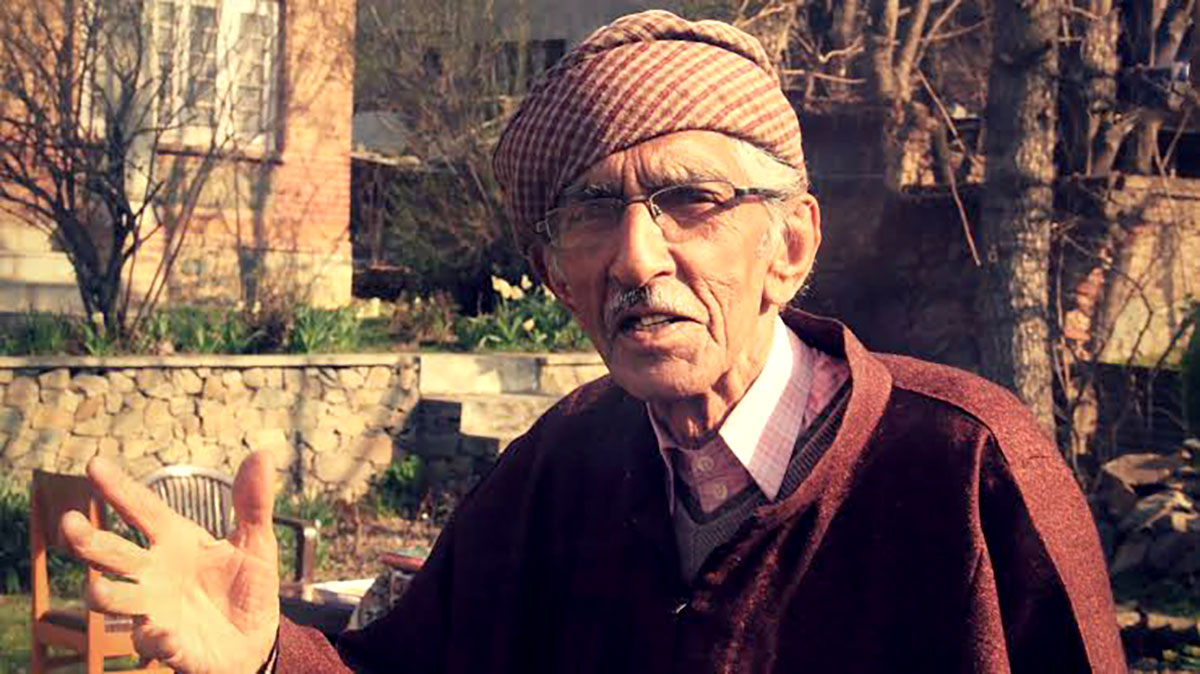
Drawing on Aristotelian mimesis, the philosopher Paul Ricoeur emphasised the interplay of spectacle, melody, and lexis as instrumental to artistic creation. Rahi masterfully incorporated these elements into both his Nazms and Ghazals, producing striking literary works that continue to captivate readers. His ability to harmonise tradition with innovation, form with freedom, and think with expression remains a testament to his enduring legacy.
A poet is perpetually engaged in dialogue—sometimes with nature, sometimes with themselves, and often with words, pain, or beauty. This poetic conversation flows ceaselessly, even in silence. At times, the poet speaks of individual suffering; at others, they articulate the collective anguish or triumphs of a nation. Like his contemporaries, Rahi sustained this dialogue, whether with the Zabarwanhills or the mythical Sonlank, exploring the essence of ‘Being’.
Contrary to the claim that he was a “poet of silence”—a label perhaps born of his perceived indifference or reticence in the face of public suffering—Rahi was anything but silent. His poetic collection On the Pier of Bridge (KadlaThatis Peth) stands as a testament to his ability to give voice to the people’s pain. Those who doubt his engagement with societal struggles need only read his 2000 acceptance speech for the Sahitya Akademi Fellowship, which unequivocally dispels the notion of his silence in the face of human suffering.
Rahi entered a world teeming with global intellectual ferment, where political, philosophical, and social ideologies—realism, romanticism, modernism, Marxism, and countless other ‘-isms’—were flourishing. Yet, his homeland remained ensnared in a profound crisis, one that persisted throughout his life.
Rahi, acutely conscious of the harsh realities surrounding him, chose poetic language as his medium to connect with his audience during these destitute times. In moments of hardship, people invariably turn to poets and leaders, seeking solace and guidance. The German poet and philosopher Friedrich Hölderlinposed a poignant question in his 1801 elegy Brod und Wein(“Bread and Wine”): What purpose do poets serve in times of need?
Martin Heidegger revisited this question, concluding that a poet must descend into the Abgrund (abyss) and sing of Dasein (existence) during such periods. Rahi, too, was acutely aware of the destitution of his era, lamenting the departure of the gods and summoning his inner poet to articulate the Heideggerian Dasein in his poem Shaiy’r (Poet).
Rahi not only responds to Hölderlin and Heidegger but also aligns himself with other poets of destitute times—Charles Baudelaire, who depicted the poet’s plight in the modern age; Stéphane Mallarmé; WB Yeats; and Rainer Maria Rilke. In his own words, Rahi defines the poet as:
A dewdrop that walks to soothe burning petals,
A cascade that flows to cut through mountains,
A breeze that runs to stir the oceans,
A gaze of love that makes the lotus blossom,
A bulbul that dreams of spring in winter.
Through these lines, Rahi captures the essence of the poet’s role—a force of solace, transformation, and hope, even in the bleakest of times.
Rahi, acutely attuned to the anguish of his times, often sought to convey this pain with an aesthetic sensibility that resonated with his audience. At times, he found solace in the act of creation itself, as reflected in his line from Nowroz-e-Saba: Shaiyru sasaan chi zakhman zevanyen (The poet makes wounds speak). On other occasions, he turned to the symbolic heights of Zabarwan for comfort and resolution, as expressed in KadlaThetusPeyth: Kiyasoonchyethmeytzevdyechtaals, zar chu zabarvun baalus peyth (What the mountains could not say, the gold of Zabarwan has uttered).

In conclusion, Professor Rehman Rahi was a multifaceted poet, critic, and writer who bequeathed a rich legacy of poetry and critical thought. He cannot be confined to the labels of modernism or progressivism alone; rather, he was a poet-philosopher whose work demands exploration alongside his contemporaries, such as Professor Rashid Nazki and Amin Kamil, within the framework of modern scholarly inquiry. His writings call for deep research and nuanced interpretation. It is imperative to move beyond mere rhetoric and establish a robust poetic and literary discourse grounded in the treasure trove of works left behind by poets like Rahi. Only then we might fully appreciate the depth and breadth of his contribution to literature and think.
(Former Secretary Adbi Markaz Kamraz, the author serves as a patron of the Kashmir Literary and Philosophic Foundation. The views expressed are personal.)