SRINAGAR: The abundance of fish in Manasbal Lake is closely tied to the lake’s water chemistry, with a two-year study finding that nine environmental variables together explained 91.2 per cent of the variation in fish abundance. The researchers found that fish were most abundant when total dissolved solids exceeded 150 mg/L, dissolved oxygen was above 8 mg/L and water temperature was above 15°C. In contrast, higher levels of total phosphorus and electrical conductivity were associated with declining fish abundance.
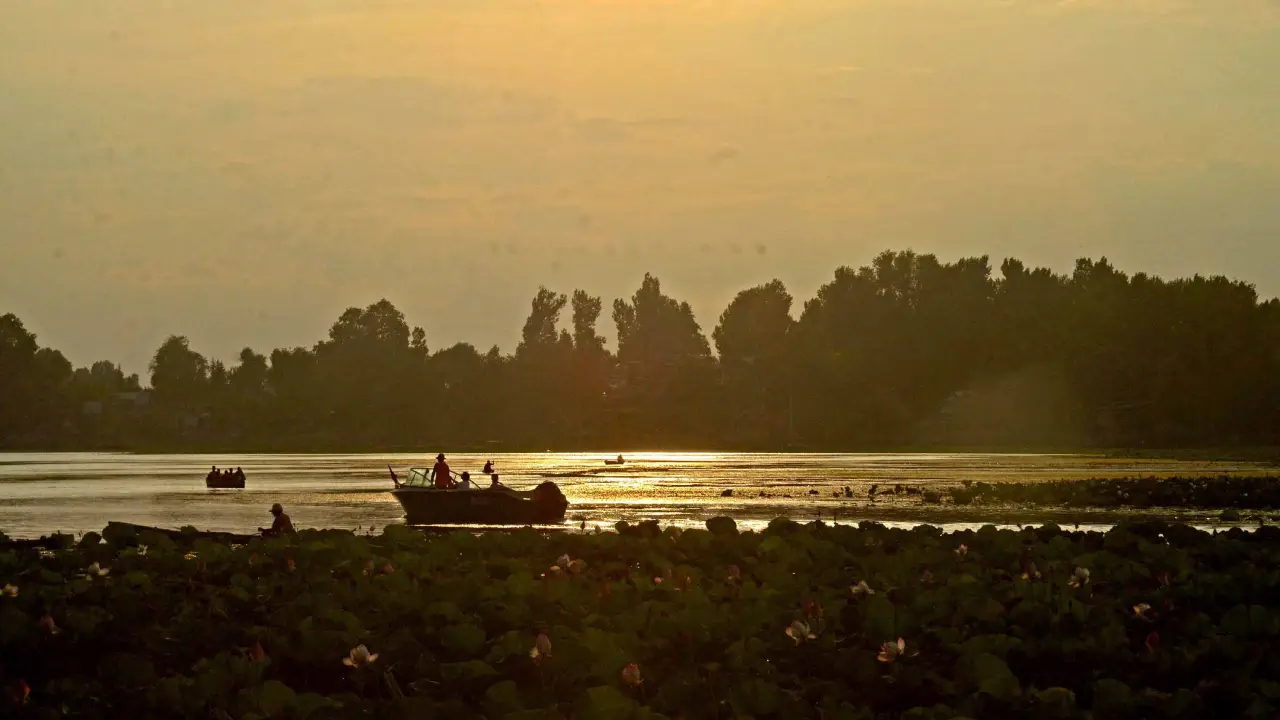
The study, conducted between August 2020 and July 2022 at three locations in Manasbal Lake, identified eight fish species belonging to two families, including three native species – Schizothorax niger, Schizothorax curvifrons and Crossocheilus diplochilus – and five species classified by the researchers as exotic: Pethia conchonius, Gambusia holbrooki, Cyprinus carpio var. communis, Cyprinus carpio var. specularis and Carassius carassius.
Published in 2024 in Water Science (Volume 38, Issue 1), the paper, Evaluating drivers of spatio-temporal variability in fish fauna of Manasbal Lake of Kashmir Himalayas was authored by Tabasum Yousuf, Saima Andrabi, Shaista Javaid, Sinan Nissar and Yahya Bakhtiyar. All authors are associated with the Fish Biology and Limnology Research Laboratory, Department of Zoology, University of Kashmir, Srinagar. The paper was published by Informa UK Limited, trading as Taylor & Francis Group.
The Findings
The researchers sampled water and fish every month at three sites for two years. Twelve water-quality parameters were measured, including water temperature, dissolved oxygen, pH, alkalinity, chloride, free carbon dioxide, nitrate, nitrite, total hardness, electrical conductivity, total phosphorus and total dissolved solids. Fish were collected using cast nets, gill nets and bag nets and identified using standard taxonomic keys.
The researchers then used two statistical techniques – the Generalized Additive Model (GAM) and Redundancy Analysis (RDA) – to determine how environmental conditions were associated with fish abundance and species composition.
The most important finding came from the GAM analysis. Of the individual environmental variables tested, total dissolved solids (TDS) had the strongest influence on fish abundance, followed by dissolved oxygen, water temperature, total phosphorus, electrical conductivity and nitrate.
When the researchers combined nine variables – TDS, dissolved oxygen, water temperature, alkalinity, chloride, total phosphorus, nitrate, total hardness and electrical conductivity – the resulting model explained 91.2 per cent of the deviance in fish abundance.
The study identified specific environmental thresholds associated with higher fish abundance. These included TDS above 150 mg/L, dissolved oxygen above 8 mg/L, water temperature above 15°C, alkalinity above 135 mg/L, chloride above 15 mg/L, nitrate above 125 µg/L and total hardness above 200 mg/L. Higher abundance was also associated with relatively low total phosphorus – between 100 and 150 µg/L – and electrical conductivity between 200 and 250 µS/cm.
Importantly, the researchers found that fish abundance declined as total phosphorus and electrical conductivity increased.
The study therefore does not suggest that every increase in a water-quality parameter is beneficial. Rather, it shows that fish abundance is associated with particular environmental conditions and that the relationship can change once certain levels are exceeded.
Diverse Fish Habitat
The research also found striking differences between the three sampling locations.
Sites 1 and 3 were predominantly occupied by Crossocheilus diplochilus, Pethia conchonius and Gambusia holbrooki. Site 2, the deepest and clearer central section of the lake, was dominated by Schizothorax niger, Schizothorax curvifrons, Carassius carassius and the two recorded varieties of common carp.
The researchers linked these differences to habitat and environmental conditions. Gambusia holbrooki, for instance, was particularly abundant at Sites 1 and 3 during spring and summer, habitats characterised by shallow, calm water and abundant vegetation.
The paper notes that some species preferred the lake’s littoral areas, while others were more strongly associated with deeper, clearer open-water zones and submerged vegetation.
The RDA analysis reinforced this spatial separation. The first two RDA axes accounted for 95.6 per cent of the variation in the eight fish species. RDA1 alone explained 86.63 per cent, with strong positive associations with nitrate, nitrite and total hardness and negative associations with total phosphorus, TDS and water temperature. RDA2 explained another 8.98 per cent and was strongly associated with free carbon dioxide, alkalinity and total hardness.
The species themselves also responded differently to these variables. Schizothorax niger and S. curvifrons, along with Carassius carassius and the two carp varieties, were positively associated with nitrate, nitrite and total hardness but negatively associated with total phosphorus, temperature and TDS. By contrast, C. diplochilus and P. conchonius were positively associated with free carbon dioxide and alkalinity and negatively associated with electrical conductivity, total phosphorus, nitrate and nitrite. G. holbrooki showed positive associations with TDS, total phosphorus, conductivity and temperature.
Human Pressure
The study also provides evidence of the different pressures operating around Manasbal.
The three sampling sites were deliberately selected to represent different levels of human influence. Site 1, near the lake entrance, is heavily used by tourists, fishermen, shikaras and motorboats. Site 2 lies in the lake’s deepest central section and was described as having clearer water and less emergent vegetation and pollution. Site 3, on the northern side, is adjacent to a village where household sewage and agricultural pollutants enter the lake; the researchers also noted blooms of macrophytes there as an indicator of pollution.
Seasonal measurements further illustrated these differences. At Site 3, for example, total hardness reached 239.17 ± 13.65 mg/L in summer, nitrite reached 29.42 ± 16.10 µg/L, electrical conductivity rose to 372.83 ± 73.4 µS/cm, and dissolved oxygen reached 9.9 ± 0.9 mg/L in winter.
The researchers associate some of the seasonal changes with human activity. They write that summer peaks in TDS were “likely due to increased drainage from nearby communities, agriculture, and mining”, while higher total hardness at Site 3 was attributed to household, agricultural and mining activities along with sewerage.
Electrical conductivity was also highest in summer, which the researchers linked to toxic metal-ion discharge and the breakdown of organic material.
The Significance
The significance of the research lies in showing that monitoring fish populations alone is not enough. The fish community provides a biological picture of the condition of the lake, while the water-quality variables help explain why particular species occur in particular places and seasons.
The authors say their findings “confirm that TDS, water temperature (WT), and dissolved oxygen (DO) have the most significant influence on the abundance of fish populations.”
They also caution that the observed fish abundance is influenced by the fishing methods themselves. The study used three types of gear, and the researchers note that different mesh sizes can selectively capture different sizes of fish. Gill nets may under-represent fish outside their target size range, while bag nets favour smaller and juvenile fish. This means observed abundance should be interpreted with some caution.
The paper ultimately argues that maintaining suitable environmental conditions is essential to sustaining Manasbal’s fish diversity. Its conclusion says the findings can help formulate “effective conservation and management strategies” for the sustainable preservation of fish resources in the region.
The research was carried out by Tabasum Yousuf, Saima Andrabi, Shaista Javaid, Sinan Nissar and Yahya Bakhtiyar. According to the authorship statement, Yousuf handled field sampling, sample analysis, statistical analysis and manuscript preparation; Andrabi conducted field sampling, sample analysis and statistical analysis; Javaid contributed to statistical analysis and manuscript preparation; Nissar worked on study design, sample analysis, statistical analysis and manuscript preparation; and Bakhtiyar led study design, research supervision, statistical analysis, manuscript preparation and editing.