by M J Aslam
Sheen, the Kashmiri term for snow, is deeply ingrained in the region’s rich oral and written traditions. It is frequently suffixed to numerous adjectives, nouns, verbs, idioms, and folktales in the Kashmiri language.
The Kashmiri language, spoken by inhabitants of the Kashmir valley and neighbouring regions, belongs to the Indo-Aryan Dardic group of languages. This linguistic heritage is shared by the people of Gilgit, Chilas, Indus and Swat Kohistan.
The word Sheen, meaning snow, has its roots in the Shina language of the Shin or Shina people of Dardistan or Kohistan of the Indus Valley. This region, known as the country of Shins, is inhabited by the Shin people.
The term Dardistan was first used by Orientalist and Gottlieb William Linguist Leitner in 1866, borrowing from Kalhana. According to Brahman mythology, Dardistan refers to the country of Dardas. However, the Dards were also described as Pishakas – a clan of demons with a terrifying appearance and brutal character.
As noted in the Linguistic Survey of India, the name Dard implies a people who ate raw flesh. Despite this, the terms Dard and Dardistan have been retained to collectively describe the tribes and countries in question, including their culture and language.
In modern times, the inhabitants of the Tulail Valley of Gurez have retained the title of Dardas. The snowy regions of Kashmir are also inhabited by people from Gilgit, Chilas, Astor, Daryl, Hunza, Nagar, Yasin, Chitral and parts of Kafiristan on the border.
The residents of Gurez, despite their Shina origins, possess a unique linguistic ability, speaking three languages: Gurezi, Kashmiri, and Punjabi. The influence of Punjabi dates back to 1819 when Sikh and later Dogra forces established garrisons in the area.
Gurez served as a strategic gateway to the Shina land of Gilgit. The Kashmiri influence on Gurezi, however, is rooted in centuries-old cultural, religious, and trade connections between the Gurezis and Kashmiris. This relationship has resulted in Gurezi being heavily intertwined with Kashmir and its people.
According to Leitner and Drew, the Gurezi language has been significantly influenced by Kashmiri. In contrast, Grierson noted that the Gurezi and Kashmiri dialects differ. The Linguistic Survey of India supports Grierson’s assertion.
Historically, the territory of Gurez extended beyond its current boundaries, encompassing areas up to Kunzalwan, Tragbal, Khoyihama, Bandipora, and Wular Lake in Kashmir.
Gurez has been described as the Arcadia of mythical Roman Gods, a testament to its breathtaking beauty. For centuries, the Shina community has also had a presence in Ladakh. The Shina people have always referred to themselves as Shina Lok, meaning people of the snowland.
The Shina dialect refers to snow as hin, pronounced as heen. This term has been adapted into Kashmiri, with a local phonetic modification, resulting in the words shin or sheen. Notably, these words have a direct root in the Shina language itself, as observed in the Linguistic Survey of India.
In contrast, the Kashmiri term Sheen does not originate from Sanskrit or Persian. In Sanskrit, the word for snow is him, heem, or hima, as seen in the term Himalaya, meaning abode of snow. Meanwhile, the Persio-Urdu word for snow is barf.
Sheen, the Kashmiri term for snow, is deeply ingrained in the region’s rich oral and written traditions. It is frequently suffixed to numerous adjectives, nouns, verbs, idioms, and folktales in the Kashmiri language.
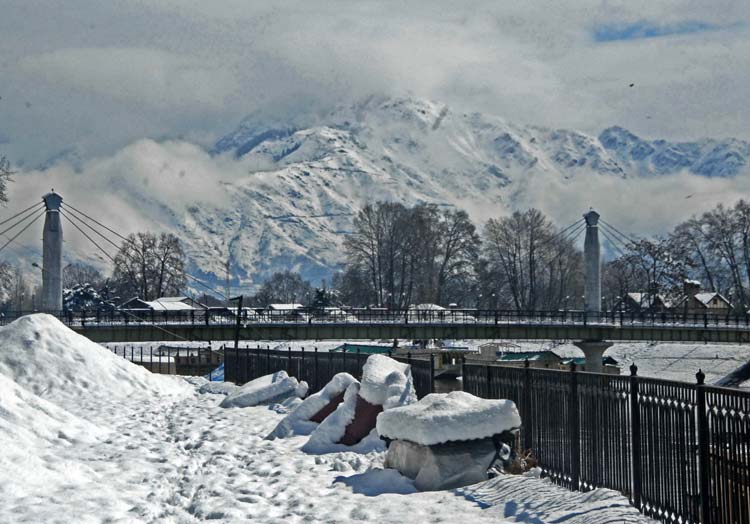
The gentle falling of snow, for instance, is described as Sheen Pewan or Sheen Wasan. Continuous snowfall, on the other hand, is referred to as Sheen e Raze Pewan or Wasan. When snow gathers in lumps, it is called Sheen e Those or Sheen e Chadri Gayi Jama. Snowflakes are delicately termed Sheen e Tul, distinguishing them from raindrops, known as Rude Qatri.
Besides, the cold wind emanating from snow-capped mountains is described as Sheen e Tchat. Heavy snowfall can render the atmosphere dull and sultry, a phenomenon referred to as Sheen e Ghate. A massive accumulation of frozen snow is called Sheen e Maen. During the summer months, the cold water resulting from melting snow is called Sheen e Aab.
The beauty of snow is also captured in the phrase Sheen e Gash, which describes the sheen of snow on a moonlit night. In Kashmiri, a person with a fair complexion is likened to snow, being described as Sheen Hui or Sheen Hish.
Interestingly, the popular Indian subcontinental candy, Barfi, owes its name to the Persian word Barf, meaning snow. This etymological connection highlights the cultural exchange between Persia and the Indian subcontinent.
In Kashmiri culture, there exist several idioms related to Sheenor snow. One such example is Sheen e Pipin, which refers to a small bird known in English as the streaked laughing thrush. According to local belief, the bird’s cry signalled the impending arrival of snowfall in winter.
The bird’s cry was likened to the sound produced by a Pipin, a Kashmiri tee-to-tum that emits a sweet melody when blown into. This ancient adage has been passed down through generations, with an alternative version being Shinah, Peto Peto, Baye Yito Yito, translated literally, this phrase means Fall, O Snow, Come O, Brother! However, its deeper meaning conveys a sense of longing for the return of a loved one who has been absent for an extended period.
This idiom is rooted in traditional Kashmiri culture, where newly married brides would often miss their parental home and siblings. The bird’s cry, in this context, symbolises the bride’s yearning for her family. This adage was once a ubiquitous part of Kashmiri culture, with children often reciting a variation of the phrase: Shinah, Peto Peto, Mama Yito Yito, or Fall, O Snow, Come O, Uncle! However, Peshe Peth Sheen Trawun is a well-known idiom in Kashmir. Historically, many Kashmiri houses had roofs made of shingle and birch barks, referred to as Singli-Pash and Burze-Pash. The term Pash in Kashmiri means a rooftop.
 Inhabitants would clear snow from their rooftops using long sticks and shovels, often with the help of hired labour known as Sheen e Wail. This labour would quickly remove the piled-up snow. Over time, the architectural design of Kashmiri houses has undergone significant changes, and these traditional rooftops are no longer found.
Despite this, the idiom’s message has endured. It cautions against hasty and careless actions, emphasizing the importance of careful consideration. Any work done hastily and without proper thought is still described by this idiom.
Another idiom, Yi’vivin Daulat, Pe’wun Sheen, Zstal’vin Daulat, and Gal’vun Sheen, offers insight into the nature of wealth. It suggests that wealth accumulates slowly, like gently falling snow, but can disappear quickly, like melting snow. This idiom can be seen as a metaphor for human life, where the wealth and vitality of youth and adulthood can rapidly fade with age.
In Kashmir, the melting of snow in early spring was followed by anticipation of the return of snow weather, known as Wandeh. The first snowfall of winter was eagerly awaited and celebrated as Nav Sheen, or new snow.
A unique tradition accompanied this celebration. Friends would engage in a playful joke called Sheen e Shot, where a small amount of snow would be wrapped in paper or hidden inside an object, such as a Kangri or an apple, and presented to an unsuspecting friend. If the recipient opened or tampered with the gift, the giver would rub the snow on their face, forcing them to forfeit by dancing or singing.
This lighthearted joke was a staple among friends in Kashmir. However, on one occasion, a Kashmiri man in the service of Ahmad Shah, the ruler of Baltistan, faced punishment for playing this prank on his master. The man presented an empty barrel with snow inside to Ahmad Shah, who retaliated by parading him naked on the back of a donkey.
Among the educated class, a variation of this joke was played. On the first snowfall, they would write a Persian couplet on a piece of paper, which read: New snow has fallen, thousand congratulations; now, what is the agreement, a trifle only, but you have to pay it. The paper would be closed and given to a friend. If the recipient opened and read the message, they were obligated to send a small gift to the sender.

In Kashmiri, the harshest period of winter, known as Wandeh, is referred to as Chilai Kalan. This term specifically denotes the 40 days from 21 December to 31 January, characterized by the severest weather conditions.
The phrase Chilai Kalan is derived from two distinct words. Chilai means 40 days of self-confinement at home, a practice that was common in the past, where people would shut themselves indoors for the duration of the harsh winter.
The word Kalan, of Persian origin, means long or big and is used to describe the severity of the weather during this period. In Persian, the term Chila also has a different connotation, referring to the 40 days of postnatal confinement for women.
Snowman and Sheen-e-Jung
There does not seem mention of snowball fights or the making of snowmen, in winter among Kashmiris, in the available literature, folklore and travelogues. While mock or playful talwar Jung and shamsher-jung are well known in folk traditions of Kashmir, sheen e Jung (snowball fight) and making of a fake snow-sculpture of a man, snowman, (Sheen e Mohniv) or of a woman (Sheen e Za’in or Sheen e Zanane or Sheen e Kor, as such, are not recorded.

However, the traditions of playing sheen e Jung and making Sheen e Mohniv are as new to the Kashmirian community as the last quarter or so of the twentieth century. In poverty-ridden old Kashmiri, the people generally preferred to be indoors. But in new Kashmir, on the first snowfall, throwing handfuls of fresh snowballs at each other and making snowmen, just for fun, amusement and laughter, have become quite popular among some young Kashmiri boys. It is a delight to see them playing sheen e Jung in multi-colour dresses in winter. The old people are generally too old to play such escapades.
These snow traditions of winter in Kashmir have been picturised in some Bollywood movies too. To Kashmir, the traditions may be new, but in many countries of the world where snow falls in good quantity in winter, these traditions are quite old. There is an old short French movie of 1896 titled Bataille de neige (literally, snow-fight) in which natives are seen laughingly throwing snowballs on each other, without hitting, at a large snow-covered town-square or street, apparently, for fun and frolic.
(The author is a Kashmir historian.)