by Dr Junaid Jazib
What older generations recall as rare calamities are now recurrent events. Developmental works may promise progress, yet when pursued without ecological foresight, they unravel the very stability that sustains life in these ranges.

It was a rainy July morning last year when Abdul Rashid, a shopkeeper from Mendhar, set out for Srinagar to buy supplies. Thanks to the Mughal Road, what once felt like a distant journey now takes only a few hours, connecting the people of Rajouri and Poonch to the Valley for shopping, healthcare, education, and trade. For families like Rashid’s, this road is not merely asphalt and stone; it is a lifeline.
Yet in the Pir Panjal region, the quest for progress often carries a double edge. On his return the next day, Rashid found himself stranded near Peer Ki Gali. Overnight rains had triggered massive landslides, cutting through the road at several points and severing the fragile connection that the highway had promised. Trapped in his vehicle for 17 hours, he sighed, “The mountains give us life, but when they are angry, nothing stands.”
His words capture the paradox of the region. On one side lies opportunity, mobility, and modern convenience. On the other lies the ecological cost of carving roads, dams, and tunnels into a young and sensitive mountain system. What was once occasional—landslides, cloudbursts, flash floods, and subtle shifts of land—has in recent years become alarmingly frequent, marking a new phase in the region’s ecological history and rendering life for its inhabitants increasingly precarious, challenging, and uncertain.
The Pir Panjal region of Jammu and Kashmir, long perceived as a rugged frontier, has always yearned for connectivity and inclusion. For decades, residents of Rajouri and Poonch remained cut off from the Valley, their journeys dictated by geography and long detours through Jammu. The opening of the Mughal Road transformed this sense of isolation. Suddenly, Srinagar was not a distant capital but a few hours’ drive away.
For students seeking colleges, patients in need of healthcare, traders looking for markets, and families hoping to reunite with relatives, this single road became a bridge to opportunity. Seasonal migrants, Gujjars and Bakerwals driving their herds toward high-altitude pastures, also found in this passage a renewed ease of movement.
The region’s aspirations now extend far beyond one highway. Proposals for tunnels, widened roads, and new transport corridors promise to bind the Pir Panjal more closely with both the Valley and Jammu. Each initiative is framed as a step toward progress: shorter journeys, stronger trade, easier access to services, and even the prospect of tourism. For local economies, long reliant on remittances or subsistence farming, these projects raise hopes of a more diversified and prosperous future.
Governments, too, invest in the Pir Panjal with strategic importance. Infrastructure here is not only about providing facilities to people, but also about fostering integration, security, and stability. A better-connected Pir Panjal can channel its fruits and handicrafts to wider markets, attract tourists to its meadows and shrines, and provide its youth with alternatives to migration. For the state, such projects promise stability. For communities, they promise dignity and opportunity.
Development here should not be seen as a luxury; it is a long-overdue necessity etched into the yearnings of people who have lived for generations at the very edge of access and attention. Villages lie snowbound for months. Children walk miles through harsh terrain simply to reach a classroom. The sick are borne on shoulders across rivers and ridges in search of healing.
A hospital, only after hours of perilous travel, a market silenced the moment a bridge gives way—these are not passing hardships but the pulse of daily life. Connectivity and growth, then, are not mere policy prescriptions. They are a plea for dignity, for belonging, for a future where the Pir Panjal is no longer treated as a periphery but recognised as a vital part of the nation’s unfolding story.
Yet necessity does not dissolve vulnerability. The Pir Panjal is not a blank canvas upon which engineers can draw straight lines of asphalt. It is a living landscape of forests, springs, slopes, and soils, a delicate system that holds people and wildlife in fragile balance. Every bridge built is also a bridge disturbed. Every tunnel drilled is a wound in the mountain’s body.
The paradox is stark: the very projects intended to secure the region’s future carry within them the seeds of its fragility and disruption. The real challenge is not whether development should arrive, but whether it can do so without tearing apart the ecological, cultural, and spiritual foundations upon which the region’s life rests.
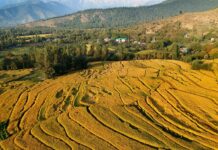
The Himalayas are often imagined as timeless and immovable walls of rock and snow. In truth, they are among the youngest and most delicate mountain systems on Earth, still rising, unsettled, and vulnerable to the slightest disturbance. In the western Himalayas, where the Pir Panjal and Chenab Valley lie, this fragility shapes daily life. Heavy rainfall, sharp slopes, and loose soils make these ranges beautiful but never fully stable.
Landslides, cloudbursts, and sudden floods remind us that building here is never the same as building on a plain. To construct in these mountains is to anchor human ambition on ground that is always shifting. The devastation of recent years, whether in Uttarakhand, Himachal Pradesh, or only days ago in Kishtwar, reveals a hard truth: the more we disrupt, the more fiercely the mountains respond.
The Pir Panjal illustrates this sensitivity in clear and tangible ways. Its steep slopes are prone to landslides and soil slippage once disturbed. Its thinning forests reduce slope stability and groundwater recharge. Its dense web of springs and streams responds quickly to even minor changes in land cover. When a road is carved into a hillside, the natural binding of soil and rock is weakened, making landslides more likely. When forests are cleared, infiltration declines, runoff intensifies, and local hydrology is thrown off balance. What appears to be an isolated intervention is rarely contained; each act sets off chain reactions across the landscape, consequences too often underestimated in conventional planning.
Human pressures have deepened these vulnerabilities. Timber extraction, overgrazing, and unregulated construction have stripped away the green cover that once held slopes intact and fed the veins of springs and streams. As a result, springs are drying, pastures are shrinking, and sudden cloudbursts now wash away roads and bridges with alarming frequency. Roads cut without care and settlements expanded without planning have turned natural slopes into hazard zones. What older generations recall as rare calamities are now recurrent events. Developmental works may promise progress, yet when pursued without ecological foresight, they unravel the very stability that sustains life in these ranges.
We must remember that when the mountains suffer, people suffer. Here, fragility is not only an environmental condition but a lived reality. A blocked road can mean a patient never reaches the hospital. A vanished spring forces women to walk miles for water. A meadow lost to erosion leaves herders without pasture or income. In these ranges, every wound in nature becomes a wound in human life.
This truth must guide every discussion on development in Pir Panjal: human life and the life of the mountains are inseparably linked. To ignore the fragility of one is to endanger the survival of the other. Yet in this region, progress and precarity often arrive in the same package.
To frame development as either salvation or destruction is to miss the reality: it is both. Roads may bring medicines more quickly, but also landslides more frequently. Dams may bring electricity, but also displacement. The task before us is not to halt development, but to reimagine it, to ask how it can be pursued without tearing apart the ecological and cultural fabric that defines the Pir Panjal. People in these mountains need roads, schools, hospitals, and electricity no less than those in the plains. What they do not need is a form of development that solves one problem while creating ten others.
The disasters in Uttarakhand, Himachal Pradesh, and most recently in Kishtwar and Ramban should not only move us to mourning, they should awaken us to warning. Each landslide and each flood is not an isolated tragedy, but a message written in soil and water. Mountains dynamite-blasted for highways crumble with the first monsoon downpour. Valleys dammed without regard for sediment load or seismic faultlines swell into floods that were once unthinkable. These are not accidents of nature alone; they are consequences of choices made in haste and hubris. If we repeat these mistakes, it will not merely echo the grief of our neighbours, it will magnify it, for here fragility and human dependence run even closer together.
The debate is not about whether development should come, but about how it arrives. The question is not one of denial, but of direction. The true concerns lie in terms of engagement with the mountains. Can roads be laid without unsettling the slopes on which villages rest? Can tunnels be carved without silencing the ancient springs that have sustained valleys for generations? Can connectivity be extended without unravelling the ecological bonds that hold forests, rivers, soils, and people together as one living system?
To treat development in Pir Panjal as a conquest over nature is to misread the Himalayas. These ranges do not yield to force. They remind us repeatedly that every incision provokes a geomorphic response. Progress here must be imagined not as an imposition on nature, but as a covenant with it. It must be a dialogue, a continuing negotiation between human need and ecological wisdom, where progress is measured not only in kilometres of road or megawatts of power, but also in the endurance of springs, the safety of slopes, and the continuity of cultural life that depends upon them.
The task is not merely to bring facilities, but to ensure that roads, power, and housing arrive without dismantling the ecological and cultural foundations that give meaning to life here. True development in the mountains will be measured not in projects completed, but in springs that still flow, pastures that still sustain herders, and valleys that still hold human communities in balance with their landscape.
What is needed is a reimagined approach, a new ethic of development that begins with the mountain, not against it. Roads must be designed and aligned with slope stability and drainage in mind, rather than simply following the shortest line on a surveyor’s map. Hydropower projects should be scaled to local needs, rather than large dams that disrupt hydrology and community life. The lived knowledge of pastoralists, who for centuries have moved with the seasons and left light marks on these slopes, must be recognised as wisdom, not dismissed as a relic. Above all, ecological fragility must be treated as the first principle of planning, not as an afterthought once damage has already been done.
To live in Pir Panjal is to dwell in the embrace of fragile giants. These mountains hold us, but they also test us. They offer water, pasture, timber, and beauty, yet they remind us that their gifts come with conditions. If those conditions are ignored, the ground beneath our feet will turn against us.
The Himalayas are not eternal walls. They are restless, rising, breathing forms of the Earth. Every landslide, every cloudburst, every broken road is not simply a disaster; it is the mountain’s language, telling us that balance has been disturbed. With each warning, the tone grows sharper, reminding us that our survival is bound to the mountain’s survival.
Development here cannot be measured in kilometres of asphalt or megawatts on a grid. Its real measure lies in whether a child can walk to school without fear of collapsing slopes, whether a herder can find grass for his flock without exhausting the land, and whether a spring will still flow for the next generation.
Pir Panjal does not deny the right to dream of progress. It asks only that those dreams take root in humility and respect, not in conquest. To care for these mountains is, ultimately, to care for ourselves. For in every crack that opens in stone, in every river that swells beyond its banks, we glimpse a reflection of our fragility. If we can learn to live lightly here, then we are not only protecting the Pir Panjal, we are rediscovering a way of being human that the world beyond these peaks urgently needs.
(The writer is HoD, Environmental Sciences, SCS Government Degree College Mendhar (Poonch). Views are personal.)