by Er Umair Ul Umar
He taught me how to see beyond the obvious, how to trace connections between events, how to ask why and how to consider what lay beneath the surface.
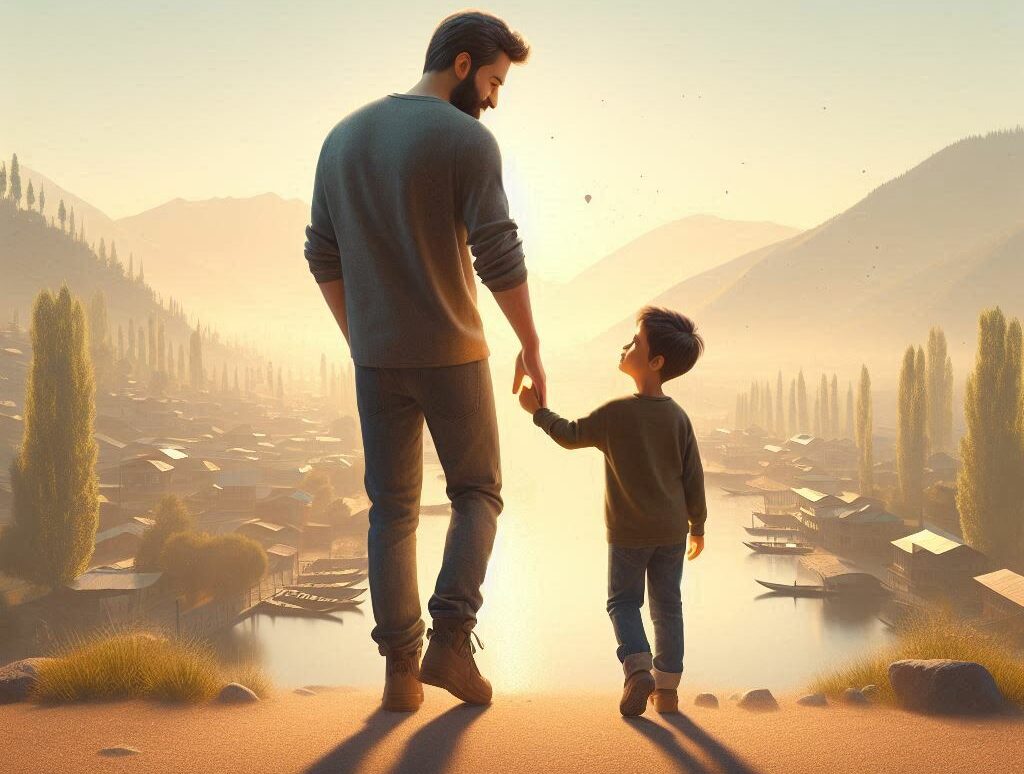
As the calendar reaches 3 July 2025, five years have passed since my beloved father, Abdul Rehman Khanday, departed this world. Yet not a day has gone by without his presence being felt, whether in our thoughts, our conversations, or the silence we carry within. His voice still lingers in my mind, his words remain carved into my being, and at times, I still turn around, half expecting to see him. There are absences so vast they begin to resemble presence itself.
My father was not one for display or noise. He embodied quiet strength, unwavering resolve, and boundless compassion, all rooted in a life of simplicity. There was dignity in his bearing, humble, composed, and firmly grounded in principle. Among his many qualities, one stood apart with striking clarity: he spoke plainly, but never cruelly. He never hesitated to speak the truth, but there was not an ounce of bitterness in him. His heart was untainted by guile, open and generous. While some may have misread his words, none ever doubted his intent. Those who truly knew him understood that his honesty came without harm.
As a father, he was also a mother. He did not merely provide; he cared with tenderness. During exam days and late nights of study, he would quietly prepare tea at midnight and bring it to us himself, a gesture of love more potent than words. He would sit beside us in silence, never speaking, simply lending us strength through his presence. He remained there until we fell asleep. That silent companionship, that constant support, was love in its purest form. How many fathers show such devotion? How many assume both roles with such balance and grace?
He began with nothing, no privilege, no inherited advantage, no easy road. Every small achievement, every ounce of respect, every measure of stability in our lives was earned through relentless effort, a will that never wavered, and unshakable faith in Allah. From that humble starting point, he forged a life of honour. He did not merely build a home; he laid the foundations for a future. For us, his children, he became the ladder on which we ascended towards dignity, knowledge, and self-worth. He raised us to stand upright, to be educated, and to think deeply. That, to me, is a legacy of rare distinction.
It was in his care that I was moulded, emotionally, morally, and intellectually. He nurtured a keen interest in international affairs and remained engaged with the evolving dynamics of global politics. His fascination with geopolitics was infectious. I found myself drawn to the same sphere he observed so attentively.
In Kashmir during the early 2000s, as the region reeled under the strain of conflict between India and Pakistan, reliable news sources were scarce. Yet our mornings and evenings found a consistent anchor in one trusted source: the radio. The BBC Urdu service, Sharbeen, became our window to the outside world.
I recall clearly that at 7.00 in the morning and again at 9.30 at night, I would sit beside my father and listen with quiet focus. These were not mere news bulletins. They were lessons in awareness, moments of shared attention, and the quiet beginnings of an enduring curiosity that deepened with each passing day. In those measured moments, my father unknowingly planted the seeds of an inquisitive and attentive mind.
Despite the political uncertainty and the atmosphere of fear that surrounded us, that period marked the beginning of an intellectual path for me. What might have numbed the will to learn instead became a foundation for thinking. My father’s passion provided the first spark, and Sharbeen sustained it. He taught me how to see beyond the obvious, how to trace connections between events, how to ask why and how to consider what lay beneath the surface.
He offered no pre-digested truths. Instead, he gave me the ability to search, to question, to think with rigour. He was a man of steadfast faith and high character. In times of hardship, he did not falter. When tested by life’s trials, he responded with patience and quiet trust in Allah. He would often say, “Jo Allah kare, behtari ke liye hota hai.” It is this same conviction that consoles me now, when the weight of his absence feels overwhelming.
My father left behind no material legacy, but something greater. He gave us the strength to stand with dignity, the clarity of strong principles, and the quiet assurance that integrity outlives all else. He touched many lives, never seeking recognition, only acting with calm decency. He taught us to live honourably, to speak gently, and to move through the world with humility. We are his legacy. We are the living expression of his values.
Five years may have gone by, but his presence remains undiminished. His thoughts, his wisdom, his laughter, and even his silences live on with sharp clarity. He was not simply a good father. He was an extraordinary one, whose love, endurance, and vision continue to shape us.
Today, as I remember him, I not only grieve his loss, but I honour the life he led, a life marked by faith, restraint, selflessness, and love. My sincere prayer to Almighty Allah is this: O Allah, when my time comes, reunite me with my parents. That reunion will be my Paradise.
I ask that Allah grant him the highest place in Jannat-ul-Firdous, forgive his shortcomings, and wrap his soul in mercy and eternal light. My beloved father, Abdul Rehman Khanday, your body may have left this earth, but your light continues to guide mine. Thank you for everything. I miss you more than language can convey.
Inna lillahi wa inna ilayhi raji’un. Indeed, to Allah we belong, and to Him we shall return.
(The author is a columnist, blogger, and IT teacher at Government Girls Higher Secondary School, Yaripora, Kulgam. Ideas are personal.)