by Dr Rafi Ramzan Dar
Contractual lecturers in Jammu and Kashmir face severe financial exploitation and bureaucratic humiliation, leading the highly qualified author to resign after a decade of service under an oppressive, discriminatory system.

Mankind has devised many epitaphs, paradigms and paradoxes in almost all spheres of its existence, depending upon prevalent circumstances and the processes of graceful evolution over time. Yet, the paradox to which individuals like me have been subjected remains uniquely and profoundly disgraceful. For an entire decade, I served as a contractual lecturer within the Higher Education Department of Jammu and Kashmir.
Recently, I found myself becoming the talk of the town once again as the government announced a significant stipend increase for medical interns, a well-deserved relief that starkly highlighted the bitter contrast of my own prolonged struggle.
This moment compelled me to recognise it as my moral and collective responsibility to introduce the intellectual community to the realities of my fraternity, and to a part of the world where teachers, medical professionals, engineers, firefighters, and public health workers exist under a completely different, often punishing set of rules.
The Bureaucratic Labyrinth
Beyond its pleasant weather, beautiful gardens, snow-clad mountains and legendary hospitality, Jammu and Kashmir possesses unique administrative quirks that you might not find in any textbook or on the internet. We have long operated under a wonderful double-engine government coupled with an efficiently exposed bureaucratic setup that seemed subconsciously engaged in one primary pastime: changing my nomenclature every few years.
When I first stepped into the academic hierarchy as the junior-most lecturer, I was officially designated as a “Contractual Lecturer.” For this title, I was paid a meagre Rs 8,000 per month that renders to a shocking Rs 266.6 per day calculated across 12 months, amounting to Rs 96,000 annually.
Since I was unmarried at that time, I managed to survive somehow, carrying only a few domestic responsibilities on my shoulders. Whether willingly or unwillingly, I kept teaching at different institutions within the higher educational setup for a decade under this depressing financial umbrella. Then, all of a sudden in 2020, I was renamed as a “Lecturer on Academic Arrangement”, a bureaucratic nomenclature as bizarre and synthetic as IUPAC chemical nomenclature, existing nowhere else in the length and breadth of our country.
The Illusion
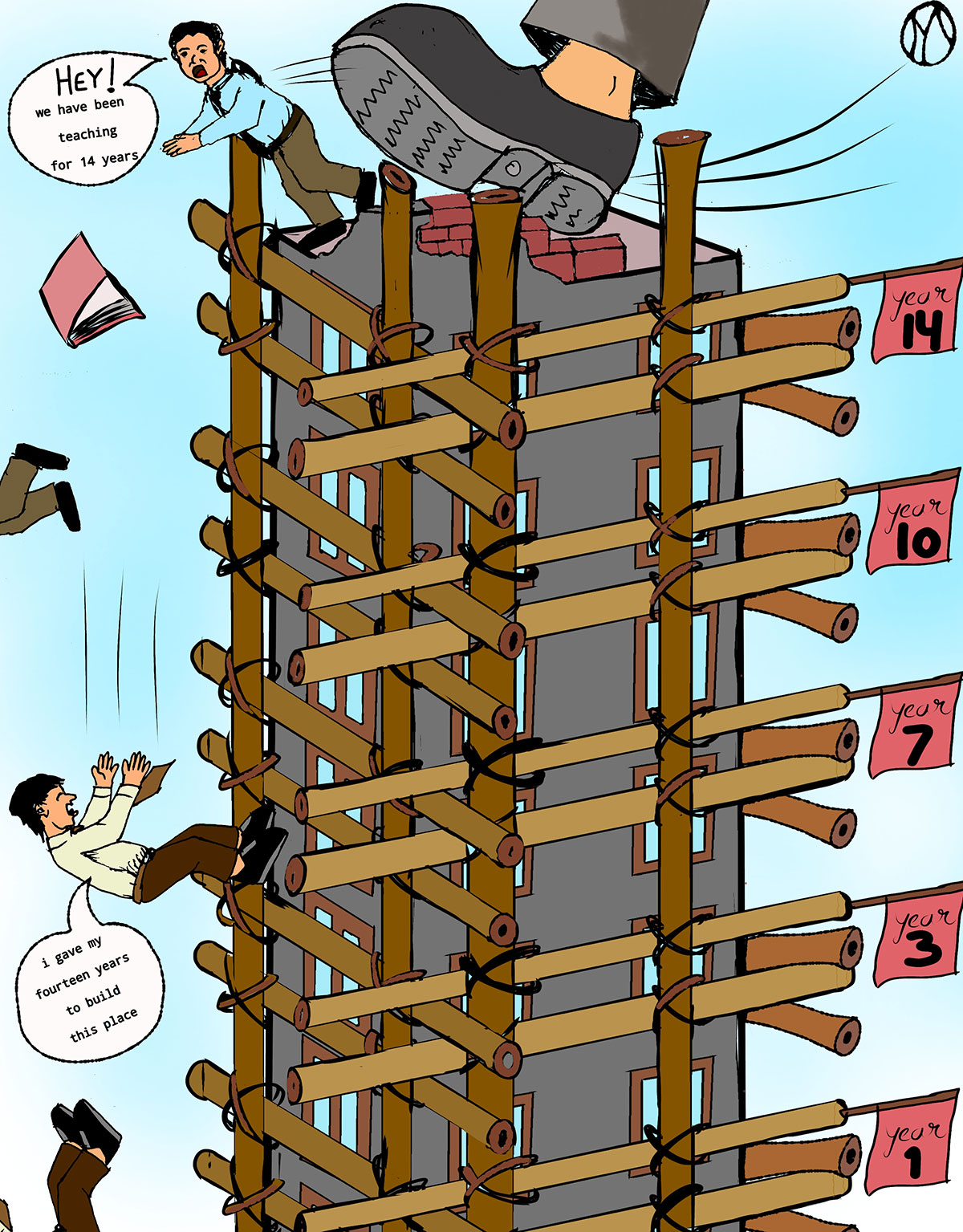
After years of consistent requests, delegation meetings, memorandum submissions, street dharnas and peaceful protests organised jointly by senior and junior scholars, my remuneration was finally enhanced to Rs 28,000 per month by the bureaucratic bosses at the helm. It was framed as a grand goodwill gesture, one for which my colleagues, my family and generations to come are expected to be perpetually indebted. I briefly rejoiced, calculating that I would finally earn Rs 933.33 per day.
However, the jubilation was short-lived. Under the newly minted rules accompanying this raise, I was thrust into a trap disguised as an administrative order. Not only was my winter salary for two entire months summarily deducted, but I was also forcefully disengaged for three months immediately following the completion of an academic session, left hanging until a brand-new session could begin. In a cruel nutshell, I was granted a mere seven months of employment out of twelve. This slashed my overall effective wages from the promised Rs 28,000 down to roughly Rs 16,333 per month, or a dismal Rs 544 per day.
There was, naturally, nothing left to celebrate. Yet, stubborn hope kept me tethered, whispering that my government would surely rectify these systemic flaws in the future. After all, I was a doctoral candidate with prestigious credentials like NET, SET and JRF proudly adorning my curriculum vitae. Besides, I was no longer a fresh-faced novice, but an educator boasting nearly a decade of dedicated service.
The Stigma
Yet, this experience became a source of deep anxiety when I realised it held zero currency outside my region. Whenever I sought opportunities elsewhere, my decade of teaching experience was routinely dismissed on technicalities because I was officially slotted against an Assistant Professor’s vacant post under a tainted “SL-10” designation, yet paid far below even a peon’s starting salary. It was a humiliating paradox that mocked both my labour and my intellect.
Like thousands of fellow contractual teachers, I knocked on every conceivable door, moving from pillar to post with my grievances. Instead of a hearing, I was met with wide-open doors meant only to show me out like an outcast. Within my own workspace, I became an easy target for immediate administrative authorities, heads of departments and principals, who began treating thousands of contractual educators like the “children of a lesser god” under the very roofs meant to foster enlightenment.
To pour salt into our open wounds, the office of the Director of Colleges introduced a mandatory requirement for CID and police verification- to be renewed on an exhaustive, yearly basis. Despite having served the institution faithfully for ten years, I was subjected to this frantic, bureaucratic red tape annually. On numerous occasions, several of my colleagues failed to receive their meagre wages until the academic session had practically expired, simply because of petty, unresolved neighbourhood disputes that triggered adverse CID notations.

Silenced Voices
When it came to academic insights, curriculum improvements or institutional suggestions, my input was routinely ignored by college authorities. My advanced qualifications, technical expertise, as well as pedagogical skills counted for nothing because I was never truly considered an organic part of the system. In a display of supreme irony, whenever I stepped forward to help mediate discipline-related student grievances, I was slapped with official show-cause notices for daring to take initiative.
When the Supreme Court articulated clear rulings regarding fair compensation and labour rights, my government, which loudly claims to exist solely for the welfare of its citizens, turned a deaf ear. I find myself utterly perplexed: how can a person surrender their entire youth to an academic department, only to find themselves utterly incapable of supporting their family as its sole breadwinner?
The Breaking Point
Does my government feel even a flicker of shame when highly qualified, heavily experienced intellectuals are forced to abandon academia entirely, turning to the streets to sell nuts and dry fruits just to survive? Have administrative offices become so profoundly soundproof that they can no longer hear these agonising cries, or have our leaders grown entirely myopic to the quiet tragedies unfolding among the common people?

It was this realisation that finally broke my spirit and gave me the courage to quit. I chose to step away from this toxic academic machinery to seek out respectful, productive opportunities elsewhere. Even if I find nothing immediately, I can at least finally breathe the fresh air of freedom away from this subjugated and discriminatory environment.
I leave it to you, the readers, to raise your individual and collective voices for the welfare and dignity of scholars who are barely surviving, let alone thriving, under such an oppressive regime. Today, it is me. Tomorrow, any one of you could become prey to this regressive contractual trap.
It is high time we grant these true sons and daughters of the soil their rightful respect, a dignified nomenclature and decent wages grounded in the sacred principle of “equal pay for equal work.” Let us wake up and raise our collective voice to heal our institutions before the light of our scholarship is permanently extinguished.
(The author has been teaching in a college for many years. The ideas are personal.)