Shabeer Ahmad Lone offers a critical appraisal of Dr M Maroof Shah’s exploration of absurdism, transcendence and the search for meaning. He examines the book’s philosophical foundations and spiritual insights, while assessing its ethical implications and intellectual limitations.
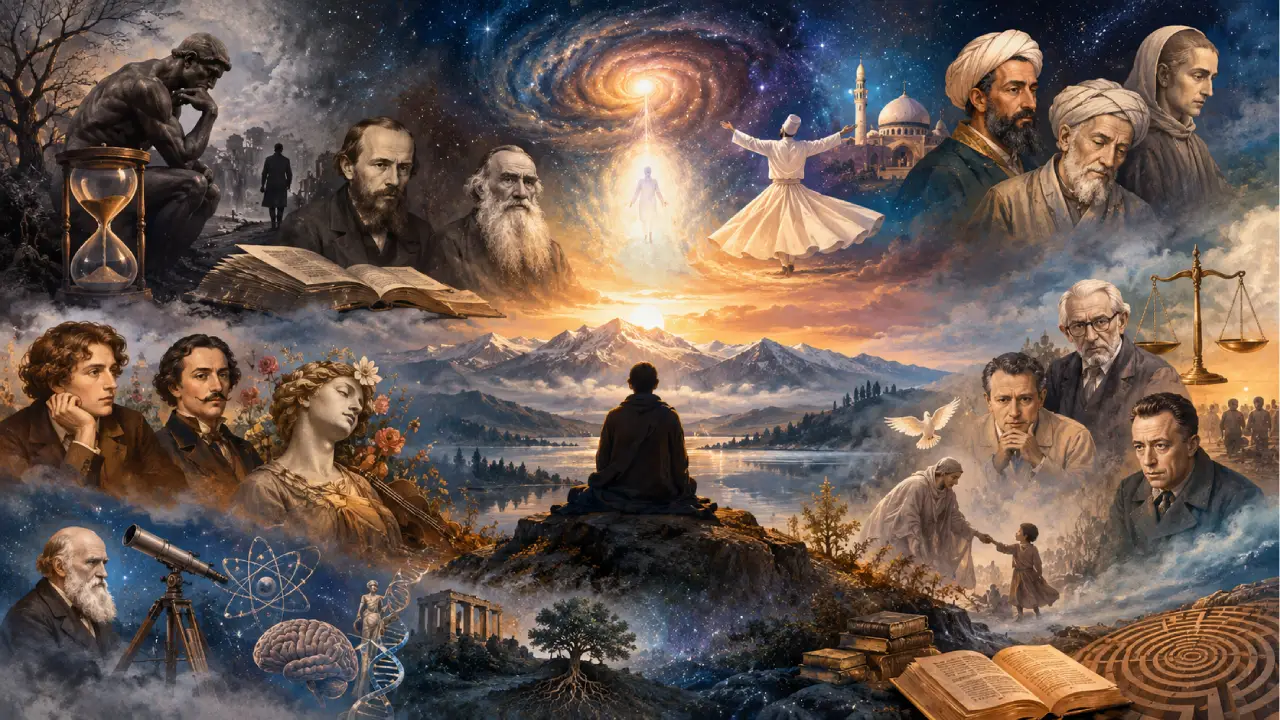
What is the meaning of existence, and is human life ultimately an absurd confrontation between our inexhaustible longing for meaning and an indifferent universe? Or does the apparent meaninglessness of existence reveal less about reality itself than about the limitations of our perception and our estrangement from its transcendent ground? Is our longing for the Infinite an illusion born of human vulnerability, or an intimation of a deeper dimension of being? Can love, beauty, justice, goodness and truth possess ultimate significance in a universe without transcendence? And, perhaps most crucially, how do we distinguish genuine spiritual knowledge from the consolations of imagination and the projections of human desire?
At the heart of these questions lies a profound philosophical and spiritual inquiry: whether absurdity represents the final truth of human existence or a condition to be transcended through a fuller understanding of reality, consciousness and the sacred. It is this enduring quest for meaning, transcendence and the recovery of the Infinite that animates Dr M Maroof Shah’s eighth book, Why I Am Not an Absurdist? A Journey Beyond Meaninglessness, a thoughtful, illuminating and intellectually stimulating and refreshing exploration of existence, meaning and the human predicament.
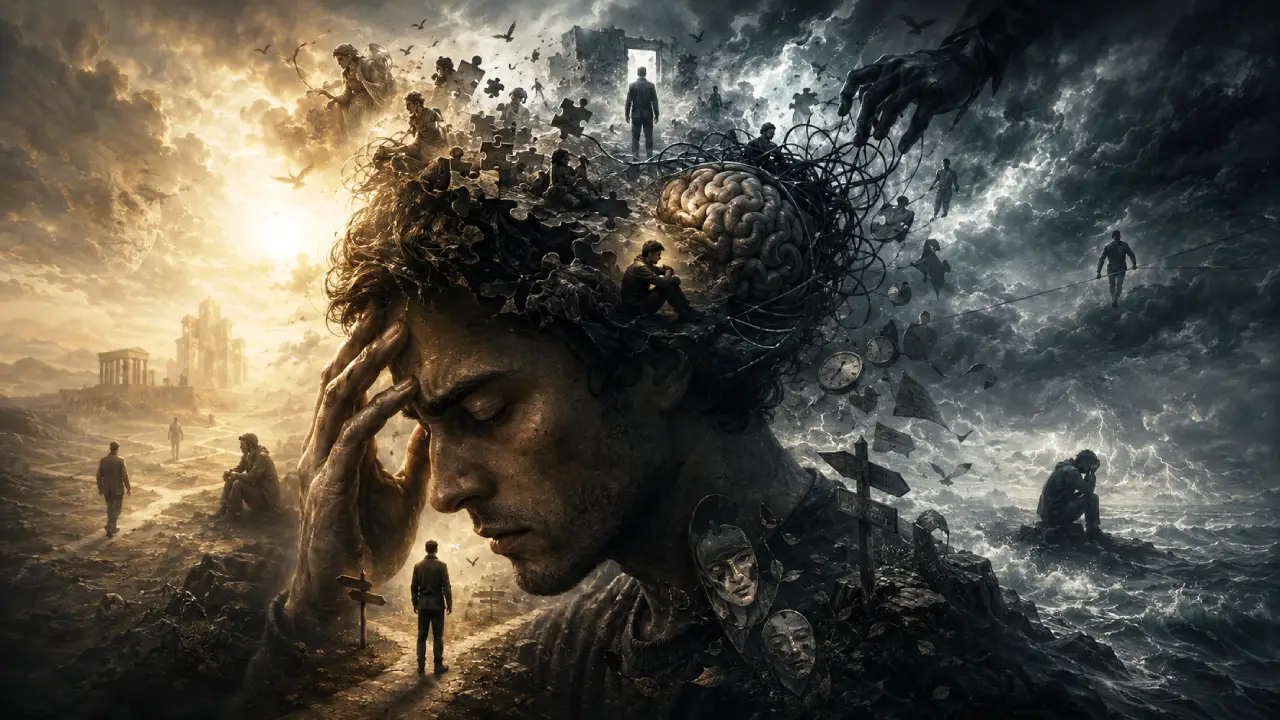
The surrealist cover offers a profound visual meditation on humanity’s quest for meaning and transcendence. The ascending staircase, contemplative portrait and luminous doorway evoke the inward journey from existential uncertainty towards awakening, hope and spiritual illumination. The boundless sea, distant horizons and soaring bird symbolise freedom, expanded consciousness and the possibility of discovering meaning beyond the apparent absurdity of existence. This 231-page volume is published in its First Edition in August 2026 gracefully by Blue Rose Publishers, New Delhi/London.
Intellectual Landscape
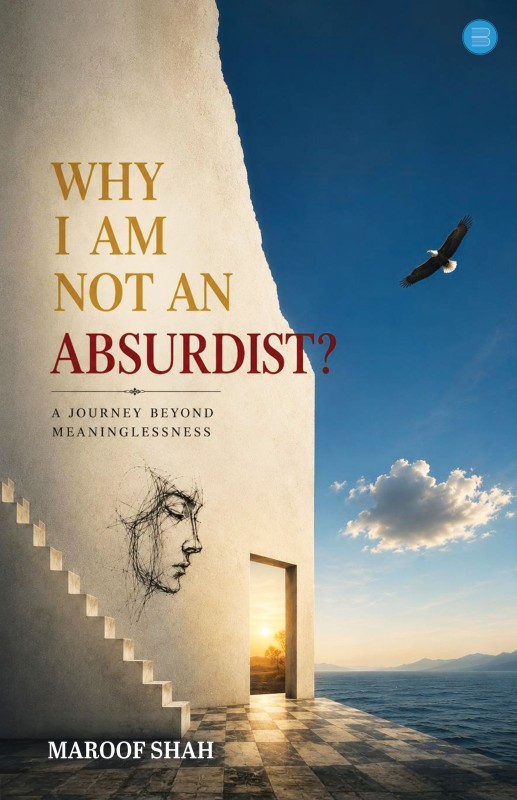
An ambitious and wide-ranging inquiry into modernity’s crisis of meaning, Why I Am Not an Absurdist? brings existential philosophy into conversation with literature, metaphysics, mysticism and perennial wisdom. The result is a reflective exploration of the human search for meaning across diverse intellectual and spiritual traditions.
Its intellectual landscape encompasses six interconnected dimensions of the human predicament.
The first concerns suffering, mortality, absurdity and the search for meaning. These themes are explored through Camus, Dostoevsky, Tolstoy and Wittgenstein.
The second examines transcendence and ultimate reality, drawing on the thought of Schuon, Nasr, Chittick, Guénon and Eckhart.
Iqbal’s philosophy of Khudi, spiritual freedom and creative self-realisation offers another dimension. It affirms the human capacity to discover meaning through an active and transformative relationship with the Divine.
The book also explores inward transformation through attention, love and surrender, illuminated by the writings of Weil, Heschel, Underhill, Hafiz and the Mother.
Ghalib, Keats, Baudelaire and Coomaraswamy reveal how beauty and artistic imagination can disclose dimensions of existence that transcend utility.
Another strand connects meaning with responsibility, compassion, justice and human solidarity. Here, the perspectives of Levinas, Heschel, Lewis and Camus come into focus.
Finally, Dawkins, Eliade, Campbell and Wittgenstein, despite their markedly different intellectual positions, open critical inquiries into science, myth, religion, language, wonder and the limits of reductionist explanation.
Together, these diverse voices establish a compelling dialogue across philosophical, spiritual, aesthetic and ethical traditions.
Through critical encounters with Albert Camus, Samuel Beckett, Friedrich Nietzsche, Simone Weil, Frithjof Schuon, Abraham Joshua Heschel, Wittgenstein, Dostoevsky and Ibn ʿArabi, alongside the Qur’an, Buddhist wisdom, Christian mysticism and the poetry of Hafiz, Bedil and Ghalib, Maroof Shah interrogates the assumptions underlying absurdism, nihilism and existential alienation. His inquiry goes beyond rejecting absurdism to question whether its diagnosis of the human predicament is philosophically exhaustive. Might the apparent absurdity of existence reveal less about the ultimate nature of reality than about the limitations of human consciousness, the impoverishment of wonder and the loss of a meaningful relationship with transcendence? This question gives the book its philosophical impetus and civilizational relevance. It invites us to confront suffering without capitulating to despair, explore transcendence without withdrawing from life, and rediscover meaning through spiritual insight, ethical responsibility and shared humanity.
The book’s central contribution lies in recovering transcendence not as an escape from the human condition but as a possibility for its fulfilment. It challenges both existential despair and facile religious consolation, proposing that meaning is neither reducible to material achievement nor adequately secured through wishful thinking. Rather, it invites us to seek meaning through self-knowledge, spiritual awakening, ethical responsibility and a deeper encounter with reality. Its affirmative vision suggests that human flourishing requires more than survival, consumption or the assertion of individual freedom: it calls for wisdom, love, beauty, compassion and fidelity to what is ultimately Real.
Literary Resonances
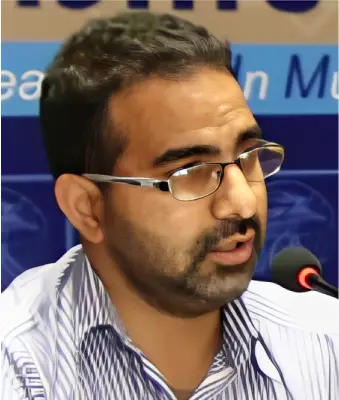
The opening literary and mystical resonances are particularly appropriate. Wordsworth’s longing for the Infinite, Rumi’s yearning for the lost Origin, Ghalib’s metaphysical scepticism and Persian reflections on love and annihilation establish a universal dimension to the human search.
Across these traditions, existence appears as more than biological duration or material circumstance: it becomes a journey of return, discovery and transformation. Yet the mystery of existence also demands intellectual humility. As Ghalib’s celebrated verse suggests, the ultimate riddle of the universe cannot be exhausted by human ingenuity. Such humility, however, should deepen inquiry rather than terminate it. Mystery is not an excuse for intellectual surrender; it is an invitation to enlarge the horizons of understanding.
Philosophical Distinctions
A crucial distinction is necessary at the outset. Absurdism, nihilism, existentialism and scepticism are related but not interchangeable positions. In Camus, the absurd arises from the confrontation between humanity’s longing for intelligibility and the apparent silence of the universe. It does not simply mean that life is worthless.
Nihilism questions or denies ultimate meaning and value; existentialism investigates freedom, responsibility and the human condition; scepticism questions the limits and certainty of knowledge. Camus’s response to the absurd is not passive despair but revolt, lucid endurance and solidarity. His refusal to surrender to comforting explanations is also an ethical refusal to justify suffering and murder in the name of an ultimate purpose. Any adequate engagement with his thought must recognise this moral seriousness.
The central question raised by Shah’s title is consequently more demanding than whether life can be made meaningful. It is whether absurdism offers a complete account of existence, whether its exclusion of transcendence is justified, and whether human experience provides grounds for a wider metaphysical understanding.
Shah’s alternative appears to rest on the conviction that the limits of human knowledge should not be mistaken for the limits of reality, and that consciousness, beauty, love, moral experience and mystical insight may disclose dimensions of existence inaccessible to purely material or reductionist interpretations. The force of this alternative depends, however, not merely on its spiritual appeal but on the strength of the arguments and experiences through which it is developed.
The Problem of Evil
One of the book’s most philosophically demanding engagements concerns Camus’s critique of theodicy. The problem of evil remains a formidable challenge to religious metaphysics: how can divine omniscience, omnipotence and goodness be reconciled with injustice, natural suffering and the anguish of the innocent?
Drawing upon Frithjof Schuon, Shah explores the distinction between the Absolute and the relative. In this metaphysical perspective, the Absolute is not subject to the limitations and imperfections of contingent existence. Evil possesses no independent or ultimate reality comparable to the Absolute Good, although its manifestations within human experience are undeniably real and morally consequential.
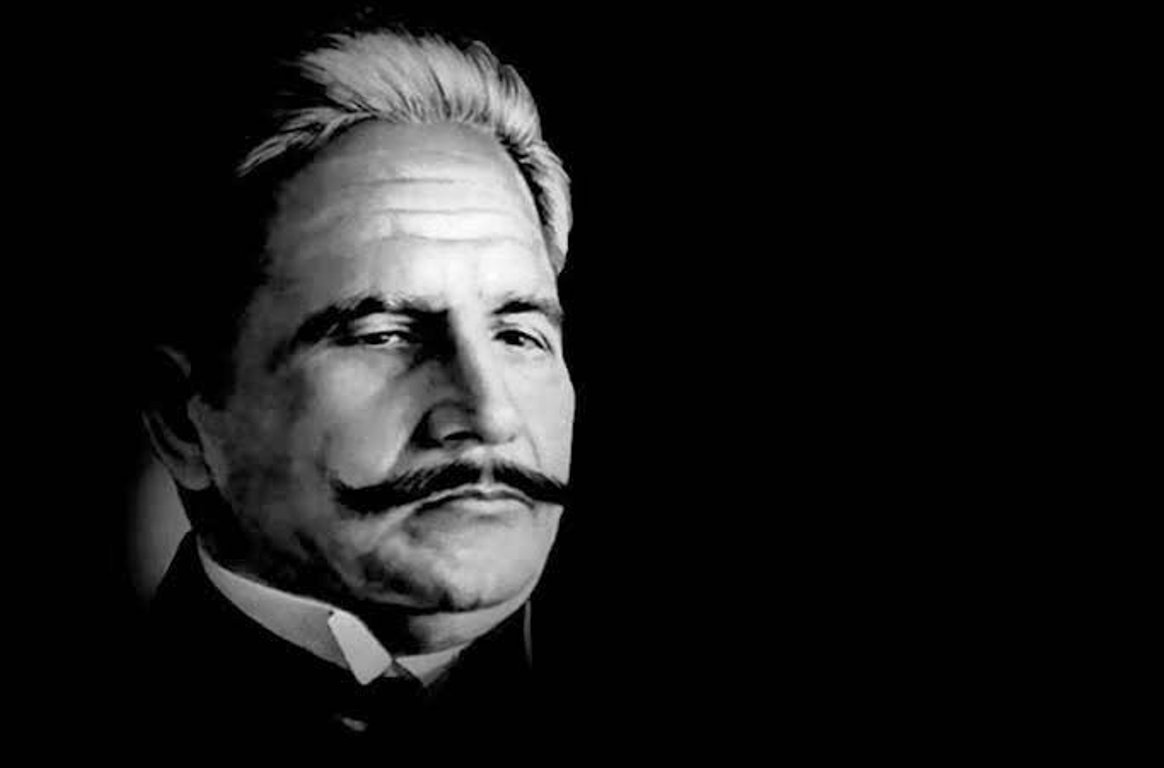
This distinction is valuable, but it should not be mistaken for a complete resolution of the problem of evil. Metaphysical explanations must still confront the lived reality of suffering, especially when it is innocent, involuntary and apparently undeserved. Nor can every manifestation of evil be attributed to the misuse of human freedom. Natural disasters, disease, animal suffering and the vulnerability of children remain difficult questions.
The distinction between the metaphysical status of evil and its terrible experiential reality must never become a means of diminishing the latter. The strength of Shah’s approach lies in moving the discussion beyond an exclusively speculative defence of God towards the moral and spiritual transformation of humanity. The decisive question becomes not merely how to explain evil but how to resist it, alleviate suffering and cultivate goodness.
Yet natural suffering and the anguish of the innocent remain profound challenges that neither free will nor metaphysical explanations fully resolve. The enduring insight is that transcendence must not become escapism, surrender must not mean passivity, and faith must never silence conscience. The true measure of spiritual wisdom lies not merely in explaining suffering, but in confronting injustice, alleviating pain and translating metaphysical insight into compassion, moral responsibility and shared human flourishing.
Here the existential dimension of The Night of Metaphysics becomes significant. Abstract explanations may offer little consolation to someone confronting bereavement, injustice or unbearable suffering. Human beings require not only intellectual understanding but also compassion, prayer, hope, solidarity and spiritual companionship.
Faith in the unseen (iman bil-ghayb) need not represent an abandonment of reason; it can express an awareness that human knowledge, however valuable, remains finite. Yet genuine faith must also withstand questioning and moral scrutiny. Its credibility is demonstrated not by evading suffering but by responding to it with courage, tenderness and responsibility.

Inward Transformation
The discussion emphasis on inward transformation is particularly significant in this context. “Man must be light unto himself,” Shah observes, emphasising self-knowledge and the dispelling of avidya (ignorance) through irfan (gnosis) (p. 130). His reflections on hope and spiritual contentment further suggest that fulfilment lies beyond restless desire, in an awareness of divine presence (pp. 130–131).
This emphasis resonates with the Socratic imperative of self-examination and the spiritual traditions that regard self-knowledge as a pathway towards wisdom. Yet inward illumination must not become an exclusively private achievement. Its authenticity is ultimately tested by the quality of one’s conduct, the depth of one’s compassion and one’s response to the suffering of others.
Iqbal’s philosophical vision further enriches this discussion by resisting the reduction of spirituality to passivity. His conception of khudi, or the cultivated self, emphasises moral agency, creative participation and spiritual courage. The relationship between surrender and selfhood therefore becomes especially important.
Tawakkul is not helpless resignation, niyyah is not merely inward sentiment, and righteous action is not optional to spiritual life. Trust in God must accompany responsible effort; spiritual conviction must manifest itself in character and action. The spiritually awakened self is not one that withdraws from the world but one that becomes more capable of participating in it with integrity.
The dialogue between Camus and Simone Weil offers another profound avenue into the problem of meaning. Camus confronts the apparent silence of the universe, while Weil examines the self that demands existence conform to its desires and expectations. Her concept of decreation suggests that freedom may require the relinquishment of possessive ego-consciousness.
Christ’s “Thy will be done”, Buddhist anatta, Sufi fana and Meister Eckhart’s detachment offer distinct approaches to transcending the illusion of autonomous, self-sufficient individuality. Their convergence is illuminating, provided their considerable theological and metaphysical differences are respected. They do not articulate one interchangeable doctrine; rather, they open different paths of reflection on the limits of ego, attachment and self-centred perception.
A particularly interesting contribution is Shah’s engagement with Ibn ʿArabi’s maqām lā maqām, the station of no station (p. 94). This evocative mystical conception points towards a spiritual standpoint that transcends confinement within particular stations and fixed perspectives. It suggests that the journey towards the Divine cannot be reduced to the possession of a spiritual status or the finality of a conceptual position. Its philosophical significance lies in challenging spiritual complacency and the tendency to mistake partial apprehension for ultimate understanding.
Shah’s contrast between religious surrender and existential revolt (pp. 96-98) further explores freedom through harmony with the Divine. Yet this distinction deserves careful qualification. Religious surrender must not be confused with political submission, moral passivity or acquiescence in injustice. Likewise, existential revolt should not automatically be dismissed as spiritual rebellion. Camus’s revolt, particularly as developed in The Rebel, is also an affirmation of human dignity, moral limits and solidarity. His insistence that no absolute justification should license the destruction of human beings remains an indispensable ethical challenge to religious and metaphysical thought.
The crucial distinction is between self-transcendence and self-negation, between spiritual surrender and passive resignation. The relinquishment of egoism must not entail the abandonment of individuality, conscience or moral agency. Nor should the spiritual language of acceptance legitimise oppression or preventable suffering. The most fruitful synthesis, therefore, is not to choose submission over rebellion or rebellion over submission, but to recognise their distinct and potentially complementary dimensions.
Surrender the ego, not the conscience; resist injustice, not existence; transcend attachment, not compassion; and embrace mystery without abandoning inquiry. Freedom is not merely the capacity to impose our will upon the world; it is also the wisdom to distinguish what must be transformed from what must be accepted.
Modernity’s Crisis
Nietzsche and Beckett deepen this intellectual landscape in different but equally significant ways. Nietzsche’s declaration of the death of God identifies not simply a crisis of religious belief but the destabilisation of inherited moral and metaphysical foundations. His confrontation with nihilism and his demand for the affirmation of life expose a question that religious thought cannot evade: can inherited convictions retain authority merely because they are inherited, or must they be examined, renewed and lived?
His challenge is important because a superficial return to religious language cannot, by itself, overcome the crisis of meaning. Any credible spiritual alternative must demonstrate its vitality through intellectual honesty, moral creativity and the transformation of life.
Beckett, meanwhile, gives literary form to existential disorientation through waiting, repetition, silence, uncertainty and the fragile persistence of human companionship. His tragicomic imagination reveals the strange coexistence of suffering and laughter, despair and endurance.
His work does not offer an easy metaphysical resolution, but it makes visible the human capacity to persist even when explanations fail. Such literature deserves more than a simple classification as an illustration of absurdity. It can expose the vulnerability of human existence while also compelling us to examine the forms of solidarity, tenderness and resilience that survive within it.
Shah’s critique of modernity extends this inquiry into the conditions of contemporary civilisation. Drawing upon Camus’s The Fall, he questions humanity’s estrangement from deeper knowledge and spiritual meaning. His concern is with a civilisation increasingly rich in information but impoverished in wisdom, love, dignity and compassion.
The distinction is vital: information is not understanding, technological capability is not moral maturity, and material advancement is not necessarily human flourishing. Modernity’s crisis is therefore not simply intellectual or religious; it is also ethical and civilizational.
Wonder and Transcendence
The book’s defence of wonder, beauty and the sacred is among its most refreshing contributions. “God still speaks,” Shah writes, “and all those who have faculty of hearing do hear him” (p. 145). This statement invites a recovery of attentiveness to the signs of transcendence within existence. Even scientific wonder, illustrated through Richard Dawkins’s appreciation of awe, offers intimations of the mysterious (pp. 173–174).
The example is particularly suggestive because it indicates that wonder need not be confined to explicitly religious experience. Scientific inquiry itself can deepen our awareness of the intricacy, vastness and astonishing intelligibility of the universe, even when its practitioners interpret these experiences differently.
The book’s engagement with mysticism extends this inquiry beyond the conventional boundaries of existential philosophy. Its central suggestion is that the apparent absurdity of existence may arise partly from the limitations of perception rather than from the ultimate nature of reality.
The inability of reason to explain existence does not establish that existence is meaningless. Equally, the limits of human understanding cannot, by themselves, prove the existence of transcendence. This distinction is essential. The possibility of transcendence, philosophical arguments for it, experiences interpreted as spiritual disclosure, and claims grounded in revelation are related but different forms of knowing. A rigorous metaphysical inquiry must examine their respective claims, foundations and limitations.
A particularly important question follows: how can genuine spiritual insight be distinguished from subjective projection, psychological consolation or culturally inherited belief? Mystical experience may transform the individual, deepen compassion and disclose dimensions of existence that ordinary consciousness overlooks. Yet the intensity or sincerity of an experience does not automatically establish the truth of every metaphysical interpretation attached to it. Spiritual experience deserves neither automatic dismissal nor unquestioning acceptance. It calls for discernment, philosophical reflection, ethical testing and humility. This is where the book’s dialogue between reason and contemplative wisdom becomes especially valuable.
A recurring insight is that humanity does not necessarily abandon its longing for the Absolute when it loses faith in transcendence. That longing may instead become attached to finite substitutes: wealth, power, pleasure, recognition, ideology and the ego. The problem is not simply the absence of ultimate aspiration but the misdirection of an aspiration that seeks fulfilment in what is inherently limited. Mystical traditions challenge this confusion by inviting humanity to discover deeper significance in nature, beauty, love, contemplation and ordinary experience.
The Qur’anic distinction between the transient and the Eternal gives this vision a particularly profound expression: “Everyone upon it will perish, and there will remain the Face of your Lord, Owner of Majesty and Honour.” (55:26–27)
The verse places the impermanence of creation against the permanence of the Divine. Its existential significance lies not in dismissing the world but in reorienting human attachment towards what is ultimately enduring. Similarly, the Qur’an invites humanity to discover divine signs within the universe and the self: “We shall show them Our signs in the horizons and within themselves until it becomes clear to them that it is the Truth.” (41:53)
Contemporary Relevance
This recovery of sacred perception has immediate contemporary significance. Humanity inhabits an age of unprecedented technological capability, informational abundance and material production, yet these achievements coexist with ecological destruction, consumerism, loneliness, alienation and moral fragmentation. Digital technologies increasingly compete for human attention, while artificial intelligence raises new questions about knowledge, creativity, agency and what is distinctively meaningful in human life. The ability to process information or explain the mechanisms of existence does not necessarily provide an understanding of its significance.
Science, philosophy, spirituality and ethics address different but potentially complementary dimensions of the human search. Science investigates the natural world through observation and explanation; philosophy examines the foundations, implications and limits of knowledge; spirituality explores ultimate meaning and inner transformation; ethics considers how human beings ought to live and act. An integrated understanding requires intellectual openness without confusing their methods or standards of justification. What is needed is not the rejection of reason but its enrichment through humility, ethical intelligence and a deeper awareness of human responsibility.
The book’s exploration of beauty and art develops this argument through lived experience. Beauty is not merely an aesthetic pleasure or an emotional refuge from adversity; it can become an occasion for perceiving dimensions of existence otherwise obscured by habitual consciousness. A flower, a poem, a snowfall, a child’s smile or an act of kindness may disclose a significance that cannot be adequately communicated through abstract propositions alone. Meaning is sometimes not merely argued for; it is encountered and experienced.
Camus himself recognised the sustaining power of nature, beauty, artistic creation and human relationships, even while refusing metaphysical consolation. Beckett’s tragicomic imagination similarly reveals the persistence of laughter and human endurance amid suffering. The perennialist interpretation adds another dimension: beauty may be more than consolation; it may disclose a deeper order of reality.
Yet aesthetic experience must not become an escape from moral reality. Simone Weil’s discipline of attention, Buber’s I–Thou encounter and the Islamic ideal of ihsan suggest that genuine beauty should transform how we see and treat others. Its highest expression is not merely an appreciation of beautiful objects but a life characterised by sincerity, compassion, justice and excellence.
Recovering the Sacred
In his reflections on Beyond Absurdism: Recovering the Sacred, Shah develops one of the book’s most compelling propositions: perhaps the among the book’s most compelling insights is that the world may not have lost its sacredness; humanity may have lost the capacity to perceive it.
Here is how one can get hold of the essences – the heart of things and the reality behind the appearances and see how beautiful is this vision of the “beyond,” the world of ideas. This answers Camusian-Beckettian problem with the vision of essences. To quote Underhill who argues, not by turning to mystics but to artists, universally recognised priests of art that essences are revealed to all those who purify perception. Through mystical insight, contemplative awareness and the recovery of wonder, the ordinary becomes capable of disclosing extraordinary significance. A leaf, a bird, a stone or a blossoming flower may become an invitation to contemplate the depth of existence. The chapter’s emphasis on self-knowledge is equally important. Intellectual advancement without inward examination can produce information and power without wisdom or moral maturity.
Its reflections on death, gratitude and the theology of gift further enrich the discussion. Life, consciousness and existence themselves may be received as gifts rather than treated as possessions. The mystical ideal of dying before death signifies the relinquishment of egoism and possessiveness, not the negation of earthly life.
Likewise, Islamic dhikr, Hindu karma yoga, Taoist wu-wei and Christian contemplative spirituality, despite their different foundations, illuminate the possibility of transforming ordinary activity through remembrance, intention and selfless commitment.
The book also emphasises service, goodwill, humility, divine remembrance (p. 156) and the overcoming of pride and self-will (p. 173). These are not incidental virtues but essential dimensions of spiritual maturity. Yet its vision of spiritual tranquillity invites an important ethical qualification: inner peace cannot justify indifference to injustice, genocide, war, corruption, polarisation or ecological destruction.
Authentic spiritual realisation must translate into compassion, moral courage and solidarity with the vulnerable. Psychological suffering, likewise, demands empathy, social support and appropriate care. Spiritual maturity is measured not merely by peace within, but by a conscience awakened to the suffering of others. Surrender to God, never to tyranny; transcend the ego, never your responsibility.
Everyday Meaning
The psychological dimensions of this inquiry are equally important. Human beings encounter the crisis of meaning not only through philosophical doubt but through grief, bereavement, loneliness, fear of death, anxiety, disappointment and the loss of belonging. These experiences cannot always be resolved by intellectual argument or spiritual instruction.
They require empathy, companionship and, where necessary, appropriate professional care. A philosophy of transcendence becomes humane when it recognises the complexity of suffering rather than treating every distress as a failure of faith or perception.
Shah turns to Wittgenstein’s philosophy to illuminate the search for meaning in the intimate texture of everyday life. Wittgenstein’s wonder at the mere existence of the world suggests that life’s deepest mysteries cannot always be resolved through additional explanations. Sometimes what is required is a transformation of perception. A shared meal, a moment of silence, snowfall, hospitality or a child’s smile can disclose extraordinary significance when approached with awakened attention.
The chapter’s reflections on Wittgenstein further reveal wonder as an antidote to familiarity, boredom and existential indifference (pp. 205–206). Attentive perception can transform the ordinary into an encounter with the beauty and mystery of existence.
The dialogue with Simone Weil is especially illuminating. Attention, freed from distraction and possessive desire, becomes an ethical and spiritual discipline. Sufi detachment similarly invites freedom from attachment without abandonment of the world. Most importantly, the chapter connects transcendence with the treatment of other human beings. Love, hospitality, justice and compassion towards strangers, orphans, widows and vulnerable people are not peripheral to spiritual life; they are among its most concrete expressions. The shade of heaven becomes meaningful when its intimations are translated into earthly conduct.

Radical Amazement
Overcoming the Absurdity Paradigm: Revisiting Resources in Heschel, provides another particularly illuminating response to existential alienation. Heschel’s concept of radical amazement challenges humanity’s dangerous familiarity with existence. We witness the sunrise, experience love, drink water, encounter beauty and inhabit a universe whose very existence remains astonishing, yet habit often deprives these experiences of their significance. Awe is not an abandonment of reason but its enlargement through intellectual humility. The mystery of existence may not be evidence of meaninglessness; it may be an invitation to deeper understanding.
Heschel’s philosophy of sacred time also offers a compelling critique of materialistic civilisation. While modern humanity seeks mastery over space through possession, production and power, meaningful existence requires learning to inhabit time through contemplation, gratitude, celebration and compassion. The Sabbath represents freedom from the tyranny of acquisition and productivity, restoring a sense of holiness to ordinary life. His vision of existence as a work of art further transforms meaning into a moral and creative responsibility. Life acquires significance through love, justice, beauty and participation in the redemption of the world.
Heschel does not simply refute Camus within Camus’s own philosophical framework. Rather, he questions the assumption that transcendence is irrelevant to the human predicament. Where Camus encounters the apparent silence of the universe, Heschel discovers mystery and invitation. Yet Camus’s ethical insistence on confronting suffering remains a necessary corrective to any spirituality that risks turning wonder into withdrawal. Their dialogue is most productive when neither is reduced to a caricature of the other. Awe without justice can become sentimentality; revolt without openness to wonder can remain confined to the visible limits of experience.
Ethical Responsibility
The wider literary and philosophical references further illuminate the relationship between transcendence and human responsibility. Ionesco’s reflection on humanity’s timeless longing for an Absolute-freedom, heaven, beauty, peace and transcendence-complements Shah’s central argument. C. S. Lewis’s hope that heaven will dissolve our apparent contradictions offers an imaginative expression of ultimate reconciliation, while Dostoevsky’s Elder Zosima, with his emphasis on active love, grounds spiritual aspiration in concrete responsibility towards all creation. These perspectives reinforce an important insight: the ultimate significance of transcendence is not exhausted by metaphysical speculation; it must find expression in the manner in which human beings love, serve and care for one another.
Taken together, these profound philosophical explorations reveal the book’s larger civilisational concern. A society cannot measure its progress exclusively through economic growth, technological innovation, political power or intellectual sophistication. These achievements become meaningful only when accompanied by justice, wisdom, ecological responsibility, moral integrity and respect for human dignity.
Poverty, displacement, violence, communal prejudice, exploitation and environmental destruction are not merely political or economic problems; they are also profound challenges to any civilisation that claims to value human life. Religious conviction without ethical conduct, freedom without conscience, prosperity without compassion and knowledge without wisdom cannot constitute genuine human flourishing.
Critical Assessment
The book’s intellectual ambition is considerable. Its comparative method creates opportunities to bring otherwise separated philosophical and spiritual traditions into conversation, while its movement between literature, metaphysics and lived experience gives the inquiry a wide human horizon. Its strength lies in refusing to confine the crisis of meaning to one discipline or worldview. It recognises that existence must be considered not only as a philosophical problem but also as a lived, moral, aesthetic and spiritual reality. The chapters on sacredness, Wittgenstein and Heschel are particularly valuable in bringing abstract questions into the texture of ordinary life.
Nevertheless, the book’s ambition also invites critical scrutiny. Its wide-ranging conversations raise questions about the relationship between exposition and original argument, and about whether all its comparative connections are developed with equal philosophical depth. The distinctions between existential absurdism, nihilism, scepticism and metaphysical non-dualism deserve careful preservation.
The convergence of mystical traditions should not obscure their differences concerning God, selfhood, salvation, emptiness and ultimate reality. The perennialist perspective offers an interpretive framework, not an uncontested philosophical conclusion. Similarly, the metaphysical grounding of meaning requires argument beyond the observation that human beings long for transcendence or experience wonder and beauty. A desire for the Infinite may be existentially significant, but its metaphysical implications must still be examined.
The book also invites further engagement with secular accounts of meaning and moral flourishing. Human dignity, solidarity, love, creativity and responsibility are not concerns exclusive to religious or metaphysical worldviews. A robust defence of transcendence should therefore engage seriously with the possibility that meaningful and ethical lives can be lived without explicit religious belief. Such engagement would not weaken Shah’s spiritual position; it would clarify what transcendence adds to existing accounts of human value and why its metaphysical claims deserve consideration. Likewise, a more sustained response to Camus’s ethical objections would help establish whether Shah’s alternative can preserve the moral clarity of revolt while offering a deeper account of existence.
Editorial Observations
A final editorial review may also be worthwhile. Material on pp. 94-97 recurs on pp. 101-104; a passage on p. 125 reappears on p. 126; and another repetition occurs on p. 206. Reviewing these instances and consolidating where appropriate would improve coherence, flow and literary polish.
Such editorial refinement would further enhance the intellectual and literary quality of an already ambitious work. A work that brings together so many traditions should be judged not by whether every question is finally settled, but by whether its encounters are illuminating, its distinctions responsible and its central claims open to examination. The book’s significance lies partly in inviting readers to revisit assumptions they may have inherited from either secular modernity or conventional religiosity.
Its greatest achievement is perhaps its refusal to reduce the search for meaning to a choice between intellectual honesty and spiritual hope. It invites us to confront suffering without romanticising it, to question religious formulations without prematurely dismissing transcendence, to appreciate beauty without overlooking injustice, and to cultivate inward freedom without abandoning outward responsibility. It reminds us that metaphysics becomes meaningful when it informs ethics that faith becomes credible when embodied in character, and that spirituality becomes transformative when expressed through compassion and service.
Why I Am Not an Absurdist? is ultimately an invitation to recover the depth of existence. Its answer to absurdism is not a simplistic denial of suffering, nor an attempt to silence existential questioning through ready-made assurances. It is a wider horizon of inquiry in which reason acknowledges its limitations without renouncing its responsibilities, wonder renews perception, self-knowledge disciplines the ego, beauty awakens the heart, and transcendence offers an ultimate orientation to ethical life. The book’s most valuable challenge may be its insistence that the crisis of meaning cannot be addressed solely by changing our theories of the universe; it also requires transforming the way we inhabit it.
Perhaps the deepest human freedom lies in the capacity to accept what is beyond our control while courageously transforming what is within our responsibility; to surrender possessiveness without surrendering conscience; to encounter mystery without abandoning reason; and to seek the Infinite without turning away from the finite. The ultimate test of spiritual awakening is not withdrawal from the world’s suffering but a heightened sensitivity to it.
Wordsworth’s longing for the Infinite, Rumi’s yearning for the Origin, Ghalib’s metaphysical questioning, Iqbal’s creative selfhood, Nietzsche’s confrontation with nihilism, Camus’s revolt, Beckett’s tragicomic endurance, Weil’s attention, Schuon’s metaphysical vision, Wittgenstein’s wonder and Heschel’s radical amazement converge here not in an identical doctrine, but in a shared recognition that human existence cannot be adequately understood through superficiality, complacency or self-enclosure. Their differences remain significant; their dialogue is valuable precisely because it refuses to make the human search smaller than it is.
The journey towards meaning is therefore neither an escape from humanity nor an endless assertion of the ego. It is a movement towards wisdom, humility, love, justice and the recovery of our deepest relationship with reality. Heaven, in this sense, is not merely something to await beyond earthly existence; its ethical and spiritual intimations can be cultivated in the way we live, the beauty we recognise, the suffering we alleviate and the humanity we honour.
The deepest response to absurdity lies neither in resignation to meaninglessness nor in escape from the human condition, but in awakening to a reality in which existence acquires depth, purpose and transcendence. To move beyond absurdity is not merely to affirm that life has meaning, but to embody that meaning through wisdom, love, moral courage and responsibility. Genuine transcendence does not distance us from the world; it deepens our engagement with its beauty, suffering and possibilities.
The search for the Infinite must enlarge our compassion for the finite; faith must illuminate our response to suffering; and spiritual insight must find expression in justice, human dignity and service. Ultimately, no understanding of meaning is complete unless it transforms our way of life, deepens our recognition of the humanity of others and strengthens our commitment to alleviating suffering. The truest measure of transcendence, then, is not how far we rise above humanity, but how profoundly we honour its dignity and work towards a more compassionate and humane world.
The bibliography of Shah’s Why I Am Not an Absurdist? A Journey Beyond Meaninglessness is intellectually wide-ranging. Its particular strength lies in bringing existential philosophy into conversation with literature, metaphysics, comparative religion, mysticism, perennial wisdom, aesthetics and the ethical challenges of human existence.

Yet a crucial question of practical and ethical significance remains: Does the book translate its existential, philosophical, metaphysical, spiritual, psychological, literary and civilizational insights into a lived ethic of encountering the Other-with dignity, empathy, justice and respect for difference-or does its engagement remain predominantly theoretical and contemplative?
My sincere gratitude to Dr. Muhammad Maroof Shah for his thought-provoking writings and valuable intellectual contributions. In an age marked by materialism, sectarianism, intolerance, polarisation, conflict, violence and a crisis of meaning, his work invites critical reflection on existence, transcendence, wisdom and shared humanity. Why I Am Not an Absurdist? makes a timely and worthwhile contribution to this inquiry, challenging us to look beyond absurdity towards meaning, purpose and a deeper understanding of life. Its enduring value lies in connecting intellectual and spiritual inquiry with compassion, moral responsibility, respect for human dignity and a more humane engagement with the world.
(This is a web only book review. The author is an educator. Ideas are personal.)