One of Kashmir’s oldest chronicles, Kalhana’s Rajatarangini, has received rare recognition from UNESCO. What is this remarkable work, and why does it matter? Here are seven answers to questions that naturally arise.
What is the status that UNESCO bestowed upon Kashmir’s Rajatarangini?
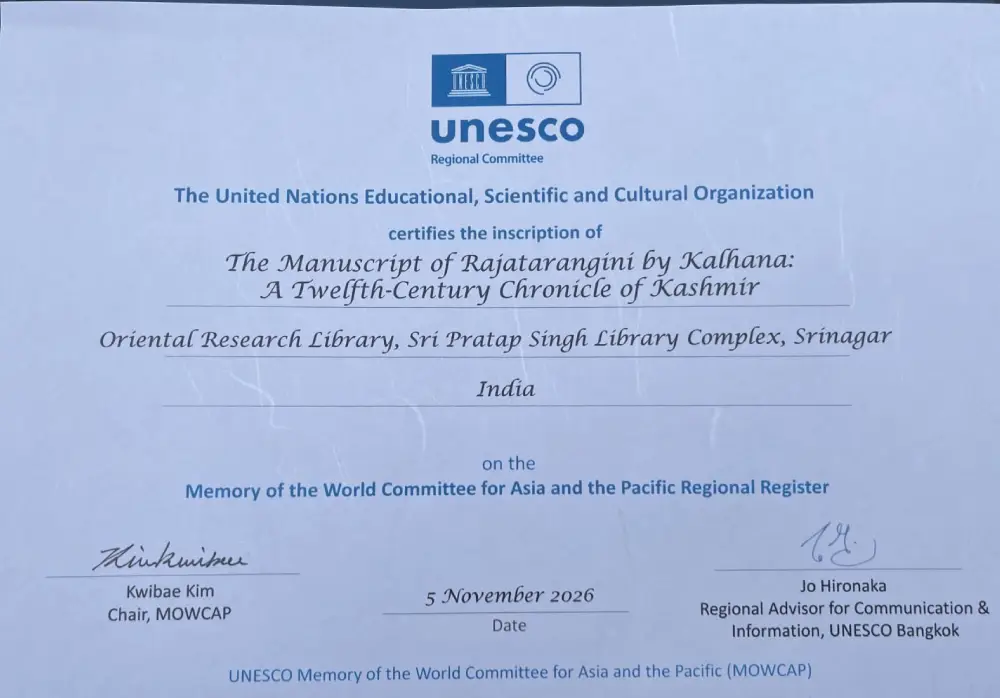
Rajatarangini, the twelfth-century chronicle of Kashmir, was inscribed on November 5, 2026, on UNESCO’s Memory of the World Asia Pacific Regional Register. The decision came at the 11th session of the Memory of the World Committee for Asia and the Pacific (MOWCAP) in Jakarta, Indonesia.
Two other Indian works were inscribed alongside it: the Mahabharata and Kautilya’s Arthashastra. The recognition applies to the documentary heritage represented by the manuscript. It is not a World Heritage Site designation.
The listing is regional, not global. The next level is the International Memory of the World Register. The national, regional and international registers are separately administered. They are not compulsory stages in a ladder, so a regional listing does not lead automatically to an international one. A separate nomination dossier is needed, and it is judged on its own merits.
The inscription, The Manuscript of Rajatarangini by Kalhana: A Twelfth-century Chronicle of Kashmir, clearly mentions that it pertains to Kalahana’s creation. The subsequent chronicles of Kashmir are Jonaraja’s Dvitīya Rajatarangini, Srivara’s Tritīya Rajatarangini, Prajya Bhatta’s Rajavalipataka and Suka’s Chaturthi Rajatarangini. The inscription concerns the specific manuscript preserved at the Oriental Research Library in Srinagar, rather than automatically covering every surviving copy, translation or continuation of the chronicle.
Nominations must go through the national channel, with the custodian’s consent, the Indira Gandhi National Centre for the Arts (IGNCA) in this case. There is precedent. The Natyashastra and the Bhagavad Gita were inscribed on the international register in April 2025.
The inscription brings no grant. UNESCO has long said listing carries no automatic financial support. Funding would have to come from sources such as the Ministry of Culture, IGNCA, and the National Mission for Manuscripts, the Jammu and Kashmir administration or private donors. The listing can strengthen such applications and raise attention to conservation, digitisation and scholarship.
What is Rajatarangini all about?
Rajatarangini (River of Kings) is classical Sanskrit kavya, or poetic literature, which is neither scripture nor fiction. It brings together historical events, mythology, traditions, political commentary and moral reflection.
It runs to about 7,826 verses, divided into eight tarangas (waves). Kings, queens, wars, landscapes and temples are narrated in verse, with elaborate language and metaphor. It traces Kashmir’s rulers from legendary beginnings to his own lifetime. It covers dynasties, succession, invasions, conspiracies, administration, taxation, floods, famines and irrigation. Its author has consulted earlier chronicles, inscriptions, coins, royal grants and other records. He also criticises earlier writers and stresses impartiality. The chronicle’s treatment of later centuries, notably the Karkota dynasty and the Lohara period, is generally considered the most reliable.
The opening sections contain legend that cannot be treated as fact. These include Kashmir’s origin as a vast lake called Satisar, its draining, the sage Kashyapa, Nagas, and very ancient genealogies and dates. Historians treat the chronology here with caution. The stories still show how medieval Kashmiris imagined the origins of their land. Religion runs through the narrative, but it is not the purpose. The text describes Shaivism, Vaishnavism, Buddhism, temples, monasteries, pilgrimage centres, royal donations and sacred geography. It reflects a religiously plural Kashmir.
The chronicle is also a reflection on power. It repeatedly examines arrogant, corrupt, greedy or oppressive rulers and draws lessons on the duties of kingship, justice, misgovernance and the instability of authority. The work matters not merely for listing who ruled Kashmir, but for showing how a Kashmiri intellectual nearly 900 years ago tried to separate “credible” accounts from “unreliable ones” and preserve them through literature.
Who was Kalhana?
Kalhana, author of the Rajatarangini, came from a Brahman family close to the centre of power. He was the son of Campaka, a minister under King Harsha. The family’s standing rested on public service and learning.
Campaka was dvarapati, or Lord of the Gate, a senior officer in charge of frontier defences. Kalhana records Campaka’s part in the expedition against the mountain fortress of Dugdhaghata on the Darad frontier, shortly before 1099. He also records his father’s loyalty to Harsha during the king’s struggle to keep his throne.
Campaka, however, was absent when Harsha met his final catastrophe. Kalhana says the king had given him a special mission. The chronicle reports a dialogue between the king and minister. Aurel Stein argued that such details could scarcely have survived except through Campaka himself. Stein also traced Kalhana’s account of the king’s flight to Mukta, a servant of Campaka’s household and one of the few survivors.
Stein identifies Kanaka, Campaka’s younger brother, as Kalhana’s probable uncle. Kanaka was a musician and Harsha took singing lessons from him and rewarded him with one lakh gold coins. Kalhana credits him with saving the great Buddha image at Parihasapura when Harsha was confiscating precious objects. Kanaka later retired to Benares and spent his last years in religious devotion.
Kanaka was born at Parihasapura. Stein infers that it was also the family’s ancestral home. Kalhana knew its sacred buildings and landscape closely. Kalhana never states his own birthplace, so Parihasapura should be described as the probable family home, not his confirmed birthplace.
Kalhana was a Shaiva. The invocations to Shiva that open the books of the chronicle make that clear. He wrote respectfully of Buddhist kings, monasteries, stupas and images, and praised the compassion of the Buddha and the Bodhisattvas. He condemned the destruction of a Hindu shrine and showed equal concern for the desecration of a Buddhist image. The chronicle preserves a Kashmir where traditions coexisted and often shared patronage.
Trained in Sanskrit grammar and literary theory, Kalhana knew the great classical poems and historical romances. He had studied Mahabharata and the Ramayana and knew the historical poem of his fellow Kashmiri, Bilhana. His references to earlier writers also preserve evidence about Kashmir’s intellectual life.
His standing is reflected independently in Mankha’s Srikanthacarita. Mankha describes a poet named Kalyana at a gathering of scholars and officials. Stein believes that this was almost certainly Kalhana.
Kalhana left no account of his own life. The chronicle says nothing definite about his childhood education, his wife or his children. It does not record when or where he died. His death is unrecorded. His work outlived him by centuries.
When was Rajatarangini discovered by Kashmir?
Kashmir never truly lost the Rajatarangini. Kalhana completed it around 1148 to 1150, and Kashmiri writers kept it alive for centuries. The work had a long afterlife. Jonaraja, a court pandit under Sultan Zain ul Abidin, continued the chronicle to 1458 or 1459. Srivara carried it to 1486, and Suka and anonymous writers to 1586. In the fifteenth century, Zain ul Abidin is said to have ordered a Persian translation by Mulla Ahmad, called Bahr ul Asmar. It has never been traced.
In 1589, Akbar commissioned a second Persian translation from Mulla Shah Muhammad Shahabadi, who died in 1598. It covered the Sanskrit continuations too. Mughal and Deccan historians such as Abu’l Fazl, Nizamuddin Ahmad and Firishta drew on it. Independent Persian histories followed, including Baharistan i Shahi in 1614 and Haidar Malik Chadura’s Tarikh i Kashmir around 1617. Historian Chitralekha Zutshi argues that these were not copies. They answered the Sanskrit tradition and reshaped it.
The modern revival began in the 1820s. William Moorcroft obtained a transcript in Srinagar in 1823. HH Wilson published an essay on Kashmir’s Hindu history in 1825. The Asiatic Society in Calcutta printed an early edition in 1835, and Antoine Troyer produced a French edition and translation between 1840 and 1852. In 1875, Georg Bühler toured Kashmir in search of manuscripts. He found that the best Sharada copies descended from one ancestral manuscript. Jogesh Chunder Dutt published an English translation in the 1880s.
That ancestral manuscript has a story of its own. It was not Kalhana’s original. It was a copy made in the seventeenth century by the Kashmiri scholar Rajanaka Ratnakantha. Aurel Stein called it the codex archetypus. Bühler saw it with Pandit Keshavram, grandson of Pandit Shivaram. By the time Stein arrived in 1888, Keshavram had died, and his three heirs had divided the manuscript among themselves. Stein records that his early efforts failed. After long negotiations, he obtained the portions on loan in 1889. He credits the breakthrough largely to Raja Pandit Suraj Kaul and his son Hari Kishan Kaul.
A later account adds colour. The three brothers each wanted the heirloom for the pride of owning it. Unable to agree, they tore it into three parts and lost some folios. Stein then approached each brother separately, without letting the others know, to have his portion copied. Stein admitted that the manuscript, originally of 328 folios, lost its last leaf and one from the middle.
In 1890, the box carrying it fell into the sea at Ostend. Stein reported that the old Kashmiri paper and ink survived the soaking without visible damage.
Behind the European story stands a Kashmiri scholar. Pandit Govind Kaul of Srinagar, born in 1846, had earned Bühler’s praise in 1875. From 1888, he worked with Stein for nearly 11 years. He collated manuscript readings, prepared Sanskrit indices, traced references to the epics and Puranas, and supplied local knowledge of geography and custom. Stein called him his best Indian friend. Govind Kaul died of typhoid in June 1899, a year before the translation appeared.
Stein published the critical Sanskrit edition in 1892. His annotated English translation, with introduction, commentary and a geographical memoir, followed in 1900. It became the standard reference for generations. Later work built on it.
Ranjit Sitaram Pandit published an English translation in 1935, with a foreword by Jawaharlal Nehru. Vishva Bandhu issued a Sanskrit edition in 1963 to 1965. Bernhard Kölver published a major textual study in 1971, and Richard Salomon criticised existing translations in 1987. Walter Slaje produced a critical edition of Jonaraja in 2014. In the 2020s, Ogura Satoshi studied how Sanskrit chronicles passed into Persian historical writing.
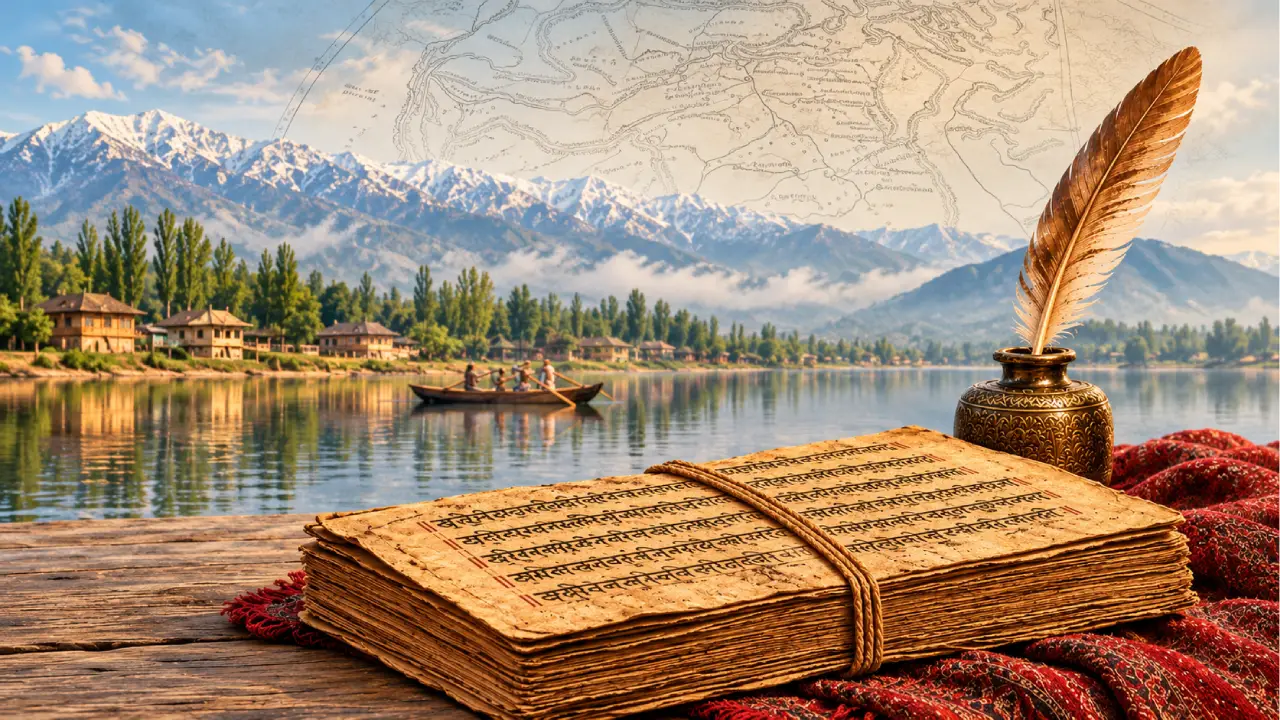
Is Rajatrangini the oldest book written in Kashmir?
No. The Valley’s literary and intellectual history reaches back many centuries earlier. Its beginnings are closely tied to Buddhist scholarship, which made Kashmir a centre of philosophical inquiry, religious learning and the transmission of knowledge across Asia.
Kalhana’s distinction is different. He produced the earliest surviving comprehensive and connected chronicle of Kashmir’s rulers and political history. The earlier traditions served other purposes. Buddhist literature explored existence and faith. The Nilamata Purana preserved religious belief, sacred geography and custom. Kalhana set out to reconstruct the past through a connected account of kings, dynasties and events.
Milinda Panha (Questions of King Milinda), one of the earliest surviving works of Buddhist philosophical literature, records a dialogue between the Indo-Greek king Menander (200 BCE), and the Buddhist monk Nagasena. They discuss the self, consciousness, rebirth, karma, suffering, wisdom and Nirvana. The Kashmir connection is intriguing. The text places the setting of the dialogue in relation to Kashmir, including a distance of 12 yojanas. In Kishtwar, the place known as Nagseni or Nagsoon is linked in local tradition with Nagasena. Archaeological or textual evidence of this still awaited.
Kashmir’s Buddhist literary history becomes more substantial under the Kushans, particularly Kanishka. The region emerged as a centre of Sarvastivada scholarship. Tradition associates Kanishka with a major assembly of scholars in Kashmir, conventionally called the Fourth Buddhist Council.
Two works are central to this tradition. The Mahavibhasha is a monumental exposition of Sarvastivada philosophy. It treats existence, consciousness, perception, causation and the nature of reality. The Jnanaprasthana Shastra, attributed to Katyayaniputra, became foundational for Abhidharma philosophy. Neither is a historical chronicle. Both are exercises in philosophical reasoning and doctrine.
Kashmir’s scholars did not only produce texts. They took part in a wider Asian movement of ideas, carrying Buddhist literature to Central Asia, China and Tibet. Kashmiri translators and scholars helped transmit the texts of several schools into Chinese and Tibetan. These translations matter because much of the original Sanskrit literature has disappeared.
The Sarvastivada tradition flourished in Kashmir, Gandhara and Mathura. It produced extensive Vinaya, Sutra and Abhidharma literature. The Gilgit manuscripts, found in the wider northwestern Himalayan region, offer further evidence of this manuscript culture. Some survive in Sanskrit. Others are known mainly through Chinese and Tibetan translations. The loss of the originals does not mean literary production was absent.
By the seventh and eighth centuries CE, another textual tradition had developed, represented by the Nilamata Purana. It moves from abstract philosophy to lived religious and cultural life. It describes Kashmir’s sacred geography, Nagas, festivals, customs, pilgrimage sites and religious practices. It records accounts of the Valley’s origin and its sacred springs. It shows how people in early Kashmir saw their land, organised their religious calendar and kept their bond with sacred places.
It is only with the turn of second millennium that Kalhana enters the scene and claims he consulted eleven earlier chronicles, according to Stein, besides other written and oral sources. Historical writing therefore preceded him, though most of those works have not survived.
Does Rajatarangni mention Muslims or Islam?
It predates Muslim rule in Kashmir by nearly two centuries. Still, it records Muslim political figures, military encounters and people from Muslim-ruled lands.
Kalhana did not use “Islam” as a religious or historical category. Instead, he used Sanskrit terms for outsiders, including Turushka, Mleccha, Yavana and Hammira. Their meanings were not fixed. Some meant foreigners in general. Others meant Turks or Central Asian groups. Some came to be linked with Muslims.
In her 2021 book The Language of History: Sanskrit Narratives of Indo-Muslim Rule, Audrey Truschke notes that Kalhana used Turushka for Muslims, for non-Muslim Turks and for earlier northwestern peoples. Mleccha could also mean non-Muslim outsiders. He used Yavana, Chandala and Hammira for Muslims in particular contexts. Muslims appear not only as enemies but also as allies and in non-military roles.
The chronicle records Mahmud of Ghazni’s attempts to enter Kashmir and offers a contemporary Kashmiri view of the resultant pressure. Kalhana knew people from the Muslim world beyond the battlefield and the royal court.
What is the scholarly critique of the Rajatarangini?
Without disputing its importance, scholars’ key debate is over how far it can be trusted as history, and how it should be read. The sharpest criticism concerns the first three tarangas. Kalhana opens with very ancient kings, genealogies and long reigns that cannot be verified. Reliability improves from about the ninth century, when inscriptions and coins allow comparison. The usual scholarly position is that the early books are not a verified political chronology. The later books, closer to Kalhana’s own time, are far more useful.
Kalhana mixes legend, prophecy, miracle and divine intervention with political narrative. Modern historians ask where memory ends, and imagination begins. Defenders reply that he wrote within the Sanskrit mahakavya tradition, where history, moral instruction and poetic embellishment coexisted. Judging him by modern research standards would be anachronistic.
Kalhana says a poet recounting the past must be free from attachment and hostility. Critics note that he often does not meet that standard. He praises and condemns rulers and measures kings against ideals of conduct. His dating also relies on the traditional Laukika era.
The most pointed recent critique comes from former civil servant Khalid Bashir Ahmad, who argues that Kalhana reconstructed Kashmir’s 3,000-year past largely through poetic imagination and fragmentary sources. He regards Kalhana primarily as a literary genius, though credits him with giving Kashmir a historical identity. Ahmad considers the early books unreliable but accepts the later portions as more credible.
The criticisms do not diminish the work. They show how to use it