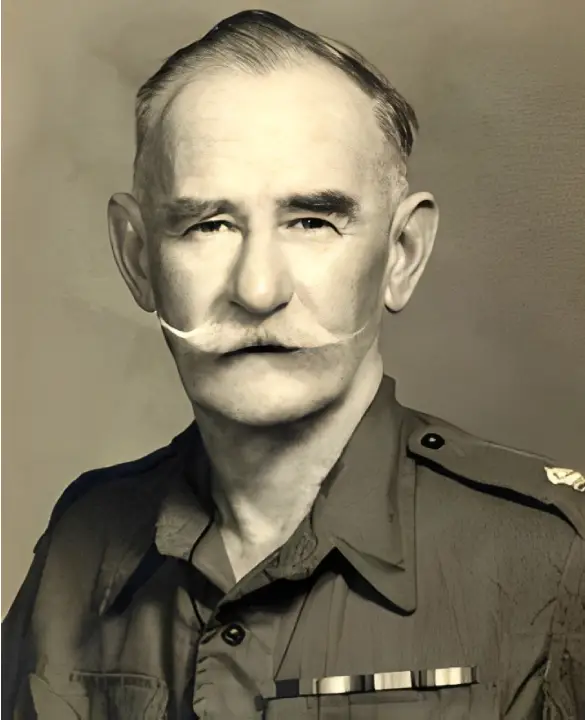
In 1912, Colin Metcalfe Enriquez (1884–1969), a British Indian Army officer and a prolific writer, wrote an article titled The Awakening of Kashmir, published in the New Zealand Graphic (Vol. XLVII, No. 20) on May 15. It is reproduced here to offer a glimpse into the developmental initiatives and projects being undertaken in Kashmir at the time.
There are not many parts of the world renowned either for beauty, climate, or natural wealth which have remained unexploited by settlers, merchants, or engineers. Yet, until quite recent times, its very backwardness has been the principal charm of Kashmir. It has always been a delightful summer holiday ground, where the hot, fever-stricken Anglo-Indian from the plains of the Punjab could lead an unconventional and healthy life, and could truthfully claim to be “monarch of all he surveyed.”
In the old days it was difficult to enter the country, as much on account of the Maharajah’s dislike and mistrust of Europeans as of the absence of good roads. The traveller has nearly always been the pioneer of civilisation, and so he proved in this case. The first concession he eked from the reluctant Durbar was permission to enter the country freely, and without application for a pass. That was not so many years ago; and from that day began the awakening of Kashmir.
In course of time, Europeans were allowed to remain in Kashmir during the winter, contrary to the previous rules. Then followed concessions in the form of house-building, trading, and fruit-farming; and doubtless before very long Europeans will be allowed to acquire land property too, though at present the Maharajah is very averse to any step in that direction.
Deepening the Jhelum
The establishment of an enterprising Anglo-Indian community, and the construction of strategic roads throughout the country connecting it with the Punjab, has been followed very rapidly by engineering undertakings on a large scale. It was very soon realised that the first hindrance towards prosperity lay in the constant floods which devastate Kashmir every few years.
The valley is about 100 miles long, and from forty to fifty miles broad. The river Jhelum winds its way with many bends and turns through the rich alluvial soil, until at Baramulla it reaches the eastern barrier of mountains, through which it forces its way with great violence down narrow gorges.
Rain, when it falls, often comes in a deluge for three days on end, and is not infrequently followed by a spell of hot weather, which brings down quantities of snow water from the mountains. Unable to escape through the narrow gorges at Baramulla, the waters of the Jhelum collect in the valley, and rise sometimes as much as fifteen or twenty feet in a couple of days. On such occasions, it inundates the whole country and does incalculable harm to property, rice crops, Indian corn, and fruit. Only too frequently, it bursts through the embankments which surround the capital of Srinagar, and floods out the entire city.
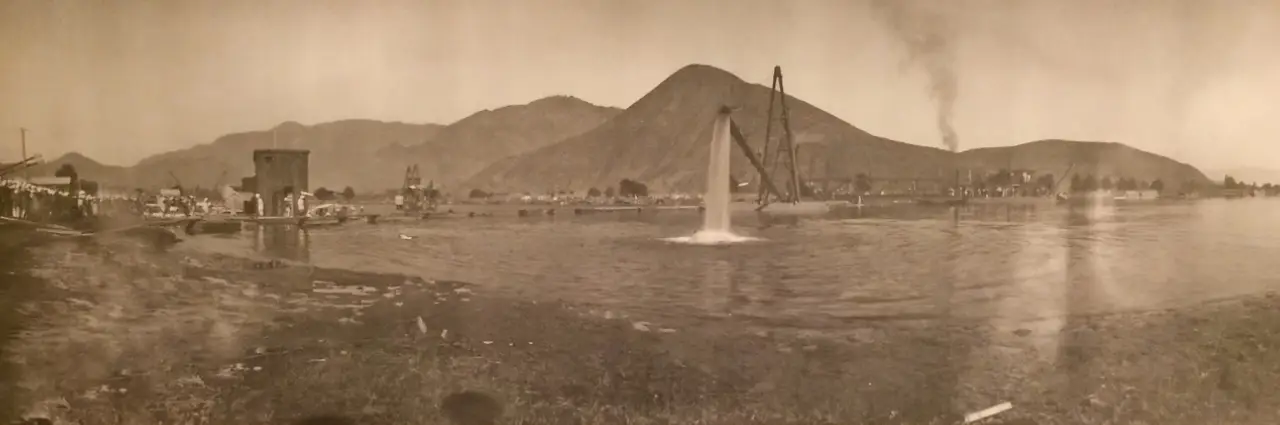
The scheme for averting these floods was conceived and executed by Colonel de Lotbinière, a Canadian by birth, and an engineer who has already made his name in connection with engineering feats in other parts of India. By means of three immense electric dredgers, the riverbed at Baramulla is being deepened, and boulders of great weight are being removed from the gorge.
The dredgers Kashmir and Jammu, which were both launched last year, work by suction. The material excavated from the bottom of the river is passed through a long steel pipe supported by cranes, and is deposited in heaps along each bank. Work is maintained for sixteen hours out of the twenty-four, and the roar of machinery and the blaze of electric light at night have astonished the sleepy inhabitants of Baramulla not a little. The third dredger, the Himalaya, grapples up rocks and boulders by means of a scoop. In order to maintain the normal level of water in the river under ordinary conditions, a dam has been built. It has been swept away once already.
The electric installation by which the dredging and other schemes are worked is a magnificent feat. The power station is situated at Rampur, a place noted for its extreme beauty. Great limestone precipices rise from the pine forests of the Jhelum, and along the face of these cliffs a considerable volume of water taken from the river itself is run in wooden galleries for nearly six miles, and is then dropped through four iron pipes onto the turbines from a height of over two hundred feet. The electricity thus generated is far in excess of what can actually be used in Kashmir.
When the scheme was first proposed, there were four main objects in view, the attainment of which it was believed would soon render the country rich and prosperous. They were: (a) The construction of a railway joining Srinagar to India; (b) The lighting of the great cantonments of the Punjab; (c) Dredging the river; and (d) The working of silk factories.
All idea of a railway has, however, been abandoned, owing to the difficulties presented by the mountain walls which shut in Kashmir on all sides. By means of the Swat Malakand canal, which is now under construction, the Punjab will be able to supply its own electric power. The dredging and the silk factories are certainly working splendidly, and it is calculated that the former undertaking will be the means of reclaiming hundreds of acres of swamp land for cultivation; but it is the opinion of many experts that these two achievements do not justify the heavy outlay of money that has been made.
The Timber Trade
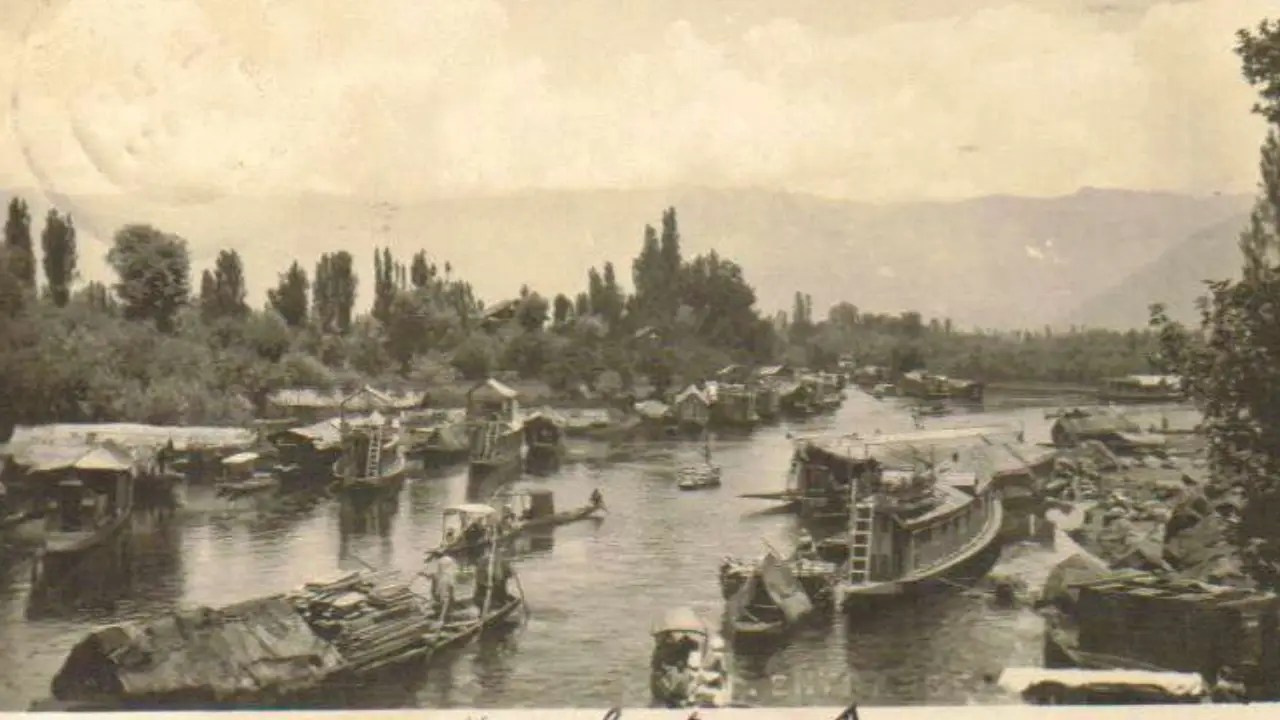
One of the chief sources of income is the timber trade. The traffic is most lucrative and is monopolised by the State. Nature has furnished streams and rivers which carry the logs free of cost from the inexhaustible deodar forests down to the Punjab, and even to the sea at Karachi. The wood is cut, marked, and thrown into the river. It can be seen floating smoothly through the valley, or charging headlong down the tormented torrent in the Baramulla defiles, or gyrating in some boiling backwater where thousands of rupees’ worth of timber sometimes get imprisoned for days. There is a staff of men always employed to re-float stranded logs and to prevent theft.
Large timber-yards are maintained at Jhelum, in the Punjab. Here such logs as are to travel still further are made into rafts, which float down in charge of a couple of men. Thousands of young trees of all kinds are planted yearly in Kashmir to prevent deforestation, and this good work is due chiefly to British influence. The possibilities of a match manufactory, which could easily compete against any imported, Europe-made matches, seem not to have struck anybody yet.
The Trade
Other trades, too, are rapidly expanding. The chief imports from Yarkand, Tibet, and Russian Central Asia are horses, turquoise, brass goods, jade, and Tibetan curios. The exports in that direction are wheat, rice, Indian corn, salt, cloth, and manufactured goods.
It is only the distance of Kashmir from a railway which prevents it from having an important and profitable trade in fruit. Every kind of English fruit is grown in the Srinagar orchards, but only within recent years has the cultivation been scientifically taken up. The result has been magical.
The strawberries, cherries, peaches, pears, apples, and melons are as good as those found in England, and are sold at absurdly small prices. Strawberries, for example, are 0.5 annas a pound, and pears 2.5 annas a dozen. Nectarines and apricots are not so good. Vines have been imported, and the preparation of a kind of vin ordinaire is placed under the management of a French expert. Mulberries grow everywhere and require no cultivating; they are of value on account of the silk industry.
Mineral prospecting, mustard-seed crushing, and jam manufacture have all been tried, but have one and all failed through lack of cooperation by the Durbar; though it must be confessed that exploiters preferred to experiment at the expense of the State than to sink their own money in the venture. That is probably the secret of many failures here. People come with no capital to risk, and are usually amateur fortune-hunters without sound business capabilities.
The Arts
The Kashmiris are not without their own arts. Their wood-carving, papier-mâché, and brass work are good. The famous Kashmir shawls are now no longer made. Carpets of fair quality are manufactured, but they do not compare with those of Persia or Central Asia. A European firm has already established a carpet factory.
There are a few liberal-minded Englishmen who have devoted themselves to improving the country without hope of financial gain. Of these, Colonel Ward has done much to better the breed of sheep and cattle. Mr Mitchell has spent both time and money on the introduction of trout, and certain mission societies have built hospitals and schools, of which benefits the Kashmiris are gladly availing themselves.
The sport of the country is now under European control and is carefully preserved. Trout have been imported from the streams of Scotland and are doing well. The rivers are well stocked with fish, which the natives hook and net only on payment of licence fees. Black bear and leopards are procurable without much difficulty in the valleys, and in the highlands are found markhor, urial, tahr, red bear, and snow-leopard.
Land Ownership
As a country to settle in, Kashmir has certain disadvantages, of which the disability of acquiring land is undoubtedly the chief. The Kashmiri himself makes business well-nigh impossible, and has a world-wide reputation for dishonesty, laziness, and cowardice. Every enterprise is strenuously discouraged by the Durbar, which has not yet overcome its inborn suspicion of European motives. Lastly, Kashmir is connected with India by 180 miles of the most troublesome road imaginable. It falls into disrepair after rain-storms, and its landslips are the despair of the engineers in charge of it.
For the rest, Kashmir is the Paradise of the world. The scenery is superb, and the climate for the greater part of the year perfect. Living is cheap, servants are maintained on the same lavish scale as in India, and the society is that of Government officials, civil and military.
Permanent residents usually live in houses situated in charming gardens. Visitors on a holiday from India live in house-boats, which in size and luxury rival their sisters on the Thames. Life is, in fact, one long “Henley,” and there are a hundred miles of river and several exquisite lakes to roam about over.
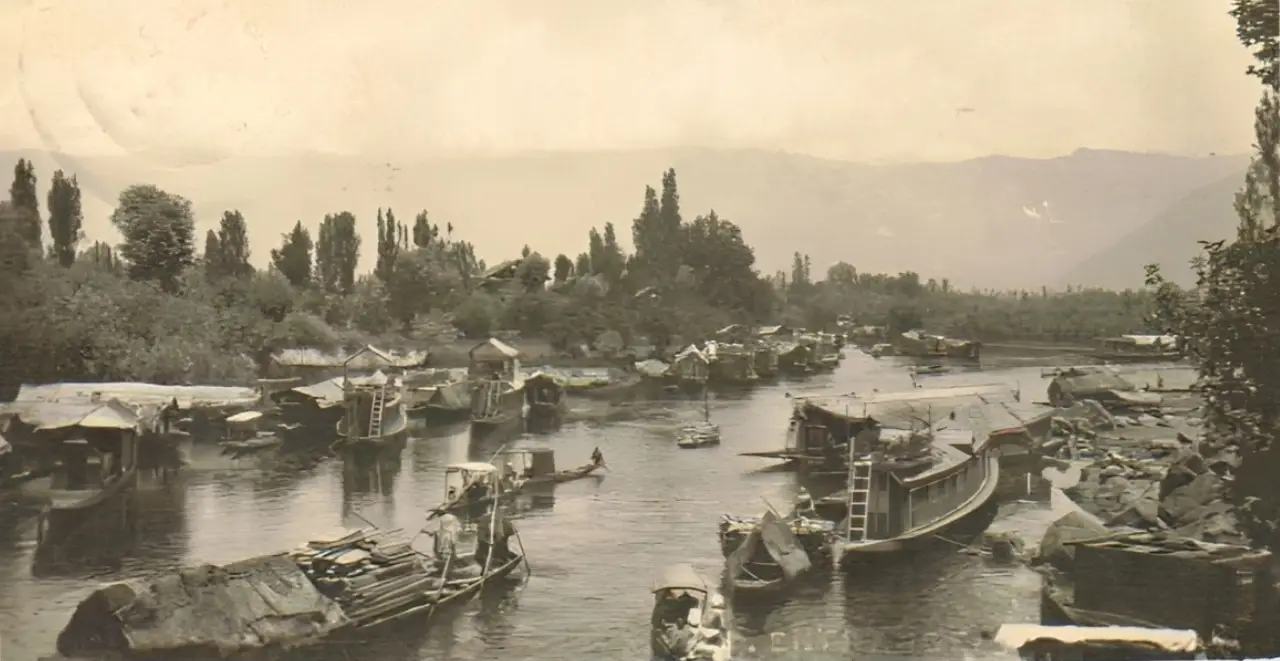
Srinagar is called the Venice of the East. The city is a maze of picturesque waterways, and the greater part of the population lives permanently in boats. The chinar trees (Platanus orientalis) are the glory of the valley; and in summer, when Srinagar is hot, camps are pitched in the uplands amongst the sighing deodar forests.