From Mughal-era resting places to thriving agricultural landscapes, Bugam village embodies Kashmir’s evolving agrarian narrative. Mujtaba Hussain reports the interplay of tradition, innovation and policy support forged Chota Punjab, a testament to rural resilience and economic growth.
On a crisp autumn afternoon, the tranquil banks of a cemented canal, which flanks the road connecting Wathoora to Khanpora Sarai, a historic resting place of Mughal rulers in Chadoora Block, were abuzz with activity. Groups of non-local labourers on either side of the canal busied themselves washing carrots and meticulously packing them into transparent polythene bags.
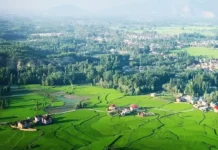
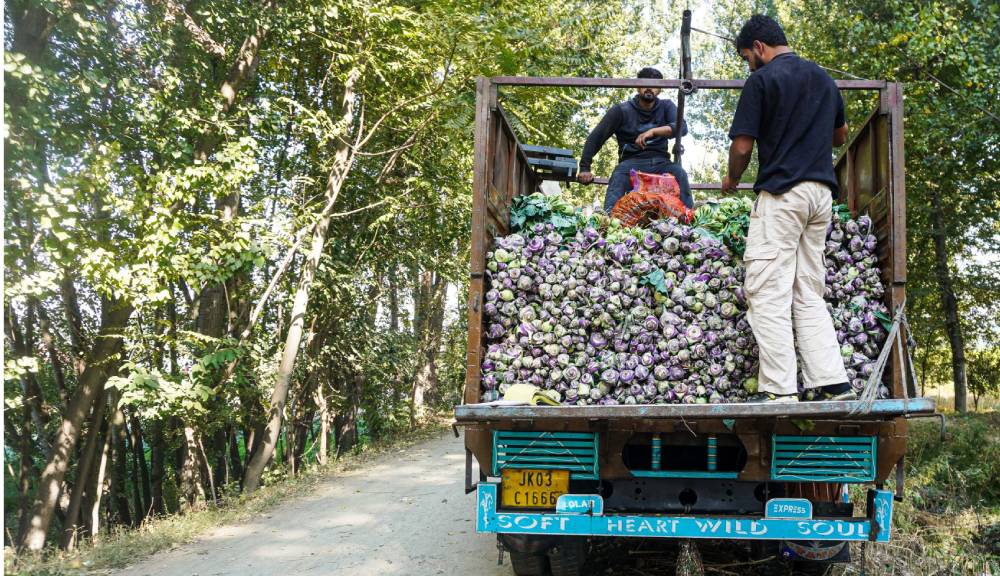
As the scenic road unwinds towards mainland Bugam, the vista reveals lush green expanses of cabbage and cauliflower fields, intersected by an intricate network of indigenous irrigation channels, the yeans and small khuls. The gentle rustling of leaves as farmers trim the overgrown foliage of cauliflower with sickles and load bundles of kohlrabi onto trucks creates a captivating tableau.
Chota Punjab
Budgam district in central Kashmir, proudly claims the title of the largest vegetable-producing district in Jammu and Kashmir. Its sprawling farms stretch across the district, with one notable cluster standing out for its remarkable productivity. Bugam, an agrarian village in Budgam district, has garnered acclaim for decades. Strategically positioned at the cusp of Budgam and Pulwama districts, this hamlet lies merely 10 kilometres from Srinagar City.
Bugam’s impressive vegetable yield not only meets domestic demands but also caters to national markets. This distinction has earned the village the apt moniker Chota Punjab, underscoring its reputation as a vegetable production powerhouse.
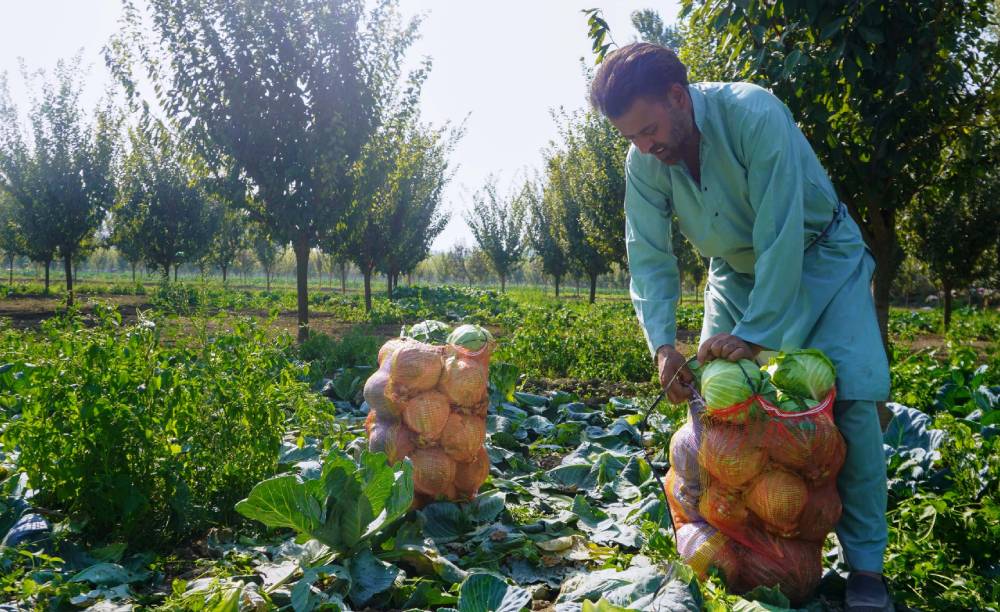
A local farmer from Bugam, who operates a vegetable shop in Chadoora town near the Srinagar-Chahri-Sharief road, reflected on this evolution. “The city residents brought about a green revolution in our village,” he said. This pivotal transformation laid the groundwork for the village’s esteemed status.
The farmer emphasised the significance of adopting vegetable cultivation over traditional rice farming. “This shift has been crucial to the economic and social development of our village and neighbouring areas,” he added. Today, agriculture and allied activities are the mainstay of most residents.
He highlighted the economic benefits of farming. “Almost every family’s income relies on agricultural production, which generates substantial earnings,” he elaborated. Notably, numerous individuals from farming families have achieved prosperity yet continue farming due to its relatively higher returns compared to alternative occupations.
Organic Growth
Bugam village boasts an impressive array of cultivated vegetables, including carrots, radish, cabbage, cauliflower, capsicum and spinach. This agricultural hub supplies fresh produce to Kashmir’s city centre and major towns, as well as distant markets in Jammu, Udhampur and Rajouri. Select vegetables, such as peas and coriander, are airlifted to metropolitan cities like Bangalore, Chennai, Delhi and Mumbai.
“Bugam’s 202.25 hectares of cultivated land comprise 160 hectares dedicated to varied vegetables, occupying 80 per cent of the total land, while orchards cover the remainder,” Tahir Hussain, Agriculture Extension Officer forChadoora explained. Approximately 400 of the 500 resident families rely exclusively on agriculture for their livelihood.

Hussain highlighted the financial allure of agriculture. “Better returns from agriculture prompt most families to prioritize farming over horticulture.”
Bugam distinguishes itself through organic and inorganic vegetable production. Hussain detailed the department’s initiatives, “We have established four organic clusters spanning 80 hectares and another 80 hectares for inorganic cultivation. To boost yields, our department offers subsidised quality fertilizers, pesticides, insecticides and plant growth regulators.”
“The provision of machine tools and irrigation pumps under the CAPEX budget exceeds 50 per cent subsidy annually,” Hussain added. “Fourteen hi-tech polyhouses, facilitated by the Holistic Agriculture Development Programme, enable winter vegetable cultivation. Plans are underway to establish additional poly houses, ensuring fresh produce availability during harsh winters.”
Irrigation Imperatives
Bugam village brags impressive revenue in the last financial year. Department of Agriculture data indicates earnings of Rs 17.07 crore, divided into Rs 9.2 crore from organic and Rs 8.5 crore from inorganic produce.
Bashir Ahmad, a member of the Parimpora Fruit and Vegetable Mandi union in Srinagar, underscored Bugam’s pivotal role. “Bugam is renowned as Kashmir’s vegetable production hub, surpassing other areas in contribution to the agriculture sector,” Ahmad emphasised maintaining this legacy.
Mehrajuddin Bhat, village chieftain and MBA graduate shared, “After completing studies, I explored private sector jobs but found vegetable cultivation on family farms more lucrative.” His seven-member family relies solely on this income. “Every village household owns a vegetable garden, tended by family and non-local labourers, employing most residents.”
Mudasir Ahmad, a farmer with 14 kanals of land, recalled past challenges. “Brokers once purchased large quantities, leaving minimal earnings for farmers.” Now, villagers directly supply produce to Srinagar mandis and distant markets in Anantnag, Jammu, Udhampur and Rajouri for better returns.
Several households partner with Kashmir’s Hotel, Restaurant and Café sector, securing retail rates over wholesale mandi prices. This direct supply chain boosts incomes.
Mudasir Ahmad expressed discontent with the local agriculture department. “We are disappointed by their inability to provide quality High Yielding Variety seeds.” He emphasised the crucial role of seed selection in determining crop quality and quantity. “Often, seeds supplied at lower rates are substandard, forcing us to procure seeds independently.”
An Agriculture Extension Office official countered, “We source seeds from local farmers, importing minimal quantities. We strive to enhance received seeds’ quality before distributing them to farmers.”
Village headman Mehrajuddin Bhat criticised the department’s complacency. “Despite the potential, the agriculture department’s inaction stifles progress.” He praised the Irrigation department’s established channel network but lamented maintenance neglect. “Canal dredging, repairs and irrigation valve maintenance are periodically neglected, causing random crop destruction and farmer burdens.”
Bhat highlighted the vital Marwal Lift Irrigation Project. “Proper maintenance requires political and administrative will, unlocking the village’s untapped potential.”
Local farmer Bashir Ahmad urged governmental bridging of traditional and modern agricultural practices. “Lacking critical infrastructure, Bugam’s fertile soil remains underutilised.” He advocated a farmer-friendly policy to expand the green revolution to other Jammu and Kashmir villages.
Mehrajuddin Nath, president of Iqbal Sabzi Mandi Batamaloo, highlighted Bugam’s prominence. “Chadoora supplies most vegetables, with Bugam excelling in cauliflower, cabbage, carrots and collard cultivation. Bugam’s impact on Jammu and Kashmir’s agricultural map is significant.”
Nath noted seasonal disparities in vegetable imports, “Summer imports from Punjab, Delhi, Himachal Pradesh, Gujarat and Uttar Pradesh are negligible, but surge in winter.” This imbalance stems from Kashmir’s reliance on dried vegetables during winter due to scarce domestic fresh produce.
Digital Age Agriculture
The Department of Agriculture’s provision of hi-tech polyhouses in Bugam boosts production. However, demand exceeds supply. Nath emphasised agriculture’s economic importance. “Our mandi supports 30,000 to 50,000 families. Labor-intensive agriculture is vital for economic well-being and combating unemployment,” Nath said.
Bugam’s buffer production underscores its agricultural significance. Its success inspired adjacent villages – Kaiser-mullah, Kuzwera, Gowharpora, Nowbugh and Dooniwara– to adopt vegetable cultivation. Bugam’s achievement offers a blueprint for Jammu and Kashmir’s agricultural growth, addressing poverty and unemployment.
Members of the Fruit and Vegetable Market Parimpora union urged protective measures for Bugam’s agricultural sector. “The administration must restrict construction on fertile land to preserve agriculture,” he asserted.
Historically agricultural hubs, Bakshipora, Maloora, Narkara, Noorbagh, Tengpora and Mujgund now feature sprawling concrete houses and commercial complexes. “Fertile land, once abundant, appears vanished.”
Union members stressed agriculture’s economic significance. “Land is essential for cultivation; vegetables cannot thrive on digital screens,” they advocated supportive government policies.
They also added, “The agriculture sector’s economic role in Kashmir is immense. Government policies should incentivise farmers, not restrict trade. Profitable farming ensures sustained agricultural growth”.