by Tanveer Ahmad Rather
Nature’s laws are unyielding. Even the slightest violation invites consequences, for there is no room for mercy. These laws offer humanity a chance to become obedient stewards and conscientious beings. Yet, when we defy nature, we inevitably find ourselves ensnared in turmoil. This is the path we tread today.
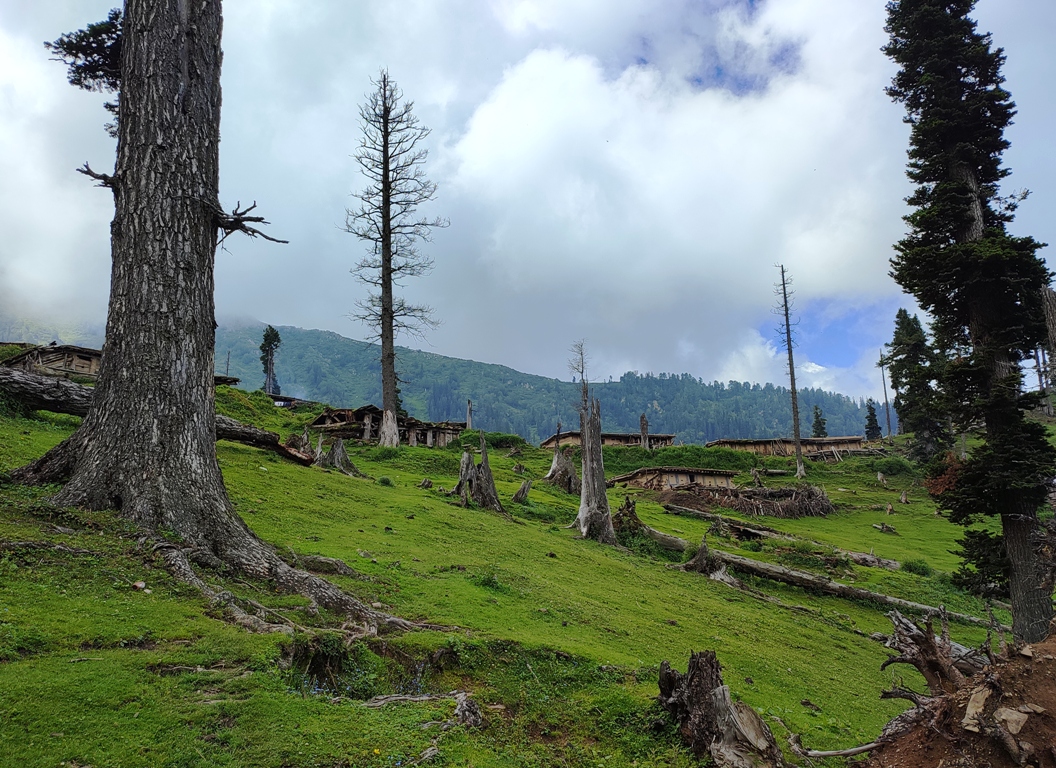
In the relentless pursuit of development and modernisation, humanity often places material gains and self-interest above the well-being of the natural world. This shortsighted mindset has led to rampant deforestation, unchecked pollution, climate change, and the depletion of vital resources—all under the guise of progress. True development, however, must harmonise with nature, fostering sustainability and balance rather than exploiting it for fleeting gains. Nature is not merely a resource to be consumed; it is an intricate system of which we are an inseparable part. To harm nature is to harm ourselves.
It is deeply disheartening to witness the degradation of nature, particularly in regions like Jammu and Kashmir, renowned for their stunning landscapes and rich biodiversity. Reports of large-scale deforestation and environmental neglect surface with alarming regularity. While developmental projects are undeniably crucial for progress, they must not come at the cost of nature’s sanctity. Protecting the environment must remain a cornerstone of any vision for the future.
The phrase ann posh teli yeli wan posh by the revered Sufi saint Sheikh Noor-ud-Din Wali, also known as Nund Rishi, carries a profound truth: food endures only as long as forests endure. This timeless wisdom resonates deeply in Kashmir, a region now grappling with the alarming degradation of its natural heritage.
Over the past two years, Kashmir has suffered a significant decline in its forest cover, losing 40.61 square kilometres, as reported by the Forest Survey of India (FSI) in its India State of Forest Report-2023. The total forest cover in the region stood at 21,346.39 square kilometres in 2023, down from 21,387 square kilometres in 2021. The report offers a detailed district-wise breakdown: Anantnag recorded 1,077.04 square kilometres of forest cover, while Bandipora, Baramulla, Doda, and Kishtwar registered 923.29, 886.44, 1,484.45, and 1,787.96 square kilometres respectively.
In 2020, Jammu and Kashmir boasted 1.15 million hectares of natural forest, covering 11 per cent of its land area. However, by 2023, the region had lost 112 hectares of this precious resource, resulting in 68.8 kilotons of CO₂ emissions. Between 2001 and 2023, the cumulative loss of tree cover reached 952 hectares due to fires and 3.23 thousand hectares from other drivers of deforestation. The period from November 2023 to June 2024 saw an alarming 4,156 forest fires, averaging nearly 17 incidents daily. These fires accounted for 22.7 per cent of the total tree cover loss in Jammu and Kashmir over the past two decades.
The figures paint a stark picture: 952 hectares of tree cover lost to fires, and 3.23 thousand hectares to other causes. The urgency to heed Nund Rishi’s words has never been greater.
I have gathered data from available sources indicating that over the past decade, Jammu and Kashmir has experienced a significant decline in forest cover, primarily due to developmental projects. Reports suggest that nearly 60-70 per cent of the cleared forest area has been lost to accommodate infrastructure development, resulting in a substantial reduction in tree cover. Much of this damage has been concentrated in the tourist and health resorts of the Kashmir Valley, particularly in Pahalgam, Gulmarg, and Sonamarg.
Politically connected and highly influential individuals have been constructing hotels, restaurants, and even government buildings on forest land. While some of these areas have been officially allocated for such developments, this practice must be halted, and these structures demolished to safeguard our “green gold” and preserve the integrity of the environment.
In Gulmarg, a renowned tourist destination, 727 hectares of forest land have been diverted for 198 projects, leading to the felling of 1,847 trees, predominantly for road construction and military use in Gulmarg and the Pir Panjal region. Meanwhile, in the Jammu division, tree felling is conducted under the supervision of the J&K State Forest Department. Out of a total of 21,483 trees marked for removal, 8,150 have already been cut, with the remaining 13,332 slated for phased removal.
In addition to the loss of over 21,000 trees, more than 716 kanals (36.2511 hectares) of forest land in the Jammu and Reasi forest divisions will be diverted to the National Highways Authority of India (NHAI) for non-forestry purposes, including the construction of the Jammu-Katra Expressway. Furthermore, the proposed construction of the new J&K High Court complex in the Raika-Bahu forest area, often referred to as the “lungs of Jammu,” will result in the felling of approximately 38,000 trees across 40 hectares of forest land.
In Srinagar, more than 110,000 privately owned trees, including apple, chinar, walnut, and mulberry, valued at Rs 13.76 crore, have been felled by the National Highways Authority of India (NHAI) to make way for the Srinagar Ring Road. Official data reveals that of the 75 chinar trees marked for removal, a staggering 58 were cut down in Pulwama district, with an additional 17 meeting the same fate in Anantnag district over the past few years. The felling of over 200 poplars, which once formed a green tunnel leading to the colonial-era Amar Singh College building in Srinagar, has sparked outrage among the college’s alumni and students, who have condemned the act as vandalism.
In the health resort of Pahalgam, around 700 to 800 conifer trees are slated to be felled along a corridor proposed by the Jammu and Kashmir Projects Construction Corporation (JKPCC). This move is expected to deal a severe blow to the natural beauty and environmental integrity of Pahalgam. The proposed corridor will cut through forest compartment 35, causing extensive ecological damage.
Similarly, in the central Kashmir district of Ganderbal, the government has sanctioned the use of 82.2539 hectares of forest land in the Sindh Forest Division for the construction of a 220 KV Srinagar-Leh transmission line by the Power Grid Corporation of India. The State Forest Corporation is overseeing the felling of approximately 700 trees, yielding around 122,000 cubic feet of timber. The total length of the transmission line is 375 kilometres, with 42.327 kilometres passing through forested areas. In 2021, the agency constructing the Zojila Tunnel faced criticism for chopping down over 300 trees without obtaining permission from the Forest Department.
In the Pir Panjal region, a forest advisory committee sanctioned the felling of 40,035 trees, poles, and saplings across eight districts on 8 July 2015 to pave the way for power transmission lines through the Mughal road. More recently, expert panels at India’s environment ministry have recommended environmental and forest clearance for the Ujh multipurpose hydropower project in Jammu and Kashmir.
This decision was made in December 2020, and the project proposes the construction of a 116-metre dam, requiring the diversion of 4,350 hectares of land, including approximately 680 hectares of forest land and the clearance of 214,502 trees. The project declared a national project in 2008, is part of India’s efforts to harness the water available under the Indus Water Treaty.
The unchecked exploitation of forest land in the region has raised concerns. Politically connected individuals are constructing hotels, restaurants, and even government buildings on forest land, often with official allocations for such developments. This practice must be prohibited, and these structures demolished to safeguard the region’s natural heritage and environmental integrity.

Climate change poses the most pressing environmental emergency of our time, with far-reaching implications for both the environment and human health. This impending disaster threatens various sectors, including glaciers, permafrost, rivers, forests, soils, ecosystems, society, and the economy.
The effects of climate change are already being felt, with erratic snowfall patterns and unusually warm winters, as seen in January, signalling a shift in the region’s climate patterns. This raises concerns about the impact on local ecosystems and ways of life. The diverse ecosystems and communities, particularly poor rural populations living in the mountains across the Union Territory, are among the most vulnerable to climate change.
(The author is a PhD student in Forestry at the Faculty of Forestry, SKUAST-K. Kashmir Life neither confirms nor denies the author’s research, statistics, or numbers presented in the essay.)