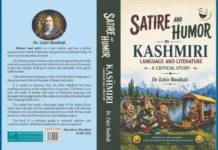
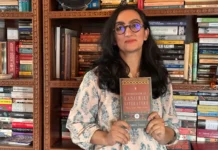
Heeba Din’s Drawing Political Narratives with Humour in Kashmir examines how cartoons in Kashmir serve as instruments of political meaning, blending humour, semiotics, and visual rhetoric to reflect and shape public sentiment, writes Muhammad Nadeem
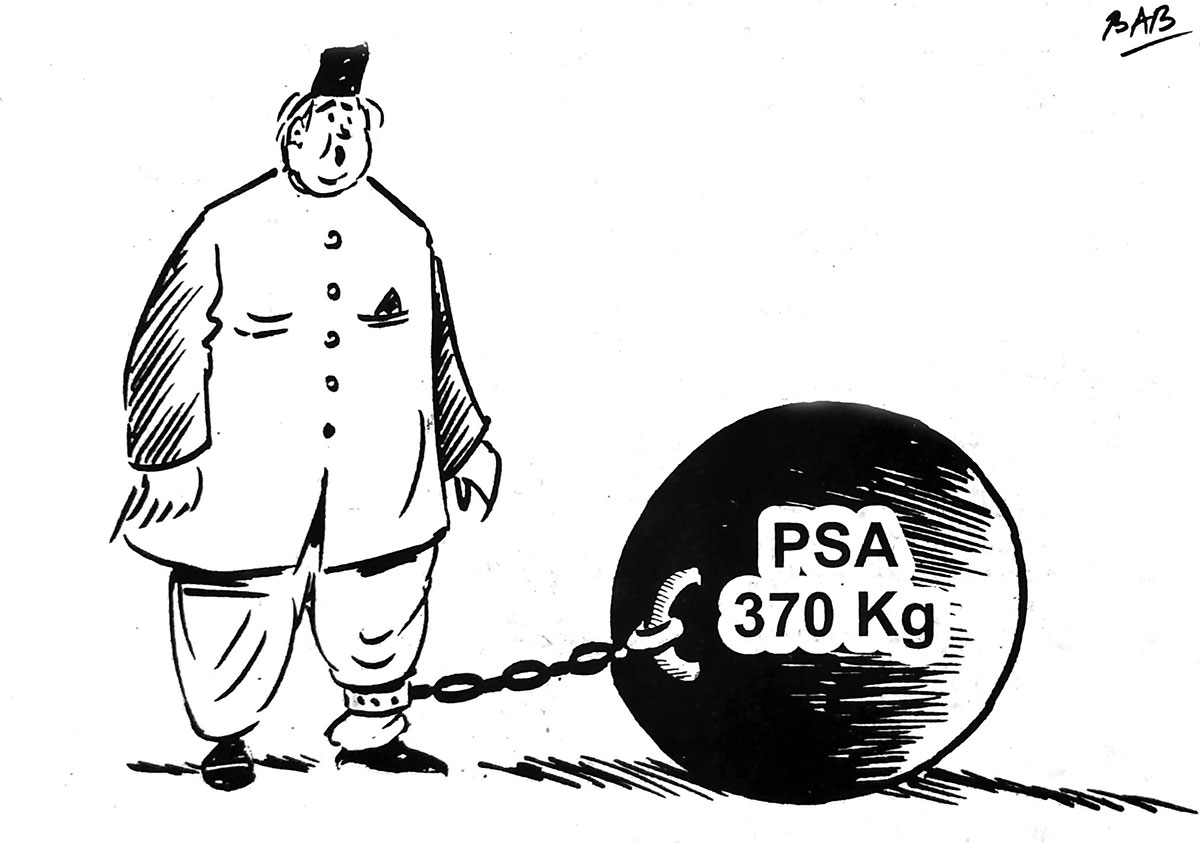
Heeba Din’s book, Drawing Political Narratives with Humour in Kashmir: Satirical Brushstrokes, opens a disciplined and ambitious enquiry into the role of humour, satire, and visual rhetoric in one of South Asia’s most contested spaces. The book sets out a clear central thesis: political cartoons in Kashmir operate as meaning-generating instruments that, through humour, rhetoric, and metaphor, produce narratives which both reflect and shape public sentiment. Heeba positions cartoons as simultaneously artistic artefacts and rhetorical devices, and argues that their cumulative circulation matters for political memory and identity formation.
The introduction calibrates its argument within Kashmir’s long history of political contestation, tracing the legacies of partition, multiple wars, and the enduring salience of identity politics. Heeba frames the problem of locating humour in Kashmir as an analytic challenge, given the region’s sensitivities and the frequent costs paid by cultural critics. The book invokes George Orwell to anchor its normative view of political humour, citing his memorable line, “Every joke is a tiny revolution.” This move is a framing device because Heeba seeks to show that even small acts of derision can redistribute symbolic power in highly asymmetrical contexts.
Heeba combines semiotics and rhetorical analysis, committing to Roland Barthes’ threefold division of the image: the linguistic text, the non-coded iconic message, and the coded iconic message. The author explains how each layer will be used to unpack cartoons and how visual metaphors will be mapped into source and target domains under Max Black’s interaction theory. This methodological clarity is a strength: readers are given a transparent interpretive toolkit that can be applied across print, broadcast, and digital artefacts. The book also provides an account of the practical constraints that conditioned the research, including archival gaps and difficulties in accessing early-generation cartoonists, which increases the credibility of the analysis.
The book’s significance is timely and multidisciplinary. Published in 2025 against the backdrop of continuing post-2019 political reconfiguration in Jammu and Kashmir, Heeba’s work addresses an urgent need to understand non-verbal political discourse in an environment marked by curbs on conventional media, periodic internet shutdowns, and rapid platform-based circulation and the recent book bans. By treating cartoons as historical evidence and rhetorical artefacts, the book situates itself at the intersection of political communication, media studies, and South Asian history. It thereby offers a conceptual and empirical entry point for scholars and practitioners who must make sense of political meaning-making when conventional opinion instruments are limited.
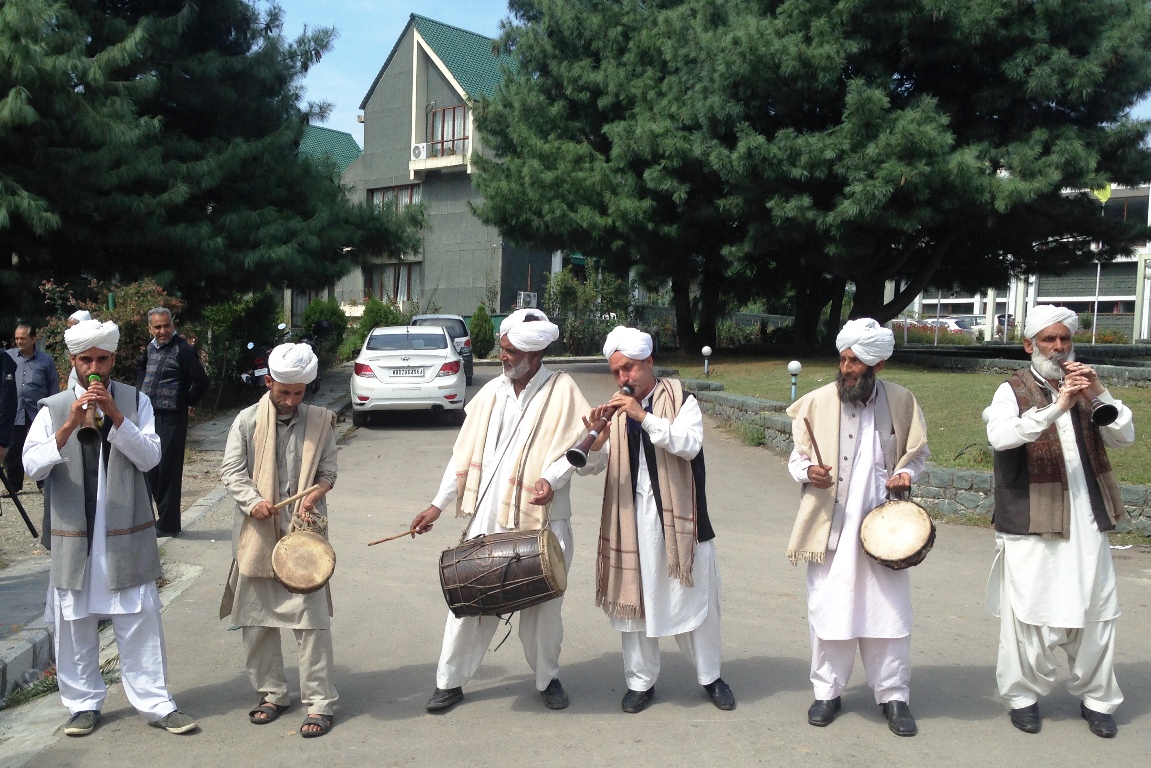
Folk Theatre
Heeba’s first substantive achievement is to historicise the practice of satire in Kashmir beyond a narrow contemporary focus. The book recovers long-standing traditions of satirical performance, from Bhand Pather to televised satire, and links these to Urdu journalistic practices that normalised satirical editorial techniques. This longue durée approach widens the analytical aperture and avoids the trap of treating political humour as merely a modern, platform-driven phenomenon. In tracing earlier media forms such as Doordarshan-era satire and Urdu second-editorial traditions, Heeba demonstrates continuity between pre-modern folk satire and modern editorial cartooning, which strengthens the claim that humour in Kashmir has institutional depth.
Heeba interweaves humour theory, Barthesian semiotics, and the neo-classical canons of rhetoric adapted for visual discourse. The result is a conceptual architecture that is both capacious and operational. For instance, the use of DeSousa and Medhurst’s modified canons, invention, disposition, style, memory, and delivery, translated into visual affordances such as composition, line, and typographic delivery, gives analysts concrete levers for reading cartoons as instruments of persuasion rather than as ephemeral entertainment. This translation from verbal rhetoric to graphic technique is one of the book’s most useful methodological contributions.

Cartooning
Heeba’s deconstruction of cartoons at three analytic levels, linguistic text, denoted message, and coded iconic message, is rigorous and consistently applied in the book’s exemplars. This layered reading is useful, especially where cartoons rely on culturally specific allusions. Heeba emphasises that “The linguistic text functions as a means to control the projective power of the images,” an observation that captures how captions or labels anchor potentially polysemous visuals and steer interpretation. The book’s use of Black’s interaction theory of source and target domains further helps to map how particular metaphors migrate meaning across conceptual fields.
The historical vignettes are effective and often original. Heeba recovers episodes that show how satire was institutionalised in the valley, such as the sustained popularity of the televised satire Hazaar Dastaan and the role of Urdu op-ed traditions like Chirag Beigh ke Qalam Sae. These examples do two analytic jobs: they situate contemporary cartooning in a tradition of popular satire, and they document state responses that illuminate the political stakes of humour. Heeba also documents the recurrent function of cartoons as social correctors, a view supported by archival episodes of suspension and state pushback that show humour’s capacity to provoke response even when direct political action is constrained.
The book offers a productive base for cross-case research. Heeba gestures toward analogous debates about cartoons in other conflict zones, and her method is portable: the same Barthesian and rhetorical instruments can be used to compare Kashmir with Palestine, Serbia, or Ukraine. Such comparative work would help produce typologies of humour in conflict, distinguishing cases where satire primarily operates as resistance, where it is co-opted as propaganda, and where it functions chiefly as catharsis.
The political cartoons in Kashmir are not peripheral amusements but historical and rhetorical artefacts that both reflect and shape public sentiment and political memory. Heeba anchors this claim in a multiscalar account that moves from nineteenth-century Indian Punch traditions to the vernacular press in Kashmir, and then to the localised practices, institutions, and personalities that sustained cartooning in the Valley. Her approach blends press history with visual analysis, on the premise that cartoons must be read both as immediate rhetorical acts and as cumulative instruments of cultural conditioning.
The Newspapers
The book’s significance is sharpened by contemporary political realities in Kashmir. Heeba writes against a backdrop of contested media space, book bans, archival losses, and an evolving digital visual culture. She notes that “many archives managed by the State Information Department were gutted during the 2014 floods”.
Heeba traces the earliest local cartoons to the mid-1930s, citing examples in weekly Rehbar and Hamdard, and argues that cartoons have been “a feature of the press in Kashmir for almost 88 years.” This temporal claim reframes cartoons as an enduring medium in Kashmiri public life rather than a short-lived novelty. Heeba then maps institutional developments: Ranbir, Hamdard, Daily Aftab, Srinagar Times, and, later, Greater Kashmir, showing how editorial decisions, front page placement, and resident cartoonists shaped readership habits and interpretive conventions.
The book also locates the medium within scholarly conversations on visual rhetoric, semiotics, and humour theory, preparing the ground for later chapters that operationalise Barthes’ three-code approach and rhetorical disposition analysis.
Heeba is explicit about the limits of the surviving record, and she explains that the study “had to stitch together the information collected from the archives (whatever is available) and further reference it with oral history collected by senior cartoonists and journalists alike.” The use of oral testimony to recover the biographies of figures such as Ghulam Ahmed and Bashir Ahmed Bashir is convincing and gives texture to institutional histories that would otherwise risk abstraction.

Significance of Cartoning
Heeba’s argument that cartoons operate on two planes, an immediate plane of humour and an implicit plane of cumulative conditioning, is persuasive and well substantiated. She marshals historical exemplars to show how cartoons both elicited laughter and, over the years of repetition, contributed to public frames. That claim is supported by comparative scholarship she cites, and it is consistent with the book’s empirical material, which demonstrates long-standing motifs and symbol repertoires across decades. Heeba’s reading of recurring symbolic tropes, Kangri for winter, skeletons for decay, and chess as politics, illustrates how cultural codes acquire layered meanings through sustained visual labour, a point that is theoretically useful and empirically traceable across the sampled newspapers.
The biography of Bashir Ahmad Bashir as a central figure for Urdu cartooning and the documentation of the 1977 privilege motion against Srinagar Times vividly demonstrate the political stakes of satire in the Valley. These episodes show how cartoons could provoke institutional reactions, an important corrective to any romanticised view of humour as harmless.
The book’s section on Sexism and Stereotyping in Cartoons is necessary and frank. Heeba documents how cartoons relied on gendered tropes, showing women as cultural custodians and men as public actors, and she observes that cartoonists “frequently use well-established stereotypes, including gender roles and identities.”
The chapter, Metaphors and Identity Through Political Cartoons in Kashmir, offers an account of how editorial cartoons in the Valley use metaphor and cultural symbolism to shape collective memory and social identity. This chapter situates cartoons not simply as ephemeral entertainment but as visual texts whose connotations operate within local cultural repertoires, as she writes, “connotations are arbitrary and reveal the underlying meaning and emotion attached to the sign.”
The metaphors are the primary vehicles through which cartoons translate complex political experience into immediate visual meaning. Heeba leans on Black’s interaction theory and Schilperoord and Maes’ taxonomy to identify replacement, fusion, juxtaposition, and scenario metaphors as recurring devices. Cartoons function as contested sites of ideological assignment because their success depends upon shared background knowledge: “If the cartoonist uses a particular allusion or metaphor that the reader isn’t aware of, the cartoon will fail to make any sense to the reader.” These claims position the book at the intersection of semiotics, humour studies, and political communication.

The Cultural Connect
The book’s significance is amplified by its empirical attention to localised cultural markers: Kangri, Wazwaan, Darbar Move, as well as to transnational frames that the Valley’s cartoonists have adapted, such as depictions of global actors in the Iraq era. Heeba makes a persuasive case that the repeated use of particular metaphors produces a “social identity map” that assigns roles and values to institutions, communities, and political actors. This is timely work: in a post-2019 media ecology where conventional channels are constrained and visual circulation has intensified, Heeba’s analysis offers a method for reading how cartoons both register and produce political sentiment in the Valley. The book thus serves both as a conceptual toolkit and as an empirically grounded intervention in South Asian media studies.
Her attention to linguistic anchorage and to how captions “anchor the projective power of images” is an analytically fruitful move that makes visible the interplay between text and image in single-panel cartoons.
By anchoring interpretive claims in a bounded dataset, Heeba avoids sweeping generalisations while permitting pattern identification across frames that the book elsewhere enumerates, including Governance, Image Making, Kashmir Conflict, Secessionists, Indo-Pak relations, International Affairs, Culture, Environment, Elections, and Miscellaneous.
Heeba recognises cartoons’ dialectical relation to myth. As she observes, “cartoons were sites that both sustained and broke myths,” a succinct formulation that captures the medium’s ambivalence. The book’s mapping shows how some tropes, modernisation as Westernisation, or gendered domestic roles, are repeatedly naturalised by cartoons, even where other panels use satire to deconstruct institutional claims such as the sanctity of democratic forms. That dual function matters for scholars who wish to deploy cartoons diagnostically: one must ask not only what cartoons ridicule, but what they inadvertently reproduce.
Diplomacy
In Carnivalization of Politics: Understanding India-Pak Relations via Cartoons, adapts Mikhail Bakhtin’s carnivalesque to show how cartoons invert hierarchies, parody official ritual, and expose diplomatic spectacle. Heeba notes that Bakhtin’s carnival renders the grotesque and the comic as political instruments that “resist totalitarianism not with another form of dogmatism but by maintaining multiple alternative perspectives.” She argues that cartoons perform a dual function, namely ridicule and critique, by converting solemn gestures into theatrical acts and thereby enabling civic reflection.
The chapter Visual Vocabulary is an empirical companion to the theoretical claim in the previous chapter. Its stated aim, “to locate prominent codes, icons, and symbols that cartoons have banked upon over the years under the reference period,” produces a systematic lexicon of local and transnational signs that readers of Kashmiri newspapers come to recognise as semiotic shorthand. Heeba demonstrates that recurring motifs such as the Shikara, Samavar, and the apple do more than evoke place; they accrue ideological valences that condition what is thinkable and sayable about class, governance, and identity.
Heeba persuasively shows that cartoons routinely juxtapose the handshake with hidden weaponry, writing that leaders are sometimes drawn “shaking hands, a symbol of peace and cooperation, while artillery was shown juxtaposed in the respective pockets of the leaders.” This visual incongruity stages hypocrisy as a sight to be read, and it grants the audience permission to interpret diplomacy as theatrical rather than substantive. Heeba combines this insight with humour theory, showing how superiority, incongruity, and relief function differently in the India-Pak frame. She argues that the India-Pakistan frame “mostly banked upon the superiority theory to drive the message of the cartoon,” and she supports this with examples where leaders are ridiculed as PR actors rather than genuine statespeople.
Heeba classifies humour types and aligns them with pictorial strategies. Superiority humour is used as social correction, incongruity humour exposes contradiction by combining mismatched signifiers, and relief humour offers a venting effect during high-tension moments. The book’s illustrative choices are apt: sports metaphors that reduce Kashmiris to a ball, or cartoons that render leaders as tortoises climbing toward a peace symbol, provide compact visual arguments whose logic Heeba teases out with rhetorical precision.
She extends the contribution by offering a reproducible catalogue of signs. The argument that “this visual vocabulary is thus a quick guide into understanding the visual discourse setup by cartoons over the decades in the region” is implemented through a table-like inventory of icons and their meanings. Among the entries are locally resonant synecdoches, the Shikara and Samavar, as well as transnational motifs such as the US elephant and the skull for death. Significantly, Heeba demonstrates that such codes perform classed semiotics: Karakuli caps signal elites while conical caps signal the common man, and repeated use of these devices eventually “lay bare the class divide that exists in the valley.”
The book is methodologically robust in hermeneutic terms. Heeba is transparent about scope and source material, and she situates each argument within a defined reference period. The taxonomy is useful for comparative work because it permits analysts to map metaphor types across frames, for example, replacement metaphors, fusion metaphors, and juxtaposition scenarios. The textual evidence, cartoons that show leaders as Saudagars stuffing Kashmir into a gunny bag, or a Srinagar-Muzaffarabad bus sketched as trapped between gorges, serves the dual purpose of illustration and argument construction.
For scholars, journalists, and archivists working on South Asian visual politics, this book is indispensable; it maps laugh lines onto power lines and provides the vocabulary necessary to trace how satire participates in the making and unmaking of public life.