by Asad Mirza
Economic pressures and voter discontent over the Iran war reshaped the 2026 midterms, handing Democrats congressional control and confronting Trump with a political setback that could redefine his presidency.

The 2026 midterms became a referendum on a presidency at war. Democrats captured both chambers, turning voter anger over living costs and the Iran conflict into a sweeping rebuke of Republican rule. The result strengthens the opposition’s hand, unsettles Trump’s coalition and raises a stark question: can the president change course?
The Democrats did not lose; Republicans did. Democratic gains handed them control of the House and Senate, with NBC projecting at least 259 House seats for the party. That scale of defeat is best understood not as a single-issue protest, but as a collision between economic pressure, war fatigue and a president who treated the election as an interruption rather than a warning.
Economic Anger
The most immediate explanation was affordability. High living costs and fuel prices left voters feeling the strain, while the war with Iran sharpened the connection between foreign policy and household budgets. JD Vance made that link explicit, saying the war was the reason Republicans lost and pointing to voters’ desire to end it, address inflation and reconsider America’s relationship with Israel.
His bluntness was striking: it acknowledged that the administration’s choices had alienated some of the voters who helped elect Trump.
That diagnosis should not be mistaken for a complete account. The result also reflected wider frustration with Trump’s agenda and the Democrats’ ability to turn that discontent into victories in both traditionally Republican and competitive territory. The scale of the defeat will intensify Republican arguments over whether the party neglected everyday economic concerns, became too closely identified with an unpopular war or simply failed to offer a persuasive answer to voters seeking change.
Ted Cruz described the result as a “Watergate-level repudiation” and faulted Republicans for failing to address voters’ economic pain.

Trump’s Response
Trump’s public response offered little sign of a strategic reckoning. He said he did not regard the result as a defeat for him because he had not been on the ballot, while his first public appearance largely sidestepped the party’s losses.
On Iran, he reportedly acknowledged that the war had contributed to the result but said he did not regret it and would do it again.
The contrast with Vance’s admission is consequential: one man sees the election as a message to absorb; the other has publicly questioned whether the price was worth paying.
The war’s political consequences are now harder to contain. Tehran portrayed the results as a rejection of the conflict, with Iran’s chief negotiator declaring that Americans had said “no to war”.
That is propaganda as well as political messaging; a midterm result cannot be reduced to a foreign government’s preferred interpretation. But the claim gains traction because the war’s costs are visible at home, including pressure on fuel prices, while the conflict continues and shipping risks persist around the Strait of Hormuz.
A diplomatic opening may be possible, but an election outcome is not, in itself, a peace agreement.
Senate Breakthrough
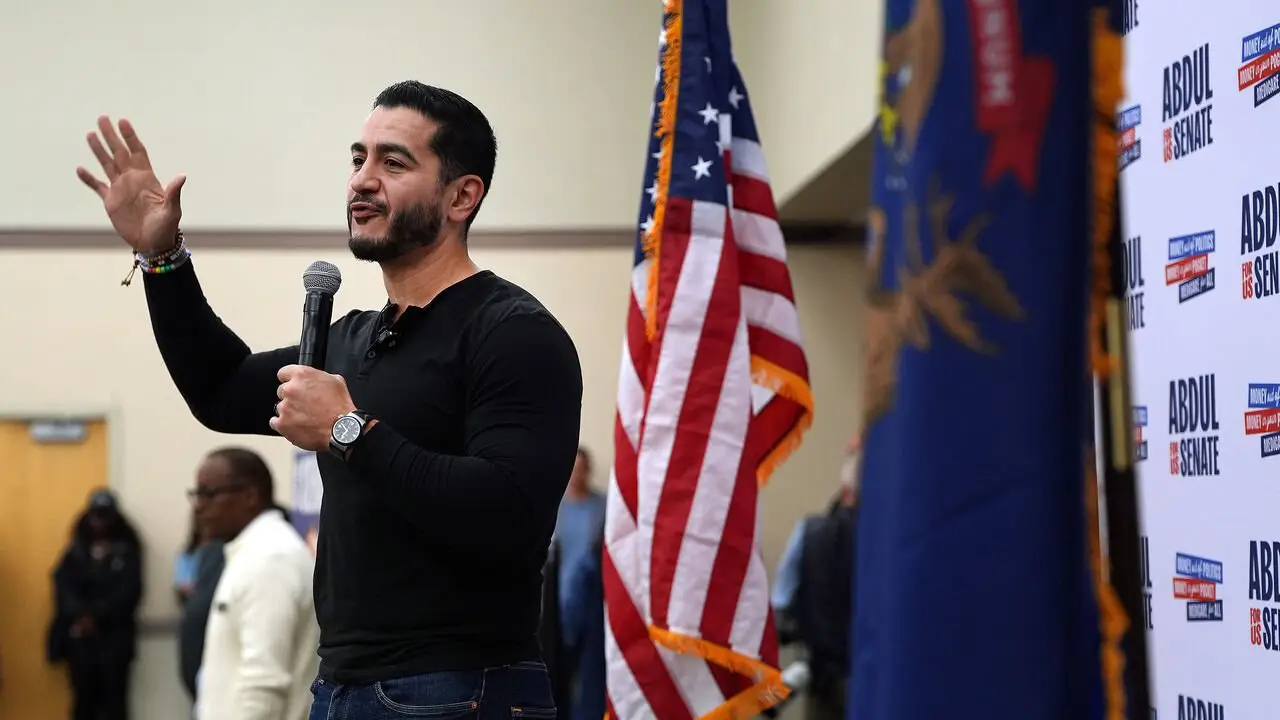
Abdul El-Sayed’s victory in Michigan makes him the first Muslim American to serve in the US Senate. A former public-health official, he won with a progressive pitch centred on universal healthcare, medical debt and limiting corporate influence.
His victory matters beyond representation: it demonstrates that a candidate who embraced an unapologetically progressive agenda could prevail in a battleground state that Trump carried two years earlier.
The campaign also exposed the challenges of coalition-building, including attacks on El-Sayed’s faith and a bitter intraparty dispute. His victory gives progressives a powerful argument in the party’s debate over how to win working-class and younger voters, but it does not prove that one platform will work everywhere.
Jeffries’ Challenge
Hakeem Jeffries is positioned to become the first Black Speaker of the House if Democrats formally choose him for the post.
His leadership now faces a dual test: keeping a newly empowered and ideologically diverse caucus together while making clear what its majority will deliver.
Oversight of Trump and his administration will be unavoidable, but voters’ economic concerns make a purely prosecutorial agenda risky. Jeffries has also faced criticism from progressives who object to his rejection of political retaliation against Trump.
That tension is not a sideshow. Democrats must balance accountability with governing and avoid allowing internal arguments about political tone to eclipse the issue of affordability.

Hegseth’s Future
Reports that Trump has asked advisers whether Defence Secretary Pete Hegseth should remain in office do not confirm that he will be fired. The accounts describe deliberations, competing pressures and no final decision. Trump has publicly praised Hegseth, while the Pentagon chief has said he intends to stay.
At the same time, Democrats have promised scrutiny, and some Republicans have questioned Hegseth’s leadership and the administration’s handling of the war.
The speculation itself shows how election losses can turn personnel into a pressure valve. Replacing a secretary might signal a reset, but it would not resolve the policy dispute that helped produce the defeat.

Congressional Constraints
The new Congress will constrain Trump more than the previous one did. A Democratic House can investigate, challenge funding and force public debate; Senate control gives the party additional leverage over legislation and confirmation battles.

Yet a majority does not automatically end a war or dictate the president’s choices as commander-in-chief. The administration still has room to escalate, negotiate or prolong the conflict, but each option carries political costs.
Continuing unchanged risks deepening voter discontent and widening Republican divisions. Retreating without a credible diplomatic outcome, meanwhile, could look like weakness to the president’s own supporters.
The central lesson, therefore, is not simply that voters rejected Republicans or that they endorsed every Democratic proposal. They delivered a warning about priorities: the cost of living matters, and a war with tangible economic consequences cannot be insulated from electoral judgment.
Trump can dismiss the result as a contest in which he was absent. But the next two years will be governed by the consequences of a result he cannot ignore.
(The writer is a New Delhi-based senior commentator on national, international, defence and strategic affairs, environmental issues, an interfaith practitioner, and a media consultant. Ideas are personal.)