by Iqbal Ahmad
Can modern scientific methods and Kharoshthi evidence compel a re-dating of the Harwan terracotta site, challenging colonial-era Buddhist attributions and refining Kashmir’s early cultural history?
We all know that most archaeological sites explored and excavated during the late 19th and early 20th centuries lacked modern excavation technology and scientific dating methods, such as stratigraphy, carbon dating, and material analysis. In the absence of these modern archaeological technologies and scientific dating methods, archaeologists may have faced certain difficulties in accurately dating and deciphering sites and their exhumed artefacts.
Although today’s archaeologists may have comparatively less field experience, they possess the advantage of modern scientific tools, such as remote sensing, GIS mapping, residue analysis, and refined dating techniques, which enable them to reach more precise conclusions. These facilities were not available to their predecessors; however, the earlier archaeologists possessed patience, passion, expertise, and experience, which enabled them to uncover major archaeological sites.
In the presence of modern scientific dating and excavation technologies, the earliest excavated sites require revisiting and re-surveying, which would improve our understanding of cultural sequences, from Neolithic settlements to early historic and medieval periods. On the other hand, several such sites have suffered from weathering, natural calamities, human vandalism, and overgrowth of vegetation. Their re-survey can help document damage and prioritise conservation areas.
Colonial-era interpretations have also divided Indian archaeology on religious lines. There has been excessive focus on identifying temples, monasteries, stupas, and mosques, while the fundamental aspects of habitation, history, art, and culture have been overshadowed. At several sites, plinths and basement remains have been identified with different religious structures. Sometimes, busts and battle scenes depicted on memorial stones are misinterpreted as gods and goddesses. In view of the availability of modern archaeological technology, such interpretations need reassessment.
Several archaeological sites of Kashmir excavated during the colonial era suffered due to poor excavation technology and limited scientific analysis. One such site is Harwan, Srinagar. The archaeological site consists of the remains of a terracotta settlement along with its wonderfully decorated pavement and a few basement remains.
The settlement at Harwan was first accidentally discovered in 1895 when workers unearthed decorated bricks and terracotta fragments during waterworks construction. Later, the site was explored and identified by Hiranand Shastri of the Archaeological Survey of India in 1919. However, the first systematic excavation was undertaken during 1920–21 under the supervision of Ramchandra Kak, the first trained archaeologist of Kashmir. He was highly successful in his excavation plan. He discovered moulded brick tiles depicting a unique artistic tradition that does not deal with religious themes but instead focuses on secular life.
The excavation exposed a remarkable tile pavement carrying stamped motifs inspired by life and nature as observed by the artist. Figures of men wearing Central Asian costumes appear, and curiously, relief figures of Scythian and Parthian horsemen, women, heads, and busts occur alongside early Gupta motifs.
RC Kak dated the site to the 3rd and 4th centuries AD, corresponding to the late Kushan era. He wrote about the pavement and other finds:
“A wonderful pavement of the courtyard round the temple, consisting of large moulded brick tiles of various shapes forming different patterns. The favourite pattern seems to have been a large disc consisting of several concentric circles with a single central piece. Each circle is composed of arc-shaped tiles of different dimensions, one of the tiles measuring 40 cm in length, 34 cm in width, and 4 cm in thickness, each shaped with a special motif.”
The principal motifs on the tiles so far discovered are:
(1) Designs consisting of frets, wavy lines, fish-bone patterns, conventional flowers, and floral designs composed of different combinations of leaves.
(2) Leaves of aquatic plants common in the neighbouring Dal Lake, lotus leaves, and indigenous flowers in full bloom, arranged in various compositions.
(3) Geese running or flying in rows with flower petals or leaves in their bills; ducks, cocks, or pheasants often placed at the centre of floral patterns; and cocks fighting.
(4) Rams fighting, cows suckling their young, elephants, deer turning their heads backwards towards the moon, and archers on horseback chasing deer and shooting arrows at them.
(5) A lady carrying a flower vase, a dancing girl, a female musician beating a drum, a soldier in armour hunting deer with bow and arrow, men and women conversing while seated in a balcony, and boys carrying floral festoons on their shoulders.
These tiles occupy exactly the positions in which they were laid by ancient workmen, as each bears a number in Kharoshthi script. This ancient script was in use in north-western India from the 2nd century BC to the 2nd century AD. It therefore follows that the tiles belong to a period before the latter century, possibly by a considerable margin.
The presence of Kharoshthi numerals intended for the guidance of common labourers indicates that the script was at the height of its popularity when the tiles were produced. Accordingly, Kak placed the date of the tiles, and consequently the diaper pebble masonry associated with them, between 100 BC and about 200 AD. This conclusion receives further support from the style of the human figures and other designs stamped on the tiles.
The physiognomy and, to some extent, the dress of the figures are wholly unlike those of any races presently residing in Kashmir. Their facial characteristics closely resemble the inhabitants of regions around Yarkand and Kashgar, with heavy features, prominent cheekbones, narrow and slanting eyes, and receding foreheads, faithfully represented on the tiles. Some figures are dressed in trousers and Turkoman caps.
The only period when Kashmir had close connections with Central Asia was during the supremacy of the Indo-Scythians and Kushans in the early centuries of the Christian era, when Kashmir formed part of the Kushan Empire extending from Mathura to Yarkand. Kanishka (circa AD 78), the greatest Kushan emperor, is said to have convened his great council of Buddhist divines in Kashmir. It is possible that a prosperous Kushan patron built this shrine at Harwan, where, according to ancient Kashmiri history, the great Buddhist patriarch Nagarjuna resided.
The peculiar importance of the Harwan monument lies in the fact that these remains are unique in the subcontinent—possibly in the world—and provide life-like representations of these enigmatic peoples.
Although archaeologists generally date the Harwan terracotta site to the 3rd and 4th centuries AD, I believe the tiles themselves predate the 3rd century AD. Given that the Kharoshthi script ceased to be in use after the 2nd century AD, the tiles can more plausibly be dated between the 1st century BC and the 2nd century AD.
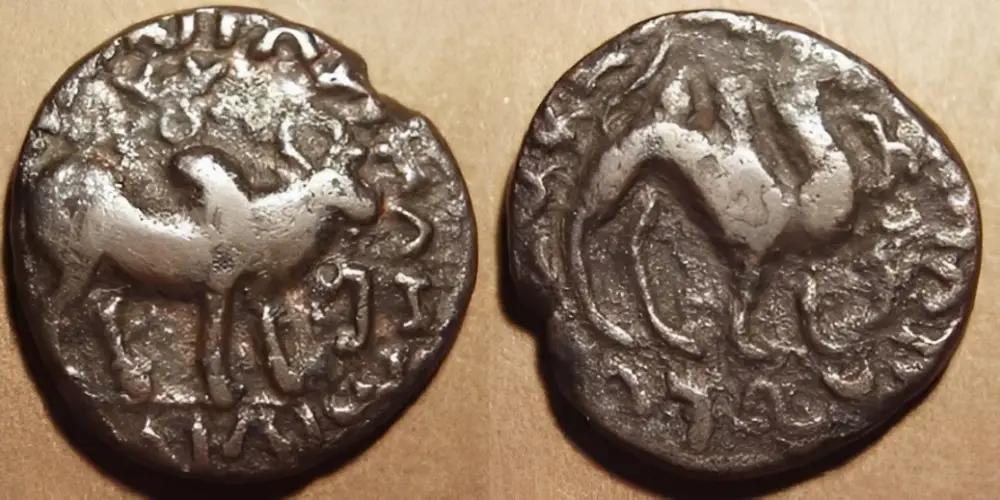
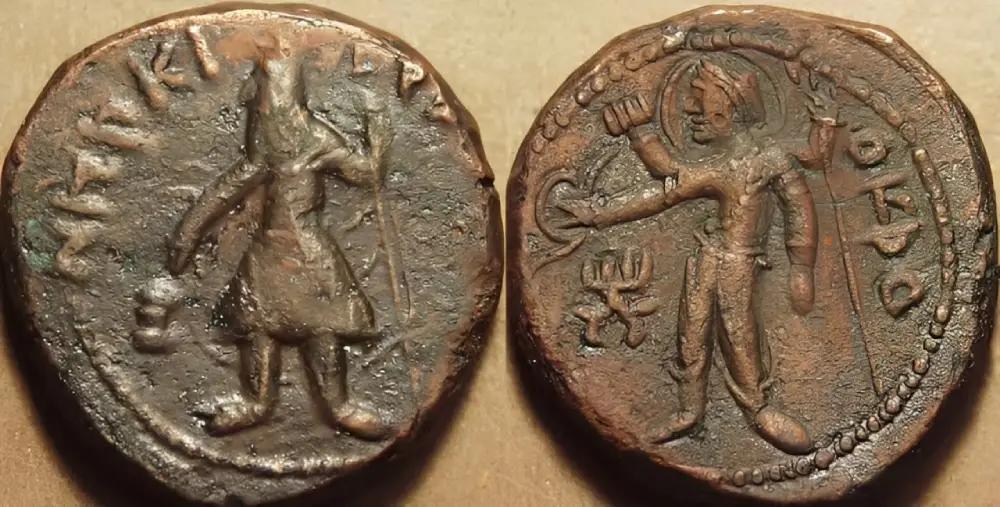
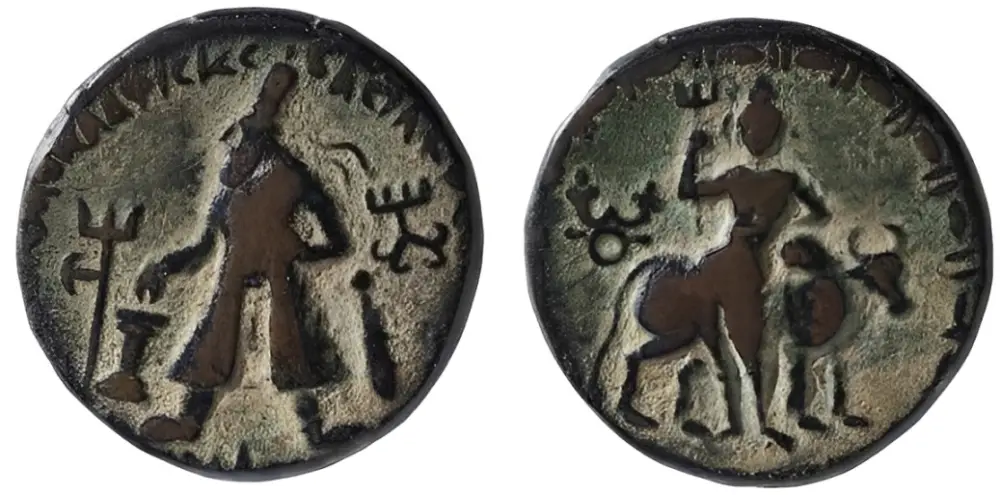
Another important point concerns the religious beliefs of the Kushans. There exists a general narrative that the Kushans promoted Buddhism, leading to the attribution of terracotta sites—including Harwan—to Buddhist culture. However, no tile from any terracotta settlement in Kashmir carries clear evidence of Buddhist iconography. The Kushans were possibly fire-worshippers, as evidenced by fire altars depicted on their coins. They also displayed Greek, Persian, and Indian deities such as Nana, Ordo, Mao, Oesho, Ardochsho, Shiva, Shiva with Nandi, and occasionally Buddha, indicating religious pluralism rather than exclusivity.
Therefore, attributing Harwan and other terracotta settlements exclusively to Buddhism is not substantiated by material evidence. The hunting and war scenes depicted on the tiles are inconsistent with Buddhist teachings.
Almost all Harwan tiles bear Kharoshthi numerals, indicating the popularity of this script during their manufacture. The human motifs and artistic techniques appear highly advanced, comparable to Indo-Greek, Scythian, Parthian, and Imperial Kushan traditions. The site clearly represents an urban civilisation rather than a nomadic one.
While scholars suggesting Central Asian influence have some merit, the precise purpose of this elaborately designed pavement remains beyond current understanding. I do not question the dating of other structural remains at Harwan, but the tiles warrant reconsideration in light of the Kharoshthi numerals and iconography.

Unfortunately, none of the tiles remain at the site today, and even the layout plan of the pavement is no longer visible. Presently, the site displays only the remains of a Buddhist stupa and an apsidal temple. The terracotta tiles, for which Harwan is renowned, have reportedly been shifted to the SPS Museum, Srinagar, and secure ASI strong rooms in Jammu. Visitors leave the site without seeing its most significant artefacts.
For the convenience of tourists and the promotion of heritage tourism, there is a pressing need to establish an archaeological site museum at Harwan. Such a museum should display the terracotta collections, while replicas of the tile pavements could be laid on-site to help visitors understand the original layout. Archaeologists associated with the site should also deliberate on the central question: what was the true purpose of this meticulously designed and carefully planned tile pavement?
(The author is an archeologist. Ideas are personal.)