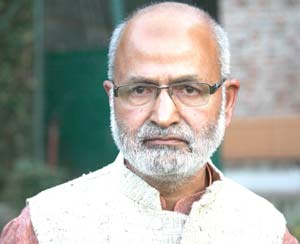
Naeem Akhtar
Much has been said about the present State Assembly on many counts. Chief reason for its estimation so high is the large turn out of voters, especially in Kashmir valley. Different political elements within the state and elsewhere have drawn their own inferences about the near hysterical involvement of people in the exercise. Having come so soon after the Ragda and Bum Bum Bole campaigns, the electoral fever took every one by surprise.
Some, including separatists have already written the epitaph of separatism as a consequence while others have called it only the democratic version of Kashmir’s struggle for justice. Whatever may be the case, it is time to evaluate the performance of the elected representatives during the first session that ended this week in Jammu.
Government and the opposition both came out in rather poor light. No new trends were witnessed which could place this house in a different category than its predecessors. In fact much of the expected dazzle was subdued by the preference shown by two prominent personalities, Farooq Abdullah and Ghulam Nabi Azad for the plusher Rajya Sabha. That happened in spite of both having promised their voters moon as the chief ministerial candidates of their respective parties who fought against each other and in best traditions of democracy turned into allies overnight. Though both parties are in power, it is some one else who is the leader of the house. An experiment that is likely to be followed up in Delhi soon when Dr Manmohan Singh might find out that his second bypass surgery might in fact have helped the young and healthy Rahul Gandhi more than him. Mufti Mohammad Sayeed has time and again hailed the present Assembly as the new powerhouse for resolution of Kashmir problem. His argument is that if this house with such unprecedented popular support could not become an institution capable of leading a resolution of problem then what else would? Even if that point is granted, his party legislators did pretty little to show any commitment to the idea of their patron. The front row of the party usually was vacant, luminaries making only symbolic presence occasionally.
Treasury benches have a reason to feel grateful to the opposition for having itself nearly demystified the much-feared ‘strong opposition’. And that is perhaps why the Chief Minister made only three ‘guest appearances’ throughout the eleven-day session. He spoke once and did not even attend the concluding day when it is a custom for the leader of the house to wind up the proceedings.
BJP played the usual stepney to its old friend NC in crucial voting for the Rajya Sabha and reflecting the unstated Congress sentiment on ‘Jammu centric’ issues. Ashok Khajuria, the party state chief added some sartorial variety by his Dogra headgear, perhaps the only soft expression he made throughout the proceedings.
The House, however, has something to celebrate as well. The mainstream political recruitment of the past decade or so, which had stopped after Sheikh Abdullah’s departure from the scene, is now impacting the elected class. Some new faces made a good impact. And they can be found in all the parties. The freshers, who made a mark, are Zulfiqar Choudhary and Mansoor Hussain of the PDP, Nasir Sogami of the NC and Vikar Rasool of Congress.
In absence of the Chief Minister, A R Rather through his diligence and knowledge of parliamentary procedures batted well. Ali Mohammad Sagar, as always was prominent by his overbearing presence and bluster and carried the day. Congress, perhaps because it carries the burden of major important portfolios played only second fiddle to NC colleagues. They would not join the coalition partner even in the verbal duals with the opposition. Their sulk looked out of place though ominous. Speaker Mohammad Akbar Lone will find himself respected more as a deputy rather than a full-fledged speaker if his performance in the opening session is an indicator.
Essentially the House was not able to rise above the routine questions asked every time and replied every time with purposeless Yes sir, No Sir, Question doesn’t arise sir. If the assembly has to contribute to the resolution of political and economic issues of the state, its first session doesn’t inspire confidence.