Budgam heads to the ballot amid dissent, rivalries, and rifts within the influential Aga family. What started as a routine by-election has evolved into a contest over lineage, loyalty, and political identity, testing whether the JKNC’s old loyalties can endure internal tensions, sectarian undercurrents, and the opposition’s attempt to redraw the region’s political map, reports Syed Shadab Ali Gillani
Less than a year after its last election, Budgam is heading back to the polls. The by-election, set for November 11 with counting on November 14, follows Chief Minister Omar Abdullah’s decision to retain his ‘family’ Ganderbal seat and give up Budgam. Unlike 2024, this exercise, however, has exposed an internal fault line within the ruling National Conference (NC), one that runs through the region’s most influential political family.
The contest has evolved beyond a test of the NC’s first year in office. It has become a struggle over lineage, loyalty, and ideology, a political duel within a single clan: the Agas. The three main candidates, from the NC, the Peoples Democratic Party (PDP), and the Bharatiya Janata Party (BJP), all belong to Budgam’s influential Aga clan. The campaigning is going to be interesting, and the outcome is expected to offer a clear idea about how the faith aligns with politics and loyalty.
Visible Divisions
Since 1996, when democracy was restored in Jammu and Kashmir after a six-year hiatus, and even before, Budgam has remained a JKNC stronghold. In 2014, Aga Syed Ruhullah Mehdi reclaimed the seat for the NC, defeating his rival by 2,787 votes. In 2024, the first post-2019 poll, Omar Abdullah’s own candidature restored Budgam firmly to the NC fold, securing a victory margin of over 18,000 votes against the PDP’s Aga Syed Muntazir Mehdi.
Omar’s decision to contest from both Ganderbal in addition to Budgam was seen as a calculated political step. JKNC insiders believe that Aga, then the sitting Srinagar MP, had persuaded him to enter the Budgam race to ensure a safe win, as Ganderbal appeared less predictable.
When the results made him win both, Omar was left to choose between the two constituencies. He retained Ganderbal. As the mandatory re-election approached, Aga and Omar were estranged. It created a situation where the ruling party is facing opposition from other parties and dissent from within.
An Absent Kingmaker
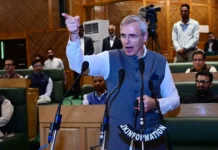
A senior NC leader, three-time MLA from Budgam, and the current Srinagar MP, Ruhullah, has emerged as one of Kashmir’s outspoken political figures since 2019. Known for his firm opposition to the BJP and his critique of the post-Article 370 political order, he has cultivated a strong following across Kashmir.
Weeks before the by-election was announced, Ruhullah was public that he would not campaign for his party. Dissatisfied, he publicly said the Omar-led government betrayed the party’s 2024 mandate, which had promised to challenge the post-2019 policy shifts. This discontent is not new. In May, Ruhullah walked out of a party working committee meeting after a confrontation with the Chief Minister.
Initially, senior NC leader Choudhary Ramzan had suggested that the party’s candidate would be chosen in consultation with Ruhullah, a signal that his influence still mattered. But that influence appears to have waned.
“Many leaders urged Aga sahib to suggest a candidate for Budgam, but he declined and refused to campaign,” a close aide of Ruhullah revealed. “He told them that if the government took a concrete step on the reservation issue, he would consider it.”
Ruhullah later distanced himself completely from the process, saying earlier promises to Budgam’s people had not been honoured. His office issued a formal warning that the use of his name, image, or voice in campaign materials would be unauthorised and could invite legal action. The statement concluded with an appeal for “clarity, respect, and responsibility” during the campaign period.
Internal Disquiet
Not being admitted publicly, Ruhullah’s silence is being felt by the party. His three terms as MLA and his stature as a political voice that is being heard make him a central figure in Budgam’s politics. His refusal to campaign is being seen as a protest and a message, a challenge to the party’s leadership and a possible pause in his own political journey.
The rift deepened further after a controversy involving Deputy Chief Minister Surinder Choudhary. During a public event, Choudhary claimed he did not know Ruhullah. The remark provoked strong protests from Ruhullah’s supporters, forcing Choudhary to clarify his statement the next day. “The misunderstanding occurred due to the rush and noise at the gathering, which confused who the comment referred to. I hold Aga Syed Ruhullah in high regard,” Choudhary later said.
The damage, however, was done. Supporters of Ruhullah poured into the streets of Bandipora’s Sonawari area, chanting slogans against Choudhary.
Their protests underlined the unease within the NC as Budgam prepares for its by-election, a contest that will test not only party discipline but also the resilience of the Aga family’s political legacy.
A few days later, a war of words unfolded between Omar and Aga, when the former distinguished the actions of MP Aga and those of senior MP Mian Altaf. “The difference between the two is like the ground and sky,” Omar told reporters outside the assembly. Ruhullah hit back, calling it “unfortunate” that the conversation had descended into personal attacks. “I am not the story here,” he said. “The real story is the existential threat to Kashmir.”
“The National Conference has plenty of leaders actively engaged in the campaign and outreach across constituencies,” Omar said. “The party has enough people for the campaign. No one is being forced.”
The Aga Triangle
With Ruhullah estranged, the JKNC fielded Aga Syed Mehmood, a veteran politician, former minister, and one of the oldest members of the Aga clan. A former member of both the Legislative Assembly and the Legislative Council, Mehmood’s candidature signals the party’s attempt to bypass a popular dissenter by invoking generational continuity and organisational control.
The contest in Budgam has now turned deeply personal. Mehmood filed his nomination with Omar and his advisor, Nasir Aslam Wani, in tow. Soon after, he played down the Ruhullah factor, saying that the party had its own base. He also appealed to Ruhullah, “my son”, to support the party candidate. The comment carried a subtle irony, for Mehmood’s own son had actively campaigned for Ruhullah during the 2024 parliamentary election.
Ruhullah’s curt reply was swift. “My loyalty is to my conscience and principles,” he wrote on X, adding that while he respected his elders, he urged them not to belittle his fight. “If they cannot comprehend it and be part of it, at least they should not drag me and my struggle to this level.”
Clash of the Clans
This familial tension has defined the opposition’s strategy. The PDP has repeated its 2024 candidate, Aga Syed Muntazir Mehdi, who had earlier lost to Omar Abdullah by a huge margin. Now, he seeks to channel the growing discontent within Budgam.
“We will try to ease the difficulties people have faced for the past seventy years,” Muntazir said during his campaign. “We will restore the rights people were deprived of—hospitals, clean water, roads. The people of Budgam have been dehumanised for decades, and it is time we put an end to it.”
The family rivalry has now reached its sharpest form. Ruhullah and the PDP’s Muntazir are closely related and both belong to the Mustafai sub-sect of Shia Muslims. In contrast, Aga Syed Mehmood belongs to the Muhammadi sub-sect, presumed to be smaller in number but historically influential. This sub-sectarian undercurrent, though unspoken, forms a quiet backdrop to the by-election.
There is growing speculation that the perceived mistreatment of Ruhullah by the NC leadership may not sit well with the Mustafai-Shia community. This group, traditionally a strong vote bank for Ruhullah and the NC, could shift to Muntazir, who shares their lineage and sect.
Muntazir, however, is playing cautiously. “It is not family versus family. The responsibility my party has given me is to answer what the JKNC has done for the people here,” Muntazir said. “Last time, thirty-six thousand voters trusted Omar Sahib, who later abandoned Budgam after his victory. This election is about accountability, not rivalry.”
Identity in Contention
Even the BJP has stepped into the fray, fielding a candidate named Aga Syed Mohsin. The announcement, however, caused immediate confusion. The Agas’ issued a clarification denying any connection with the BJP candidate after social media posts suggested he was also part of the clan.
In a statement, the family said that Mohsin Ali, son of Syed Ali Shah of Mirgund, had “absolutely no connection or affiliation, personal, familial, or ideological, with the Aga family.” The clarification described the claim as “deceptive, unethical, and wholly unacceptable.”
Aga Owais, son of Aga Syed Mohsin, added that the BJP candidate’s name had been misrepresented. “His actual name is Syed Mohsin, and he is not from the Aga clan. His name happens to be similar, and this is being used to create a misunderstanding,” he said.
The Political Geography
While Budgam is widely seen as a Shia stronghold, its electoral map is more intricate. Outside the main town, the constituency is largely Sunni, with only a few Shia-majority villages. Even within the Shia community, loyalties are fragmented. Villages such as Ichgam and Mahwara do not follow any single Aga’s guidance and often align with local religious preachers or political leaders such as Imran Ansari of the Peoples Conference.
This is the complex terrain that Aga Syed Mehmood must navigate. His campaign has carefully avoided the politics of dissent and sectarian identity, focusing instead on basic issues of governance. He speaks of roads, water, healthcare, and education.
“Budgam still has no women’s college,” Mehmood said in an interview. “Many girls cannot study beyond school because they cannot travel to Srinagar. Our roads are narrow, our water is polluted, and our hospital has only 125 beds against the 300 we need. These are not slogans, they are obligations.”
For Mehmood, this election carries a personal resonance. “Budgam’s political journey has always reflected the pulse of Jammu and Kashmir,” he said. “This election feels personal, a chance to reconnect with the soil that shaped me.”
He often draws on memory to explain his motivation. “As a child, I saw one car pass the Humhama–Budgam DC Office road in an hour. Now a thousand do, but the road remains the same. This must change.”
He has also sought to dispel talk of sectarianism. “People often speak of a Shia–Sunni divide,” he said. “I reject that. If my campaign or supporters ever use that card, I will withdraw. My politics is not of sects, it is of service.”
Recalling the turbulent 1990s, he said he had remained in Budgam through the militancy. “Many of my colleagues were killed. I stayed here, among my people. It was faith and community that kept us going.”
For Mehmood, the constituency’s loyalty to the JKNC since 1977 carries a moral weight. “The people have always trusted the party,” he said. “That trust deserves service, not speeches.”
The Opposition’s Opportunity
The opposition, however, has seized on the JKNC’s internal crisis, framing it as an opening to challenge the party’s long-held dominance in Budgam. The PDP is positioning the by-election as a verdict on post-2019 governance and what it calls the NC’s unfulfilled promises.
PDP’s Waheed ur Rehman Para described the contest as a popular vote on the JKNC’s failures, asserting the party came to power on the promise of reversing the BJP’s post-Article 370 policies but did not deliver. Para said the election represents the prestige of Budgam and Jammu and Kashmir, and argued that people need a representative who will stay accessible and responsive. “The PDP has offered that alternative,” he added.
The BJP leader Sunil Sharma has used the contest to attack what he calls the dynastic culture of “family politics,” arguing that voters are seeking credible alternatives. This places Budgam within the wider debate on Kashmir’s emerging political order.
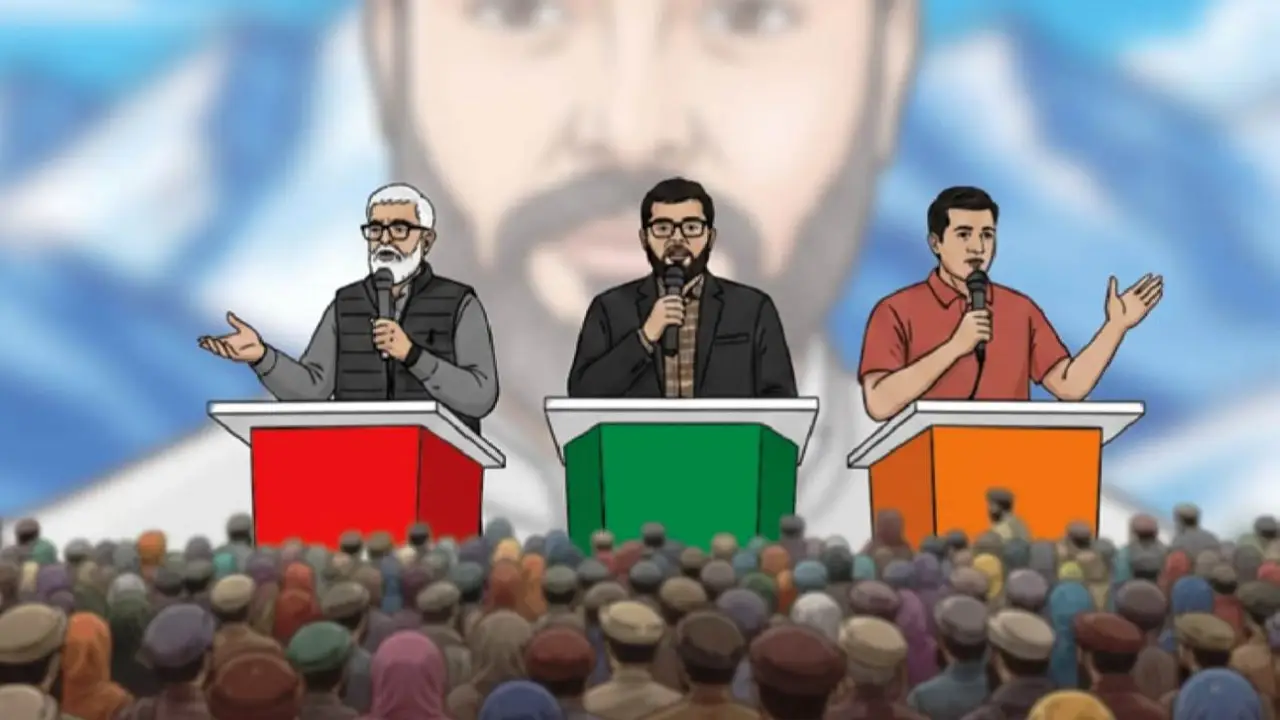
According to the Election Commission’s data, 20 candidates are contesting the by-election. The Aam Aadmi Party has fielded its Kashmir province vice-president, Deeba Khan. The Awami Itehad Party (AIP) has nominated Nazir Ahmad Khan. Independent candidate Jibran Dar and several others are also in the fray.
Within JKNC, signs of unease are evident. Omar admitted that he was forced to contest from the constituency in 2024. “Aga Mehmood saheb has already said that Aga Ruhullah is like his son and expects his full support in the election,” he said. “What else is there to add?”
The Four Undercurrents
The debate over development and delivery remains central. Ruhullah’s criticism of unfulfilled promises continues to resonate, while Aga Mehmood’s campaign highlights a list of unfinished projects as evidence of ongoing neglect. “We are neglected and left with nothing. We are political orphans,” a resident said.
The PDP has revived the debate on representation and the post-August 5 political framework, pushing Mehmood to reaffirm the NC’s traditional position. “The JKNC has stood by the people through conflict and silence,” Mehmood said. “Our struggle for dignity and Article 370 will continue. We will not compromise on that.”
The NC’s emphasis on collective strength is widely viewed as a response to Ruhullah’s dissent. The by-election is also a test of whether the party’s internal structure can sustain pressure from within and outside.
The Test
The by-election will determine whether the NC’s organisation in Budgam can function effectively without the involvement of its most recognisable local leader. It will also reveal whether the PDP’s post-2019 narrative, strengthened by the NC’s internal rift, can gain ground in central Kashmir.
“This election should not be viewed as a contest limited to a single constituency. With Ruhullah absent, a nervous NC and a hopeful PDP, this vote will shape the course of electoral battles leading up to 2029,” a political analyst observed.
For Aga Syed Mehmood, the contest is both political and personal. “This election is not about power,” he said. “It is about responsibility, to build the college our daughters need, the hospital our families deserve, and the roads that can carry our future.”
Budgam’s by-election may appear minor within the broader electoral cycle, yet it stands as a crucial signal. It will reveal whether traditional loyalties still hold, whether dissent weakens party structures, and how far Kashmir’s evolving political behaviour has settled into a new rhythm.
Many analysts describe it as a litmus test for the NC in central Kashmir. When Budgam votes, it will not merely fill a vacant seat but deliver a verdict on a family feud, assess a government’s first year, and define how identity, service, and responsibility will shape Kashmir’s next political chapter.