In Budgam bypoll, the PDP capitalised on JKNC’s estranged MP, Aga Ruhullah’s refusal to back his party’s candidate, turning NC’s internal rift into momentum that mobilised voters, fuelled anti-incumbency, and delivered a decisive victory, reports Syed Shadab Ali Gillani
The outcome of the byelection from Budgam has triggered one of the most dramatic political shifts that the town has seen in decades. The victory of the Peoples’ Democratic Party (PDP)’s Aga Syed Muntazir Mehdi, over the ruling Jammu and Kashmir National Conference (JKNC)’s Aga Syed Mahmood Al-Mosavi, has brought to an end nearly five decades of JKNC’s near-unbroken hold on the central Kashmir seat. Necessitated by Omar Abdullah’s decision to retain Ganderbal after winning both seats in the 2024 Assembly elections, the routine electoral exercise evolved into a complex political game. Fuelled by the Grand Old Party’s internal tensions, the outcome surprised all.
The final count confirmed the PDP’s success by a margin of 4,478 votes. PDP polled 21,576 votes (34.19 per cent of the vote share) and JKNC 17,098 votes 27.10 per cent). In 2024, Omar received 36,010 votes, accounting for 54.52 per cent of the total votes. More than the verdict on Omar’s first year as Chief Minister, the result raises questions about running his party as a party MP; Agha Ruhullah’s dissent changed the fulcrum of the election.
The historical context of Budgam defines the weight of the defeat. Established in 1962, Budgam has served as a pillar of JKNC’s electoral structure. It remained so till 1972 when the party lost and was defeated for the second time, almost half a century later.
Since 1977, the JKNC has consistently held the seat, primarily through the influential political family of the Agas. Aga Syed Ruhullah Mehdi retained the seat thrice from 2002 to 2014. As he moved to Lok Sabha, the 2025 bye-election victory of the PDP, therefore, represents the second major breach of this political citadel in 53 years, confirming a deep structural vulnerability directly exposed by the party’s failure to contain internal dissent.
The Party Fault Line
The 27.42 per cent drop in party vote share confirms the devastating impact of the internal political rift on the party’s core support structure. The election’s narrative was driven by the deliberate non-participation of Aga Ruhullah, who publicly refused to campaign for his party, turning a routine contest into a public display of the ruling party’s deepening internal rift.
Ever since he was elected to the Lok Sabha, Ruhullah has remained a bitter critic of his party and associated himself with a public protest against the government’s alleged failure to implement core promises contained within the 2024 election manifesto. His stated grievance focused on the rationalisation of the reservation policy, arguing that the existing structure inflicted disparity on a segment of the citizenry, a position he had earlier emphasised by joining a public protest at the Chief Minister’s residence. This act confirmed the fundamental nature of the conflict, moving beyond simple disagreement to an open political action.
This helped Ruhullah position himself as the ‘conscience keeper’ of his party, and helped him gain the top slot in the popularity graph. The political atmosphere on the ground, especially on polling day, affirmed this dynamic. He remained an active participant in the election even though he neither campaigned nor was in India.
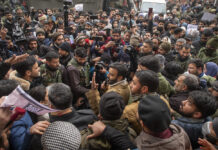
Crowds gathered outside polling stations and cheered in his name. JKNC’s campaign became secondary to the spontaneous assertion of loyalty to the dissenting Aga. Posters appeared questioning the legitimacy of the National Conference’s candidate with the query, Koun Aga? (Which Aga?). This question challenged Deputy Chief Minister Surinder Chowdhary, whose earlier video statement reportedly denied knowledge of any prominent Aga.
The question challenged the party’s attempt to invoke traditional loyalties by fielding a candidate from the same Shia clan, a former minister and a relative of Ruhullah, diverting the political spotlight onto the figure who stood against his own party structure. Politics apart, the byelection was a test for political identity, lineage, and loyalty within the influential clan.
“Aga Ruhullah never told us to vote for PDP, but we voted for them as a mark of protest, as we heard people saying in the JKNC camp that we want to defeat Aga Ruhullah,” said a young Ruhullah supporter.
Capitalising on Dissent
Recognising the force of Ruhullah’s dissent, the PDP built its entire campaign around JKNC’s internal rupture. Its leaders openly credited the anti-incumbency surge to this single act of defiance, with one even thanking Ruhullah on the campaign trail, cementing the widely held belief that his stance had mobilised a decisive support base.
With a victory his party desperately required, PDP lawmaker Waheed Para did not forget to thank Aga when the results were formally announced. His leader, Mehbooba Mufti, rose to address the crowd, but slogans were loud enough to make her inaudible. She attempted to talk, failed and stepped aside and drove him with the first post-defeat victory. Aga’s absence was more visible than the presence of all political busybodies.
Voters consistently interpreted their action at the ballot box not as an endorsement of the PDP but as a strong vote against the incumbent JKNC administration, a direct channel for expressing their anger over the perceived disrespect shown to Aga. The energy generated by Ruhullah’s position was powerful enough to disrupt even PDP’s own campaign, more than once. The overwhelming public support for Ruhullah cemented his role as the contest’s gravitational centre, proving that silent dissent spoke louder than any campaign speech and acted as the primary determinant of the outcome.
Leadership and Consequence
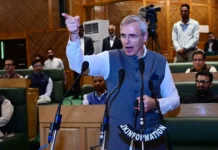
Chief Minister Omar Abdullah addressed the press following the result confirmation, accepting the 4,478-vote defeat and describing the outcome as a moment for necessary introspection within the party. Abdullah stated that the party had expected a more favourable mandate, citing its focus on district development. He confirmed that the party would immediately convene a meeting to analyse the outcome, examine the political gap, and undertake corrective action. This commitment to structural review underscored the severity of the loss, particularly the damage inflicted by internal revolt.
Abdullah also targeted the role of the dissenting MP, claiming that Ruhullah had “killed himself politically” by quitting the campaign. Using the phrase “cut your nose to spite your face,” he suggested that Ruhullah’s intended message to the leadership ended up damaging his own standing in the constituency. Abdullah said the newly elected PDP legislator would now serve as a lasting obstacle to Ruhullah’s political future in Budgam, leaving the MP isolated. He added that Ruhullah’s prospects in the district now hinge entirely on his ability to rebuild his position against the new power structure.
In response, Ruhullah offered an indirect but clear commentary on the political judgment of the party leadership. He cited a Quranic verse warning against arrogance, stating that the lesson confirmed that “arrogance is the recipe for disaster,” and that “consciousness, humility and introspection is the way.” The exchange underscored the deep and personal nature of the political rift that severely hampered the JKNC’s defence of its historical seat. This public communication confirmed that the internal conflict remains a live structural challenge to the party’s central authority.
The Electorate’s Complaint
The electorate, consisting of 125,188 registered voters, delivered a 49.92 per cent turnout. This figure represents a 2.35 per cent drop from the 2024 assembly election turnout of 52.27 per cent, a decline attributed to cold weather and a degree of voter disillusionment. Though turnout was low, the verdict was powerful.
Campaign discourse was dominated by public complaints. Younger voters highlighted the scarcity of job opportunities and pointed to the stalled recruitment for open merit aspirants since 2019. The hike in electricity bills and the dispute over the reservation policy, the issue central to Ruhullah’s dissent, formed additional targets of voter anger. The PDP strategically leveraged this collection of grievances, framing the ballot as a protest against the JKNC’s first-year promises.
“We support Agha Muntazir with all our hearts. It is not a small thing that he speaks openly and stands with the people,” a voter said. “Leaders may show arrogance, but in the end, they have to come back to the public.”
The election featured 20 candidates, including three major contenders from the Shia clergy, confirming a political contest shaped by lineage and sect. Apart from the two Aga’s at the centre of the ring, there was the BJP’s Aga Syed Mohsin Mosvi, and independent candidate, Jibran Dar.
Jibran secured 7,152 votes, capturing 11.33 per cent of the total vote and was the second runner-up. His votes represented a significant segment of the electorate that rejected the JKNC while simultaneously withholding support from the PDP as well. Dar’s 7,152 votes are 2,674 more than the PDP’s 4,478-vote winning margin. This arithmetic confirms that the JKNC’s defeat resulted from a fragmented political landscape in which internal party dissent, principally the Ruhullah factor and the presence of independent figures like Dar, effectively neutralised the incumbent party’s traditional 54 per cent vote share. Had the National Conference secured even a fraction of Dar’s vote, the outcome could have been different.
Nagrota’s Counterpoint
In stark contrast to Budgam, the Nagrota by-election in Jammu reaffirmed the BJP’s dominance. Following the death of incumbent MLA Devender Singh Rana, the party fielded his daughter, Devyani Rana, who won comfortably with 42,183 votes and a margin of 24,647. Voter turnout stood at 74.63 per cent.
The JKNC mounted a subdued campaign, contesting without support from its ally, the Congress, an implicit concession to the BJP. Nagrota’s result underscores the party’s organisational strength and the pull of legacy politics. Together, the twin by-elections delivered two divergent messages: upheaval in the Valley driven by the Ruhullah factor, and stability in Jammu under the BJP.
The Flip Side
PDP’s win gives the party a revived foothold in central Kashmir, where its influence had long been marginal. It is now positioned to sharpen its attack on the administration and tap into anti-incumbency currents. At the same time, the strong vote secured by Jibran Dar points to a growing constituency disenchanted with both the ruling party and the main opposition, signalling a more fragmented political landscape in which independents could become key vote-splitters.
The contrasting outcomes in Budgam and Nagrota underscore the fragility of the broader opposition alliance. Budgam’s defeat, rooted in the internal rift around Ruhullah, marks a significant political shift in Kashmir. Repairing that fracture, restructuring the organisation, and adapting to the reshaped power balance now form the JKNC’s immediate agenda.