The stage is set for a high-stakes electoral battle in Ganderbal, a strategically crucial constituency, in a contest that will determine the fate of the Abdullah family’s legacy in the region, reports Aiman Fayaz
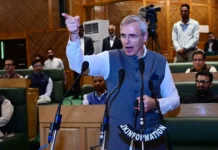
In the Ganderbal assembly constituency, Omar Abdullah, vice president of the Jammu and Kashmir National Conference (JKNC), is pitted in the contest with 14 others, mostly independents. Omar’s return to a constituency, he previously represented from 2009 to 2014, during his tenure as chief minister of the NC-Congress coalition government in the erstwhile state of Jammu and Kashmir, is a significant development.
Omar faces competition from Bashir Ahmad Mir of the Peoples Democratic Party (PDP) a Kangan native. A prominent youth leader, Mir unsuccessfully contested the 2008 and 2014 elections from the Kangan assembly constituency. He secured an impressive 12,000 votes in 2008 and 25,000 in 2014, against National Conference stalwart Mian Altaf Ahmed.
Mir’s contest with Omar will be one of the region’s most closely watched electoral battles this time.
In a surprising twist, Sahil Farooq, Congress party district president for Ganderbal, filed his nomination as an independent candidate, directly challenging Omar Abdullah. This move adds another layer of intrigue to the high-profile Ganderbal contest.
Ganderbal, constituency is a strategically important seat. It is part of the larger Srinagar Lok Sabha constituency. The political landscape in Ganderbal is dominated by three key players: the Jammu and Kashmir National Conference, the Jammu and Kashmir People’s Democratic Party, and the Congress. As a traditional battleground, this constituency is poised for another intense contest among these prominent parties.
A Region of Natural Beauty
Ganderbal is celebrated for its breathtaking landscapes, attracting visitors globally. Srinagar flanks the district, Bandipora, Kargil, Anantnag, and Baramulla, and comprises four main blocks: Ganderbal, Kangan, Lar, and Wakoora.
Historically, Ganderbal was a crucial stopover on the Silk Route, boasting revered sites like Amarnath and Kheer Bhawani. The Sindh River, which traverses the district, supports hydroelectric power projects, and supplies drinking water to Srinagar. Since its establishment in 2007, Ganderbal has been divided into six sub-districts: Kangan, Ganderbal, Tullamulla, Wakura, Lar, and Gund.
Demographically, Ganderbal’s population stood at 297,446 in the 2011 census, comprising 158,720 males and 138,726 females. This represents an increase from the 2001 census, which recorded a population of 217,907, consisting of 113,643 males and 104,264 females.
History
Ganderbal has traditionally been a bastion of the JKNC and the Abdullah family. The constituency holds significant historical importance, having been represented by JKNC founder Sheikh Mohammad Abdullah on multiple occasions, followed by his son, Dr Farooq Abdullah, the party’s current president. Ganderbal symbolises the Abdullah family’s lasting political legacy and the party’s regional influence.
The constituency’s rich political history began in 1977, when Sheikh Mohammad Abdullah, the JKNC’s leader, won the seat. His legacy was continued by his son, Dr Farooq Abdullah, who secured victories in 1983, 1987, and 1996, further cementing the family’s grip on the constituency.
The 2002 elections marked a significant shift, as Qazi Mohammad Afzal of the Jammu and Kashmir People’s Democratic Party (JKPDP) wrested the Ganderbal seat. This marked a rare defeat for the Abdullah family in a constituency long associated with their dominance. However, the Jammu and Kashmir National Conference (JKNC) reclaimed the constituency in 2008, with Omar’s victory. The seat remained with the JKNC in 2014 when Ishfaq Ahmad Sheikh won.
Previously, Farooq Abdullah had represented Ganderbal for three consecutive terms, winning in 1983, 1987, and 1996, and cementing the family’s influence in the region.
Voter Turnout in Ganderbal
Voter turnout in Ganderbal has increased significantly over recent election cycles. In 2008, 39,874 votes were cast, making up 51.80 per cent of the electorate.
By 2014, voter participation had risen further, with 53,544 votes cast, representing 59.11 per cent of eligible voters.
According to Election Commission of India data, the Ganderbal Constituency had 90,582 registered voters in the 2014 Jammu and Kashmir Assembly elections. This included 47,096 male voters, 43,485 female voters, and one third-gender voter. Postal votes totalled 96, and there were 34 service voters, comprising 32 men and two women.
In contrast, the 2008 Ganderbal elections saw 76,971 registered voters, with 39,865 males and 37,106 females. That year, postal votes numbered 20, and service voters totalled 11, including 10 men and one woman.
The Ganderbal Constituency goes to the polls on September 25, as part of the second phase of elections in Jammu and Kashmir. It will be joined by 25 other constituencies across the Union Territory, including key regions like Budgam and Rajouri.
Political Landscape
In the 2014 Jammu and Kashmir Assembly elections, Ishfaq Ahmad Sheikh of the JKNC won the Ganderbal seat with a narrow margin of 597 votes. He secured 19,478 votes, accounting for 36.38 per cent of the total. Qazi Mohammad Afzal of the JKPDP came close with 18,881 votes, or 35.27 per cent. Independent candidate Sheikh Ghulam Ahmad garnered 6,009 votes (11.22 per cent), while Congress candidate Mohammad Yousuf Bhat received 3,190 votes (5.96 per cent). The total votes cast were 56,544, with a turnout of 59.11 per cent.

In the 2008 Jammu and Kashmir Assembly elections, Omar Abdullah of the JKNC won the Ganderbal seat with 16,519 votes, securing 41.49 per cent of the vote. He defeated JKPDP candidate Qazi Mohammad Afzal by a margin of 8,215 votes. Afzal received 8,304 votes (20.85 per cent). The total voter turnout was 39,874, representing 51.80 per cent of the electorate. Ishfaq Ahmad Sheikh from the Congress came third with 8,077 votes (20.28 per cent), followed by Congress candidate Farooq Ahmad Dar with 2,622 votes (6.58 per cent).