by Iqbal Ahmad
Over time, things have changed. The growth of sectarian divisions and the spread of modern interpretations of Islam have affected traditional beliefs.
The month of Muharram is among the four sacred months in the Islamic calendar, second only to the holy month of Ramadan. The name itself suggests its sanctity. In Arabic, Muharram literally means forbidden, indicating that warfare during this time was absolutely prohibited. The Prophet Muhammad (peace be upon him) referred to it as the sacred month of Allah. While its sanctity has multiple reasons, it is most commonly associated today with the Battle of Karbala, which took place on the 10th of Muharram in 61 AH, corresponding to 10 October AD 680.
The tragic events at Karbala altered the character of this month. The sacrifices and unwavering perseverance of Imam Hussain, along with his family and companions, became the emotional centre of its observance. I remember my grandmother, a devoted Sufi, who would mark every Muslim festivity with love and devotion. Yet, when it came to Muharram, she observed it with solemnity and reverence.
She would honour the beginning of the Islamic year with dignity, teaching us the sanctity of Muharram and reviving the memory of the sacrifices made by the Ahl al-Bayt, the holy family of the Prophet. As the matriarch of our household, she never allowed social or cultural functions, particularly weddings, to be held during this month. She repeatedly reminded us to uphold the sanctity of the days.
I observed how her demeanour shifted with the sighting of the Muharram moon. Instead of celebrating the new year, she would appear as if mourning the death of a close relative. Her face would show no trace of a smile. She would not comb her hair, apply surma to her eyes, look into a mirror, or wear brightly coloured garments.
She would rise at dawn and personally prepare Mayeer (cured rice), then carry it on her head to the local Sufi shrine where she distributed it among village children. In the evenings, she would continue her usual spinning, but her songs changed. The lyrics and tone now carried the sorrowful laments of Karbala Nama, which she sang in both Kashmiri and Persian.
This tradition extended beyond our household. Across the village, residents upheld the month with similar reverence, recognising it as the time of ultimate sacrifice offered by Imam Hussain, the beloved grandson of the Prophet, on the battlefield of Karbala. Alongside his family, friends, and followers, he faced the brutality of the Umayyad Caliph Yazid’s forces and was martyred on the tenth day, known as Yawm-e-Ashura.
At the time, I was a young boy, unaware of such catastrophic history. It was my grandmother who first narrated to me the events of Karbala, her voice laced with grief and reverence. Through her account, I began to understand the emotional gravity that this incident held over the people of my land.
Though centuries had passed since that one-sided battle between Yazid’s troops and the Prophet’s family, the story remained fresh in the minds of Kashmiris. To many, it felt as if it had taken place only yesterday.
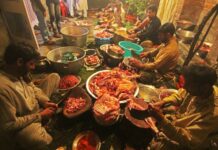
In Kashmir, it had long been a shared tradition across communities, regardless of caste or sect, to feel the sorrow and pain of Karbala. The month of Muharram was widely honoured. Some participated in mourning processions, others prepared cured rice known locally as mayeer or dod wegre and distributed it among children. Many others served sharbat or drinking water to passers-by, marking the occasion in a spirit of solemn generosity.
Although Islamic scripture does not prescribe any specific ritual for Muharram, nor prohibit marriage ceremonies during the months of Muharram and Safar, people across the region refrained from hosting such events. The devout followers of the Prophet Muhammad and his family voluntarily avoided domestic and social functions during this period, not due to religious obligation, but out of love and respect.
This raises a question. If there is no binding injunction in the religious texts, why then do people continue to observe these customs? Some clerics have condemned such practices as bida’ah, an unwarranted innovation. For those devoted to the Prophet, his companions, and the Ahl al-Bayt, it is not innovation. It is a manifestation of their unwavering faith and deep connection to the Prophet’s household. They have not allowed the tragedy of Karbala to fade from memory.
By mourning the martyrs and simultaneously celebrating their sacrifice, they believe they are fulfilling a moral obligation. In their view, it is not merely remembrance but an act of solidarity. Refraining from celebrations during Muharram becomes, for them, a way to honour the fallen and preserve the sanctity of their memory.
Another reason for the observance lies in the manner in which Islam came to Kashmir. It did not arrive through conquest. No ruler descended upon the valley to impose the faith. Rather, it was introduced by a group of mystic missionaries, descendants of the Prophet, led by Mir Syed Ali Hamadani. Their message was one of devotion, humility, and spiritual depth. Because of this, Kashmiris developed a deep reverence for the Prophet’s family, and continued to show respect for Syed saints and their shrines.
Over time, things have changed. The growth of sectarian divisions and the spread of modern interpretations of Islam have affected traditional beliefs. The older, more conservative expressions of faith have weakened, and with them, the emotional and spiritual connection to revered religious figures. As a result, the customary observance of Ashura has declined.
My grandmother, now nearing the end of her life, continues to honour Muharram in her own way. She refuses to abandon her traditions. Each year, she recites the sorrowful verses from Karbala Nama, keeping its spiritual resonance alive within our home.
(The author is an archaeologist and freelance writer. Ideas are personal.)