by Dr Ishfaq Amin Parrey
As a Kashmiri scholar of Islamic thought, Dr Tauseef Ahmad Parray’s Perspectives on Interpreting Islam in the Contemporary Indo-Pak Subcontinent: Issues and Trends marks a significant contribution to the examination of evolving intellectual currents within South Asian Islam.

Islam, as both faith and practice, has never remained static. Its interpretations have shifted across centuries and geographies, shaped by historical experiences, local traditions, and wider global trends. In the Indo-Pak subcontinent, where Islamic scholarship and culture are deeply rooted, debates on how Islam is understood continue to evolve. This region, marked by a rich intellectual history and complex socio-political realities, provides fertile ground for examining how Islam is reimagined in contemporary contexts.
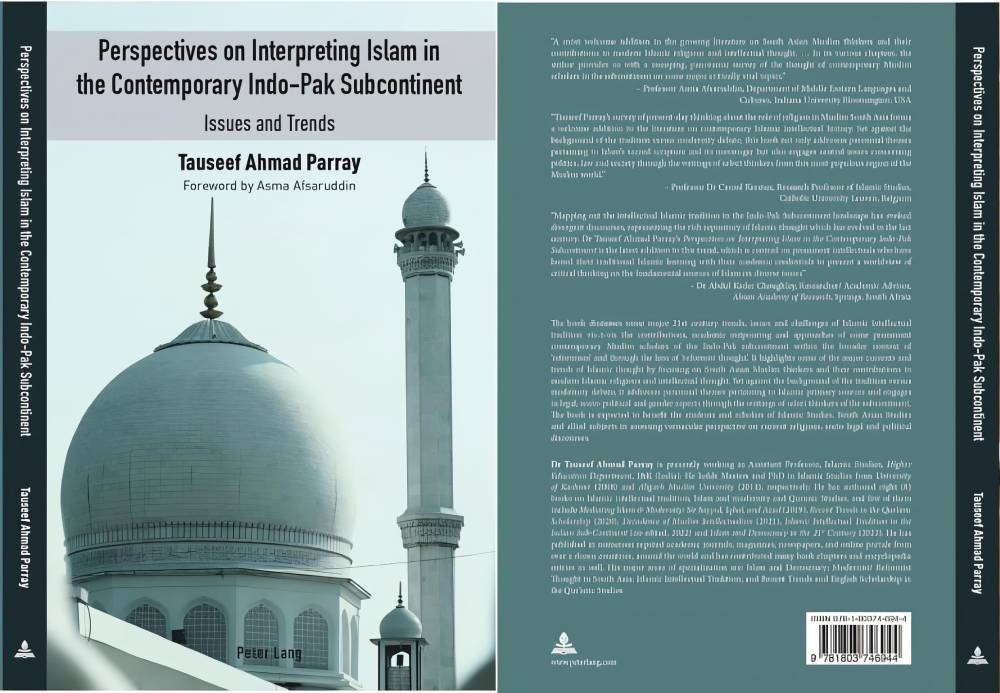
Dr Tauseef Ahmad Parray’s Perspectives on Interpreting Islam in the Contemporary Indo-Pak Subcontinent: Issues and Trends takes up this challenge. As Assistant Professor of Islamic Studies at Government Degree College, Ganderbal, Parray presents a detailed study of how Islam is interpreted, practised, and debated across India and Pakistan. He explores the tension between tradition and modernity, the rise of new intellectual frameworks, and how these shape religious discourse. This work seeks to deepen understanding and foster conversation between scholars and broader communities navigating an era of profound transformation.

Structured around six chapters, the book also contains a preface, introduction, extensive bibliography, and a foreword by Professor Asma Afsaruddin of Indiana University. The preface sets the work within the broader framework of Islamic reformist thought, highlighting how contemporary South Asian scholars have addressed critical subjects such as Qur’anic interpretation, prophetic biography, Islamic jurisprudence, and the ongoing debates on modernity, democracy, and gender.
The introduction outlines the major intellectual movements that have informed Muslim religious thought in the region. It examines how Islam has been approached through civilisational, theological, and philosophical perspectives and how these were challenged by colonial encounters and the onset of modernity. As a region with one of the world’s largest Muslim populations, the subcontinent has produced influential scholars and movements whose impact resonates far beyond its borders. Parray’s book engages with these shifts and contributes significantly to the scholarship on Islamic thought in South Asia.
The first chapter, 21st Century Trends in Qur’anic Studies: An Evaluation of Abdur Raheem Kidwai’s Contribution to the “Thematic” Approach, offers a detailed examination of Kidwai’s role in shaping contemporary Qur’anic studies. A respected authority on English translations of the Qur’an and literary Orientalism, Kidwai has introduced important interventions in this field. The chapter considers three key aspects of his work.
First is his thematic presentation of major Qur’anic ideas in The Qur’an: Essential Teachings, aimed at making the text’s core messages accessible. Second is his sustained engagement with English translations of the Qur’an across centuries, as seen in works such as Bibliography of the Translations of the Meanings of the Glorious Quran into English, 1649–2002, God’s Word, Man’s Interpretation, and Translating the Untranslatable. Third is his focus on selected verses for daily reflection, which appears in books like Daily Wisdom, 365 Selections from the Holy Qur’an, and The Qur’an Speaks to You. While Kidwai does not present a rigid methodology, his thematic approach is designed to be both readable and informative, making it suitable for a wide audience.
The second chapter, 21st Century Thematic Studies on the Prophet’s Biography: Evaluating the Contribution of Muhammad Yasin Mazhar Siddiqi (d. 2020), analyses Siddiqi’s thematic method in examining the Prophet’s life. It considers key works such as The Prophet Muhammad: A Role Model for Muslim Minorities, Rasul-e-Akram aur Muslim Khawatin, and How the Prophet Muhammad Earned and Spent Money.
These texts engage with present-day concerns, including the integration of Muslim minorities in plural societies, the socio-economic roles of women in the Prophet’s era, and the ethics of financial conduct drawn from his life. Siddiqi’s readings are grounded in context, with attention to the cultural, political, and economic factors surrounding historical events.
The third chapter, Debates on the “Tradition-Modernity” Discourse in the Subcontinent: Views and Visions of Some Prominent Modern Scholars, addresses a central theme in modern Islamic intellectual history. It locates the tradition-modernity debate within the evolution of reformist movements, distinguishing between the phase of historical Islam (610–1453 CE) and what it refers to as modern Islam (post-1453), shaped by colonialism and Western paradigms.
Within this landscape, the chapter identifies three reformist tendencies: Traditionalist, Modernist, and Islamist. Shah Waliullah is presented as a key figure whose advocacy of ijtihad and rational theology influenced thinkers such as Sir Syed Ahmad Khan, Muhammad Iqbal, Fazlur Rahman, Nejatullah Siddiqi, and Khalid Masud. These figures shaped the intellectual responses of South Asian Muslims to the shifting realities of the modern period.
The fourth chapter, Mapping 21st Century Trends in Islamic Legal Thought: Evaluating Muhammad Nejatullah Siddiqi’s (d. 2022) Contribution to Maqasid al-Shariah Discourse vis-à-vis Contemporary Challenges, examines Siddiqi’s engagement with maqasid al-shariah within ongoing legal reform debates. It positions his work in both global and regional contexts and focuses on three main areas.
First is the use of reason and human nature as foundational sources in determining legal aims. Second is the emphasis on revising the methodology of ijtihad to meet current needs. Third is the practical application of maqasid-based reasoning to matters such as the permissibility of military service in non-Muslim states and ethical questions around modern warfare. The chapter ends by outlining ten principles for the future application of maqasid theory in addressing contemporary challenges.
The fifth chapter, Islam-Democracy Discourse and Modern Muslim Scholars of the Subcontinent: An Assessment of Diverse (Shifting) Perspectives, explores the evolving relationship between Islam and democratic thought as represented by Mufti Mohammad Shafi of Deoband, Syed Abul Ala Maududi and Khurshid Ahmad of Jamaat-e-Islami, and Dr Israr Ahmad of Tanzeem-e-Islami.
It defines the Islamic movement as a political project aimed at embedding Islamic values across public and private spheres. Mufti Shafi’s interpretation of shura in the Qur’an is described as a contextual approach that contributes to Islamic constitutional theory. Maududi’s vision of theo-democracy, premised on divine sovereignty, is contrasted with Khurshid Ahmad’s effort to align Islamic governance with democratic norms. Dr Israr Ahmad’s critique of Maududi’s emphasis on popular sovereignty and his proposal for a collective authority of the ummah rooted in Qur’anic legitimacy is examined as part of a trajectory shaped by earlier thinkers such as Iqbal and Maududi.
The final chapter, Contemporary Indian Muslim Scholarship on Islam and Gender: Issues and Trends (A Review of Some Recent Works), reviews recent contributions by Indian Muslim writers on the subject of women in Islam. The chapter surveys the work of Maulana Wahiduddin Khan, Abdur Raheem Kidwai, Dr Juhi Gupta, and Zaira Ashraf Khan. Wahiduddin Khan’s Woman: The Builder of Humankind and Woman in Islamic Shariah advocates a model of gender complementarity and offers a critique of Western feminist thought.
Theological discussions on the status of women form a key part of this analysis. The volume Muslim Woman – What Everyone Needs to Know, edited by Kidwai and Gupta, addresses practical and conceptual issues faced by Muslim women. Kidwai’s Women in Islam reiterates theological arguments grounded in primary sources. Zaira Ashraf Khan’s Prophet Muhammad and Empowerment of Women presents a comparative reading of the Prophetic model and modern feminist theories, drawing on both sociological insight and scriptural exegesis.
As a Kashmiri scholar of Islamic thought, Dr Tauseef Ahmad Parray’s Perspectives on Interpreting Islam in the Contemporary Indo-Pak Subcontinent: Issues and Trends marks a significant contribution to the examination of evolving intellectual currents within South Asian Islam. Structured as an anthology, it prioritises the breadth of scholarly engagement over sustained critical interrogation. Parray surveys prominent thinkers alongside a range of emerging voices in the field of Islamic Studies in South Asia, mapping reformist trends through multiple vantage points to foster a renewed engagement with both tradition and contemporary realities.
This volume serves as a valuable and accessible resource for scholars and students across the Social Sciences concerned with modern developments in South Asian Islam. It holds particular relevance for those teaching or studying Islamic Studies at undergraduate and postgraduate levels. The author also brings a welcome inclusivity to the work by drawing attention to several local emerging scholars, weaving their perspectives into the wider academic conversation.
(The author is affiliated with Baba Ghulam Shah Badshah University, Rajouri, Jammu and Kashmir. Ideas are personal.)